
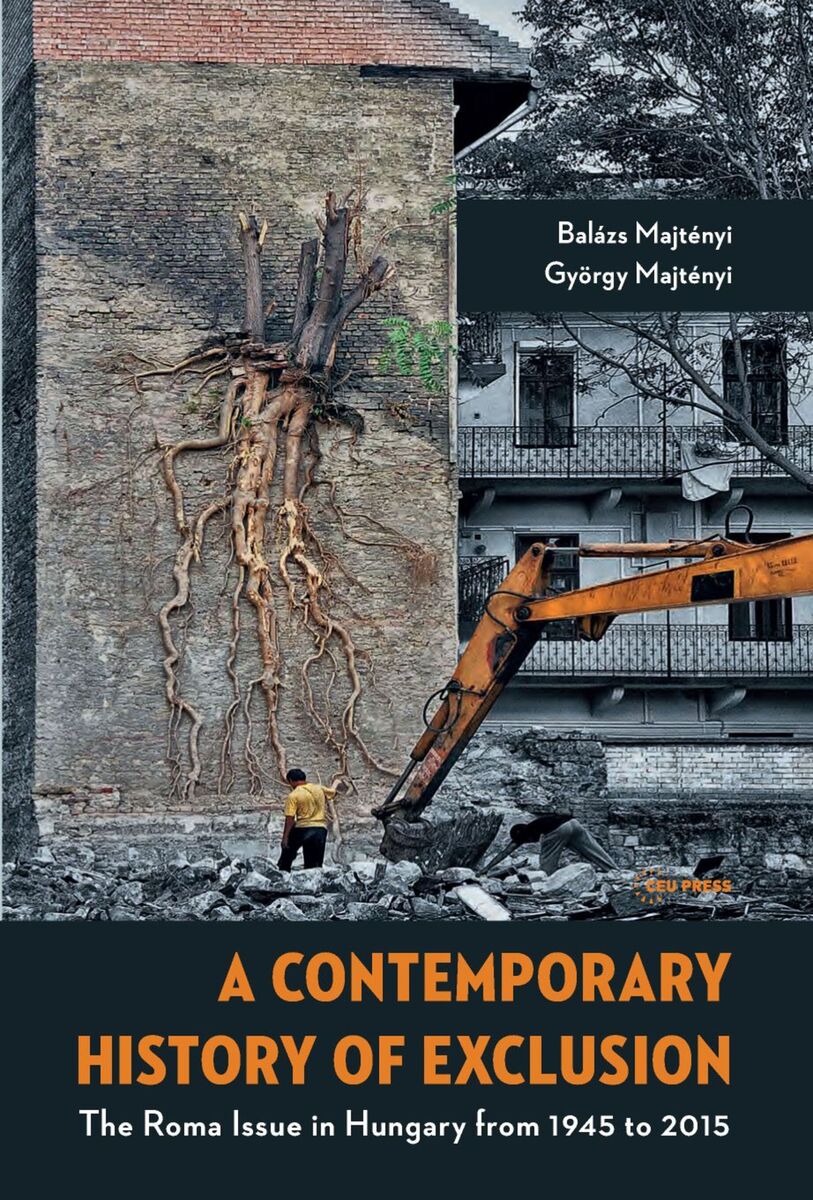
A Contemporary History of Exclusion: The Roma Issue in Hungary from 1945 to 2015
A Contemporary History of Exclusion: The Roma Issue in Hungary from 1945 to 2015
by György Majtényi and Balázs Majtényi
Central European University Press, 2016
ISBNs
Cloth: 978-963-386-122-6
eISBN: 978-963-386-727-3 (ePub)
eISBN: 978-963-386-146-2 (PDF)
About the Book
The volume presents the changing situation of the Roma in the second half of the 20th century and examines the politics of the Hungarian state regarding minorities by analyzing legal regulations, policy documents, archival sources and sociological surveys. In the first phase analyzed (1945-61), the authors show the efforts of forced assimilation by the communist state. The second phase (1961-89) began with the party resolution denying nationality status to the Roma. Gypsy culture was equivalent with culture of poverty that must be eliminated. Forced assimilation through labor activities continued. The Roma adapted to new conditions and yet kept their distinct identity. From the 1970s, Roma intellectuals began an emancipatory movement, and its legacy is felt until this day. Although the third phase (1989-2010) brought about freedoms and rights for the Roma, with large sums spent on various Roma-related programs, the situation on the ground nevertheless did not improve. Segregation and marginalization continues, and it is rampant. The authors powerfully conclude: while Roma became part of the political community, they are still not part of the national one. Subjects: Romanies—Hungary. Romanies—Hungary—Social conditions. Marginality, Social—Hungary. Romanies—Legal status, laws, etc.—Hungary. Minorities—Government policy—Hungary. Hungary—Ethnic relations. Hungary—Social policy.
About the Author
György Majtényi is a historian and professor at Eszterházy Károly University of Applied Sciences. His research interests include history of the dominant elite in Hungary during state socialism and Roma social history.
Balázs Majtényi is Researcher, Hungarian Academy of Sciences, Centre for Social Sciences, Institute for Legal Studies, and Associate Professor, Eötvös Loránd University, Faculty of Social Sciences.
Reviews
"Amid reignited identity struggles the book serves as a needed antidote to the essentialist and antagonizing public discourse that not only distorts the concept of a nation but also threatens the very rights and well-being of the Hungarian Roma minority. It is hence a useful tool for all those engaged in the field of human rights and Romani studies, but also serves as a helpful guide to anyone interested in modern Hungary and its exciting history. The well-established Hungarian scholars, Balázs Majtényi and György Majtényi, combine their extensive legal and historical expertise to examine the formation, interpretation, and implementation of inclusion policies and the management of minorities in the country."
-- H-Nationalism, H-Net Reviews
-- H-Nationalism, H-Net Reviews
"A researcher in legal studies and a professor of history, both tending to use the tools of the social sciences and be sensitive about the ethical and methodological aspects of their own work, this is an excellent combination to raise the questions which are raised in the book under review. The book examines the public discourses and the policies regarding the Hungarian Gypsies/Roma from the end of World War II until the present. The Majtényi duo strove throughout their inquiry to remain scholarly and analytical. The thoroughness with which they approached the issues and questions made it inevitable that they would highlight moral and political aspects. Theirs is a dangerous, but respectable enterprise."
-- Hungarian Historical Review
-- Hungarian Historical Review
"A the writers point out that they follow an emancipatory structuralist approach when making claims about the different aspects of the Roma issue, while remaining open to the application of other analytical viewpoints and to self-reflection. Readers meet the authors’ resulting human-rights focused approach through their descriptions and analyses. This approach is especially important if we consider that the Hungarian Roma community, a community excluded and discriminated against, faces ongoing human rights problems (difficulties that arise from their daily experiences which become integral problems in their lives). A Roma person reading this book would feel that the authors are familiar with the difficulties in their communities, indicating that the authors have succeeded in using so-called inner vision in respect of the ethnic group under discussion."
-- Intersections
-- Intersections
"Majtényi’s and Majtényi’s book is rich reading – like a colorful canvas, a montage of narratives, a selection of accounts. Even those who are familiar with the history of Roma issues in Hungary may find the book instructive, because of all the results of the authors’ own research in state archives. For beginners, the monograph is not just a source of basic information, but also a source of inspiration to continue studying the background of this timely human rights issue, the social exclusion of Roma populations in Europe."
-- Nationalities Papers
-- Nationalities Papers
Tags
Hungary, Marginality Social, Romanies, Exclusion, 1945, 2015, Contemporary History, Legal status laws etc, Government policy, Ethnic relations, Public Policy, Social conditions, Cultural & Social, Anthropology, Political Science, Social Science
Open Access Information
Label: Knowledge Unlatched
License: OA CC BY-NC-ND

 Loading...