BibliOpen logo
Search icon
Cover unavailable
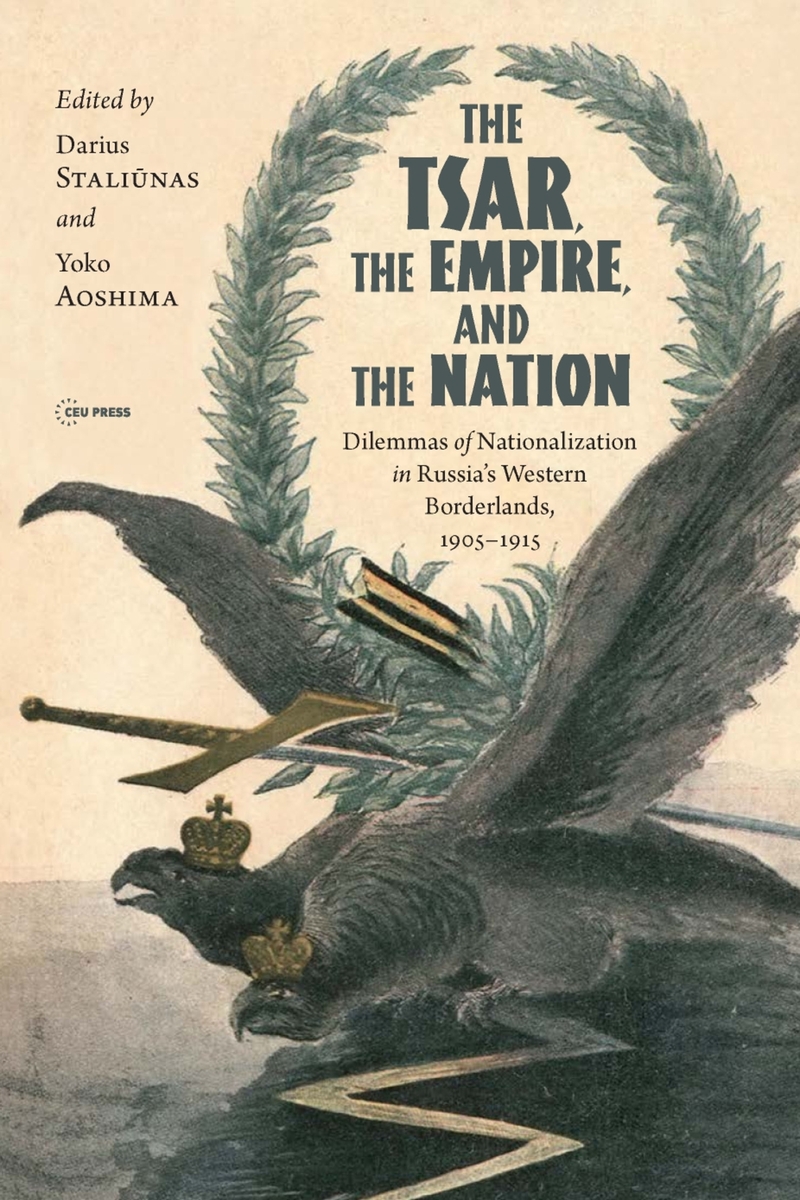
The Tsar, The Empire, and The Nation: Dilemmas of Nationalization in Russia's Western Borderlands, 1905-1915

edited by Darius Staliunas and Yoko Aoshima

Central European University Press, 2021

ISBNs

Cloth: 978-963-386-365-7

eISBN: 978-963-386-693-1 (ePub)

eISBN: 978-963-386-364-0 (PDF)

About the Book

This collection of essays addresses the challenge of modern nationalism to the tsarist Russian Empire. First appearing on the empire’s western periphery this challenge, was most prevalent in twelve provinces extending from Ukrainian lands in the south to the Baltic provinces in the north, as well as to the Kingdom of Poland.
At issue is whether the late Russian Empire entered World War I as a multiethnic state with many of its age-old mechanisms run by a multiethnic elite, or as a Russian state predominantly managed by ethnic Russians. The tsarist vision of prioritizing loyalty among all subjects over privileging ethnic Russians and discriminating against non-Russians faced a fundamental problem: as soon as the opportunity presented itself, non-Russians would increase their demands and become increasingly separatist.
The authors found that although the imperial government did not really identify with popular Russian nationalism, it sometimes ended up implementing policies promoted by Russian nationalist proponents. Matters addressed include native language education, interconfessional rivalry, the “Jewish question,” the origins of mass tourism in the western provinces, as well as the emergence of Russian nationalist attitudes in the aftermath of the first Russian revolution.

About the Author
Darius Staliunas is Chief Researcher at the Lithuanian Institute of History and teaches at Vilnius University. He has published extensively on Russia’s nationality policy in the so-called Northwestern Region (Lithuania and Belarus), ethnic conflicts, problems of historiography, and places of memory in Lithuania.
Reviews
"This volume represents a crucial and indispensable contribution to the ongoing debate on the “nationalization” of the late Russian empire, but it goes much further in problematizing the conceptual and practical entanglements between the analytical categories of “nation” and “empire,” as such. Therefore, the collection edited by Staliunas and Aoshima will be highly relevant for all students of nationalism and empire in Eurasia."https://www.cambridge.org/core/journals/slavic-review/article/tsar-the-empire-and-the-nation-dilemmas-of-nationalization-in-russias-western-borderlands-19051915-ed-darius-staliunas-and-yoko-aoshima-historical-studies-in-eastern-europe-and-eurasia-vol-v-budapest-central-european-university-press-2021-400-pp-notes-tables-index-9500-hard-bound/DACF56A93B4900FB429BE112B8AF8CE4
-- Andrei Cusco Slavic Review

"The present volume appears at a moment perhaps timelier than the editors anticipated. Focusing on the so-called western borderlands, an area that comprised the German-dominated Baltic, the Ukrainian and Belarusian lands of the Polish-Lithuanian Commonwealth, and the Kingdom of Poland (officially called the Vistula Land after 1863), the volume’s contributions focus on questions of nationality policy, confessional policy, education, and the Russian right in the period of the Duma monarchy. As a whole, the volume questions the significance of the constitutional changes of 1905 on nationality policy, suggesting that the willingness or unwillingness of centrally appointed officials to cooperate with nationalist politicians proved perhaps more decisive for the administration and political life of a given region than the press and religious freedoms granted along with the constitutional order."https://brill.com/view/journals/css/57/1-2/article-p238_17.xml
-- Curtis G. Murphy Canadian-American Slavic Studies

"Insgesamt untermauern die Aufsätze die Grundthese des Sammelbands überzeugend und auf verständliche Art und Weise. Durch ihre unterschiedlichen thematischen und räumlichen Schwerpunkte vermitteln sie den Gesamteindruck eines Imperiums, welches nicht wusste, was es in seinen westlichen Territorien langfristig erreichen wollte und daher in erster Linie bemüht war, das Schiff über Wasser zu halten. Darüber hinaus erweist es sich als gewinnbringend, den Blick auf eine mittlere Untersuchungsebene zwischen dem Dorf und dem gesamten Imperium zu richten sowie zeitlich auf die Schlüsseljahre zwischen der ersten Revolution und dem Beginn des Ersten Weltkriegs zu fokussieren. Folglich ist den Beteiligten ein lesenswerter Beitrag zur Erforschung des Zarenreiches gelungen."http://www.hsozkult.de/publicationreview/id/reb-118093
-- Georgiy Konovaltsev H-Soz-Kult

Tags
Historical Studies in Eastern Europe and Eurasia, Dilemmas, National characteristics Russian, Tsar, 1904-1914, Nationalization, Nation, Empire, Nationalism, Eastern, Russia, Ethnic relations, Political Ideologies, Education, Modern, Politics and government, Europe, 20th century, Political Science, History
Open Access Information

Label: Knowledge Unlatched

License: OA CC BY-NC-ND