BibliOpen logo
Search icon
Cover unavailable
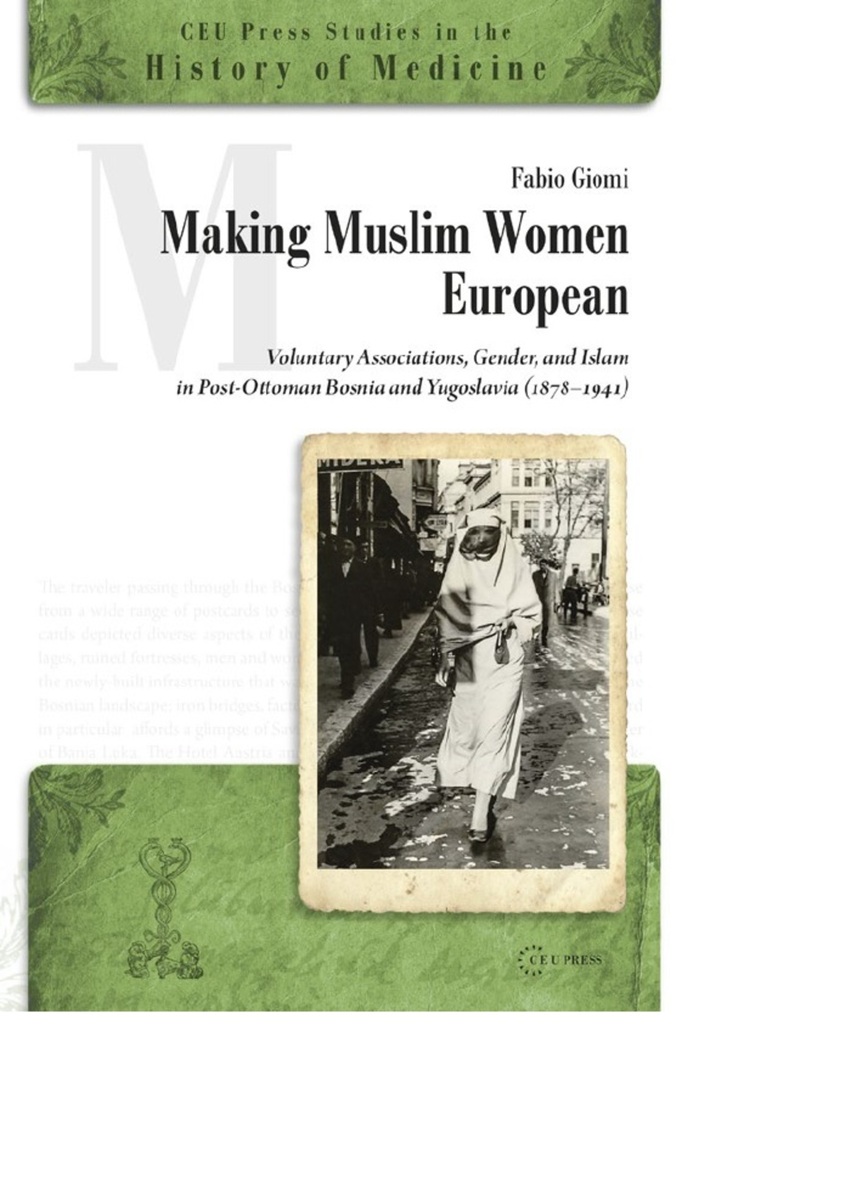
Making Muslim Women European: Voluntary Associations, Gender, and Islam in Post-Ottoman Bosnia and Yugoslavia (1878-1941)

by Fabio Giomi

Central European University Press, 2021

ISBNs

Cloth: 978-963-386-369-5

eISBN: 978-963-386-684-9 (ePub)

eISBN: 978-963-386-368-8 (PDF)

About the Book

This social, cultural, and political history of Slavic Muslim women of the Yugoslav region in the first decades of the post-Ottoman era is the first to provide a comprehensive overview of the issues confronting these women. It is based on a study of voluntary associations (philanthropic, cultural, Islamic-traditionalist, and feminist) of the period.

It is broadly held that Muslim women were silent and relegated to a purely private space until 1945, when the communist state “unveiled” and “liberated” them from the top down. After systematic archival research in Bosnia, Croatia, Serbia, and Austria, Fabio Giomi challenges this view by showing: • How different sectors of the Yugoslav elite through association publications, imagined the role of Muslim women in post-Ottoman times, and how Muslim women took part in the construction or the contestation of these narratives. • How associa­tions employed different means in order to forge a generation of “New Muslim Women” able to cope with the post-Ottoman political and social circumstances. • And how Muslim women used the tools provided by the associations in order to pursue their own projects, aims and agendas. The insights are relevant for today’s challenges facing Muslim women in Europe. The text is illustrated with exceptional photographs.T

About the Author

Fabio Giomi is CNRS Researcher at the Centre for Turkish, Ottoman, Balkan and Central-Asian Studies, Paris. Before joining CETOBaC in 2014, he was a postdoctoral fellow at the Maison des Sciences de l’Homme Foundation (Paris) and at the Institute for Advanced Study at Central European University (Budapest). His research focuses on the history of South-East Europe between the end of the 19th century and the middle of the 20th century, with particular attention to the Yugoslav space.

Reviews
"Le livre de Fabio Giomi sur les débats intra- et intercommunautaires sur « la femme musulmane » en Bosnie et la manière dont les associations musulmanes, les partis politiques, les réformistes et les traditionalistes musulmans ont puisé dans les mêmes discours et symboles transnationaux afin de lier la discussion de la nation à celle de la femme, sera d’un grand intérêt pour les spécialistes de l’ex-Yougoslavie et pour les historien.nes de l’espace post-ottoman et post-habsbourgeois en général. Il démontre clairement que les femmes musulmanes n’ont pas seulement réagi aux opportunités offertes par l’indépendance, elles ont façonné par leurs discours et leurs actes le discours genré sur leur nouvelle société."
-- Naomi Davidson Clio

"Making Muslim Women European is a unique approach in Bosnian historiography, the topic being previously approached only to a small extent, and overwhelmingly combines research into archival and printed sources, with most of them in the Bosnian Croatian-Serbian language but also in French and German. This work is an interesting gender research approach entirely about post-Ottoman Muslim women in Bosnia and Yugoslavia from the end of the nineteenth century (1878) to the beginning of the Communist regime (1941). In conclusion, this is a book that must be read."


-- Nilghiun Ismail Hiperboreea

"This work has the charm of a mosaic, of tiles collected with passion, and not simply from major libraries or national archives, but also from minor places, private institu-tions, and sources placed at the author’s disposal by individuals. Considering all the variegated forms of female commitment in the voluntary as-sociations, the book successfully challenges the Orientalist stereotype of silent and repressed Muslim women, instead describing how they began to study and to teach, to sew and to work, to write and to speak, even to dance and to sing in public and in mixed male-female settings."https://www.berghahnjournals.com/view/journals/aspasia/16/1/asp160114.xml
-- Stefano Petrungaro Aspasia

"Knjiga Fabija Giomija dobro je osmišljena i temeljita studija o muslimanskom ženskom pitanju u kontekstu modernizacije bosansko-hercegovačkoga društva i rađanja kulture stvaranja udruga, pa time i važan historiografski doprinos."https://hrcak.srce.hr/file/411183
-- Amila Kasumović Društvena istraživanja

"This book is an original contribution to the historical sociology of genderrelated transformations within the Muslim community in Bosnia between the end of the Ottoman rule and the beginning of WWII. Based on an extensive research into archival and printed materials in the local language, the volume reconstructs in vivid detail the lived reality of Muslim women at a time of profound political, economic, and social change. The history of Muslim women and the shifting discourse on gender relations"https://www.cambridge.org/core/journals/slavic-review/article/abs/making-muslim-women-european-voluntary-associations-gender-and-islam-in-postottoman-bosnia-and-yugoslavia-18781941-by-fabio-giomi-budapest-central-european-university-press-2021-xviii-401-pp-notes-bibliography-index-photographs-tables-10500-hard-bound/DB5B2EDF1AE895EE6E5177CE20C46DEA
-- Ina Merdjanova Slavic Review

"A well-researched scholarly contribution. It offers a unique perspective on the evolution of the ʻMuslim womenʼs questionʼ in Yugoslavia between the end of the Ottoman reign and the Second World War. At the same time, it offers an insight into their own voices as part of a broader discussion of what was considered European, modern and appropriate. It follows major political and societal changes and demonstrates Muslim womenʼs negotiation of their roles and image in Bosnian society,"https://doi.org/10.14324/111.444.0954-6839.1288
-- Jelena Gajić Slovo

"Fabio Giomi legt eine Diskurs- und Sozialgeschichte des post-osmanischen Bosnien-Herzegowinas bis zum Ausbruch des Zweiten Weltkriegs mit einer ausgeprägten Gender-Perspektive vor. Er stellt überzeugend dar, dass Frauen seit dem Ende der osmanischen Herrschaft direkt in die sozialen Transformationen involviert waren und bosnische Musliminnen − wenn auch mit einiger Verzögerung − allmählich Zugang zur öffentlichen Sphäre erhielten.Somit liegt ein Werk vor, das nicht nur Kenner*innen der bosnisch-herzegowinischen /jugoslawischen Geschichte anspricht, sondern ebenso Leser*innen, die sich generell für Frauen- und Geschlechtergeschichte im post-osmanischen und habsburgischen Raum oder auch darüber hinaus interessieren."https://www.vr-elibrary.de/doi/pdf/10.14220/lhom.2023.34.1.149
-- Ninja Bumann L'Homme

Tags
CEU Press Studies in the History of Medicine, Societies and clubs, Voluntary Associations, Islam, Gender, Eastern, Civilization, Gender Studies, Women, Social conditions, Europe, Social Science, History
Open Access Information

Label: Knowledge Unlatched

License: OA CC BY-NC-ND