BibliOpen logo
Search icon
Cover unavailable
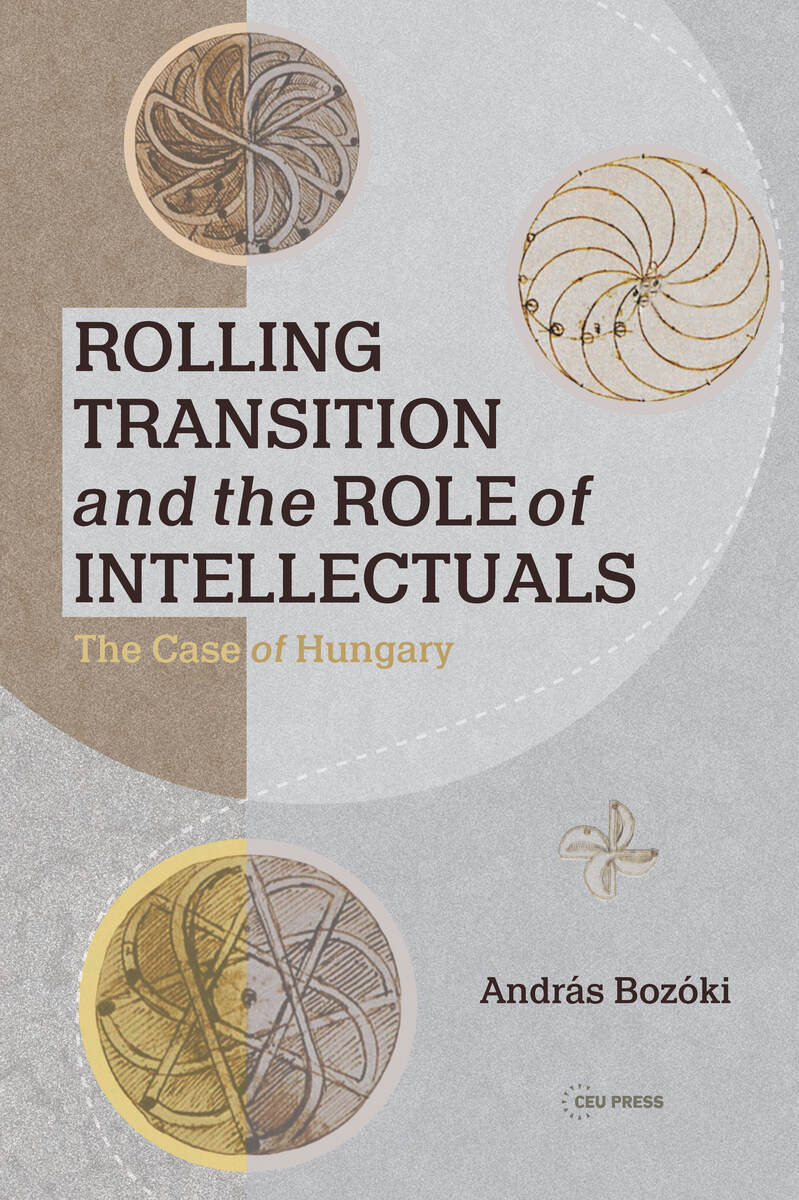
Rolling Transition and the Role of Intellectuals: The Case of Hungary

edited by András Bozóki

Central European University Press, 2022

ISBNs

Cloth: 978-963-386-478-4

eISBN: 978-963-386-679-5 (ePub)

eISBN: 978-963-386-479-1 (PDF)

About the Book

Utilizing a new and original framework for examining the role of intellectuals in countries transitioning to democracy, Bozóki analyses the rise and fall of dissident intellectuals in Hungary in the late 20th century. He shows how that framework is applicable to other countries too as he forensically examines their activities.

Bozóki argues that the Hungarian intellectuals did not become a ‘New Class’. By rolling transition, he means an incremental, non-violent, elite driven political transformation which is based on the rotation of agency, and it results in a new regime. This is led mainly by different groups of intellectuals who do not construct a vanguard movement but create an open network which might transform itself into different political parties. Their roles changed from dissidents to reformers, to movement organizers and negotiators through the periods of dissidence, open network building, roundtable negotiations, parliamentary activities, and new movement politics.

Through the prism of political sociology, the author focuses on the following questions: Who were the dissident intellectuals and what did they want? Under what conditions do intellectuals rebel and what are the patterns of their protest? This book will be of interest to students, researchers, and public intellectuals around the world aiming to promote human rights and democracy.

About the Author
András Bozóki is Professor at the Department of Political Science, Central European University, Budapest and Vienna (since 1993). His research areas include democratization, regime change, anarchism, political ideologies, and the role of intellectuals. He holds diplomas from Eötvös Loránd University in Law (1983) and Sociology (1985). He received PhD in Political Science at the Hungarian Academy of Sciences (1992). He is a holder of the Ferenc Erdei Prize (1991) and István Bibó Prize (2009). He was President of the Hungarian Political Science Association (2003-5). He was a recurrent visiting professor at Columbia University. He worked as research fellow at the Institute for Advanced Study in Berlin, just as in Florence (Italy), Vienna (Austria), Brighton (UK), Stockholm (Sweden), Wassenaar (The Netherlands), and at the UCLA. He served as Minister of Culture in the Republic of Hungary (2005-6). His recent books: Rolling Transition and the Role of Intellectuals (2022), Embedded Autocracy (2024).
Reviews
"The book successfully answers the questions of who were the intellectuals who played the most influential and comprehensive role in Hungary’s transition from state socialism to democracy, what they wanted, and what they were against. Beyond the questions, the book analysed the ideas, strategies, rotations, and activities of Hungarian intellectuals before, during, and after the transition with great success. The book is invaluable for its detailed account of the Hungarian intellectuals’ uphill struggle and their significance, its theoretical and empirical conceptualisation of regime change, and its meticulous filling of this gap in the English-language literature."https://doi.org/10.2478/ppsr-2023-0010
-- Attila Gökhun Dayıoğlu and Mertcan Öztürk Polish Political Science Review

"This is an extraordinary book that is sure to be regarded as a landmark study. It is very ambitious and equally long and offers a powerful account, both extensive and intensive, of the complex Hungarian transition to democracy between the years 1977 and 1994—from the post-Helsinki reemergence of semi-autonomous civil society groupings to the second free election in postcommunist Hungary, normally considered by political scientists to mark the 'consolidation' of democracy."
-- Jeffrey C. Isaac Hungarian Studies Review

Tags
Role, Democracy, History & Theory, Intellectual life, Political Ideologies, World, Modern, European, Politics and government, 20th century, Political Science, History
Open Access Information

Label: Opening the Future

License: OA CC BY-NC-ND