
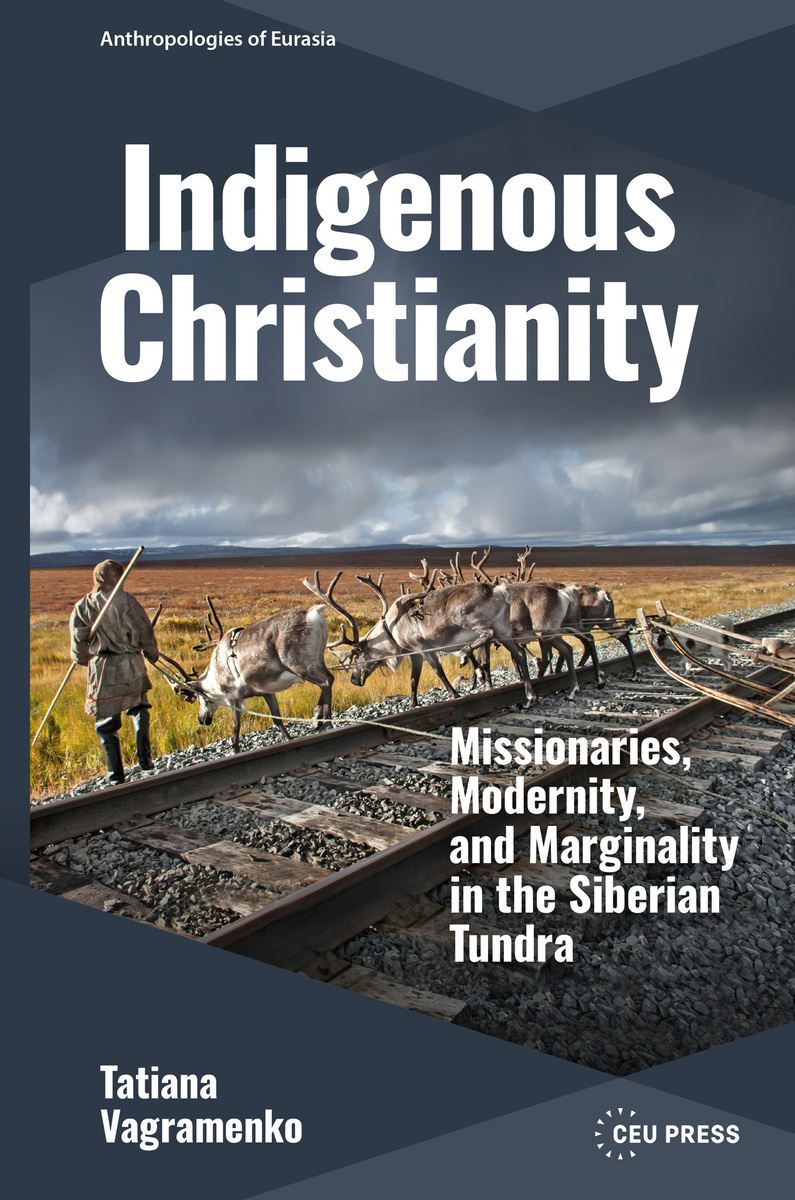
Indigenous Christianity: Missionaries, Modernity, and Marginality in the Siberian Tundra
Indigenous Christianity: Missionaries, Modernity, and Marginality in the Siberian Tundra
by Tatiana Vagramenko
Central European University Press, 2026
ISBNs
eISBN: 978-90-485-7517-6 (ePub)
eISBN: 978-90-485-7516-9 (PDF)
About the Book
This book traces the story of a Nenets indigenous community in Siberia and how their lives were transformed by religious conversion in post-Soviet and Putin’s Russia. Based on over a decade of ethnographic fieldwork in a region now largely closed to outsiders, it offers an intimate account of faith, power, and endurance in one of the Arctic’s most marginalized communities.
Nenets nomads, long shaped by Russian colonialism and Soviet modernization, experienced sweeping conversions in the mid-1990s, culminating in the creation of a tundra church tied to a radical evangelical movement. Amid Putin’s tightening control—when indigenous peoples and minority faiths faced renewed surveillance and harassment—the book follows Nenets and missionaries whose encounters across the tundra sparked tensions between converts and non-converts, faith and state. Through stories of hope, loss, and resilience, it reveals how global evangelical Christianity intersects with local traditions, reshaping kinship, belonging, and modernity in the Siberian tundra.
Nenets nomads, long shaped by Russian colonialism and Soviet modernization, experienced sweeping conversions in the mid-1990s, culminating in the creation of a tundra church tied to a radical evangelical movement. Amid Putin’s tightening control—when indigenous peoples and minority faiths faced renewed surveillance and harassment—the book follows Nenets and missionaries whose encounters across the tundra sparked tensions between converts and non-converts, faith and state. Through stories of hope, loss, and resilience, it reveals how global evangelical Christianity intersects with local traditions, reshaping kinship, belonging, and modernity in the Siberian tundra.
About the Author
Tatiana Vagramenko, Senior Postdoctoral Researcher at University College Cork and Ramón y Cajal Fellow at the Barcelona Supercomputing Centre, works at the intersection of anthropology, religious studies, and digital humanities. She studies religion and surveillance in Soviet and post-Soviet contexts and is co-author of The Lives of Soviet Secret Agents (2025).
Reviews
“This is an exceptional contribution to the anthropological study of Christianity - one of the most original to appear in recent years. Based on long term fieldwork with Nenets people in the Siberian Tundra, and grounded in a strong grasp of Soviet and Post-Soviet religious history, every chapter teaches us something new about how Christianity can shape and be shaped by life in an indigenous community. As the Nenets move through various forms of Evangelical Christianity, we find missionaries taking up the role of traditional matchmakers, Baptist fundamentalism displacing Pentecostalism and coming to represent for Nenets a return to traditional morality, and several different churches leading people to remake their sense of the spaces of tundra, village, and nation-state. And this list only scratches the surface of the unexpected findings Vagramenko presents. Beautifully written, this book should be read by anyone interested in how Christianity moves around the globe.”
— Joel Robbins, Sigrid Rausing Professor of Social Anthropology, University of Cambridge
“Grounded in detailed, long-standing research among Baptist Nenet communities, this historical ethnography conveys a deep understanding of the appeals and paradoxes of conversion in post-Soviet Russia. Moving beyond the concept of rupture, Tatiana Vagramenko shows how Baptist Nenet disenchant the indigenous spiritual sphere and re-value it as heritage. This marvelous book pushes the anthropology of Christianity to new heights.”
— Birgit Meyer, Utrecht University
“A masterful exploration of how Christian fundamentalism takes root in the most unlikely of places - the Arctic tundra. Vagramenko takes us on a journey into indigenous communities of nomadic reindeer herders in the Russian Far North where we come to understand the appeal - and consequences - of conversion to evangelical faith groups. This is truly an ethnography of great distinction!”
— Catherine Wanner, Pennsylvania State University
“This is a beautifully crafted and passionate account of Polar Nenets religiosity. The author has spent a decade travelling between distant encampments and learning about the allure of new forms of the Baptist Bretheren, and also the anxiety about how to avoid the stern eye of the Russian state. The book gives a wide overview of the history of missionisation in the region through the Tsarist and Soviet periods. It is a fresh and authoritative work of struggle to be modern and to live a moral life in a region upturned by extractive resource development and war.”
— David Anderson, University of Aberdeen
— Joel Robbins, Sigrid Rausing Professor of Social Anthropology, University of Cambridge
“Grounded in detailed, long-standing research among Baptist Nenet communities, this historical ethnography conveys a deep understanding of the appeals and paradoxes of conversion in post-Soviet Russia. Moving beyond the concept of rupture, Tatiana Vagramenko shows how Baptist Nenet disenchant the indigenous spiritual sphere and re-value it as heritage. This marvelous book pushes the anthropology of Christianity to new heights.”
— Birgit Meyer, Utrecht University
“A masterful exploration of how Christian fundamentalism takes root in the most unlikely of places - the Arctic tundra. Vagramenko takes us on a journey into indigenous communities of nomadic reindeer herders in the Russian Far North where we come to understand the appeal - and consequences - of conversion to evangelical faith groups. This is truly an ethnography of great distinction!”
— Catherine Wanner, Pennsylvania State University
“This is a beautifully crafted and passionate account of Polar Nenets religiosity. The author has spent a decade travelling between distant encampments and learning about the allure of new forms of the Baptist Bretheren, and also the anxiety about how to avoid the stern eye of the Russian state. The book gives a wide overview of the history of missionisation in the region through the Tsarist and Soviet periods. It is a fresh and authoritative work of struggle to be modern and to live a moral life in a region upturned by extractive resource development and war.”
— David Anderson, University of Aberdeen
Tags
Anthropologies of Eurasia, Marginality, Communism Post-Communism & Socialism, Social History, Political Ideologies, Sociology, Political Science, Social Science, History
Open Access Information
License: OA CC BY-NC-ND

 Loading...