
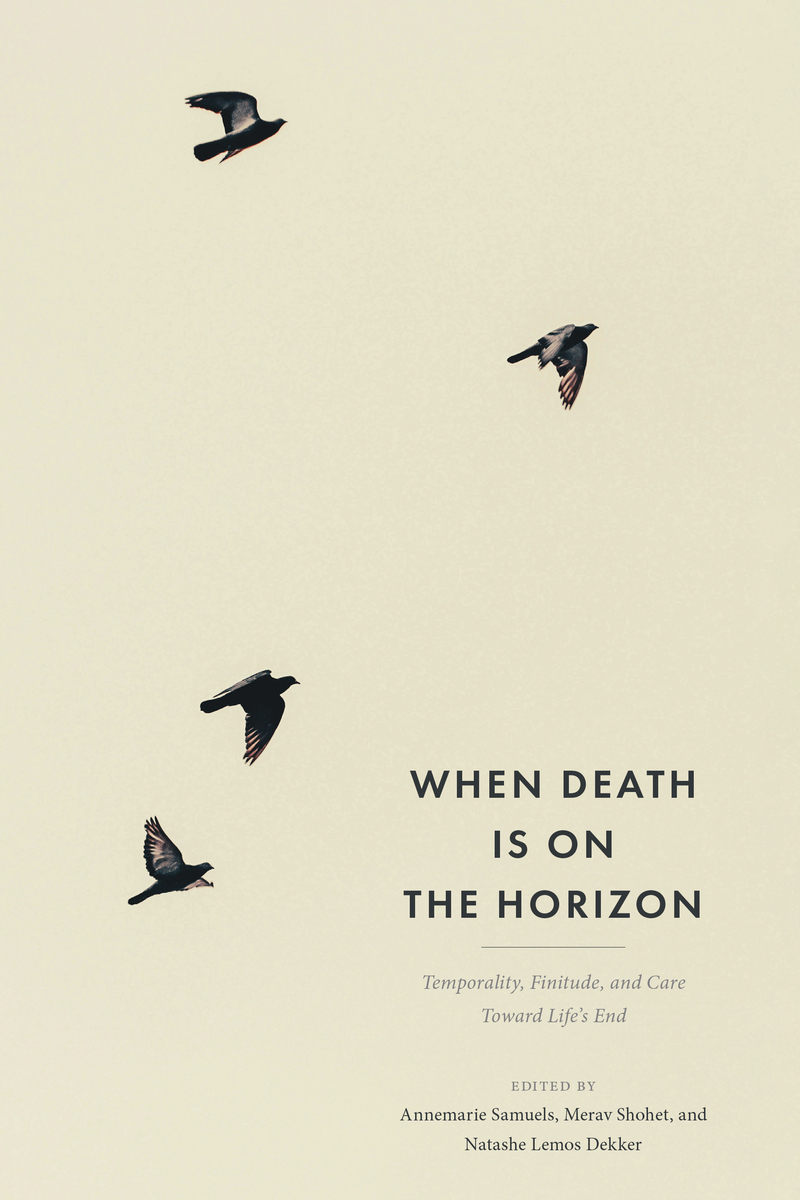
edited by Annemarie Samuels, Merav Shohet and Natashe Lemos Dekker
contributions by Devin Flaherty, Erica Borgstrom, Emma Clare, Kirsten Bashir, Catherine Pestano, Esther Ramsay-Jones, Adrienne E. Strong, Laura Vermeulen, Tine M. Gammeltoft, Hanum Atikasari, Annemarie Samuels, Merav Shohet, Sarah Lamb, Natashe Lemos Dekker, Sylvia Tidey and Yael Assor
afterword by Scott Stonington
Rutgers University Press, 2026
Cloth: 978-1-9788-5050-7
Paper: 978-1-9788-5049-1
eISBN: 978-1-9788-5051-4 (all)
The urge to engage with finitude is increasingly central in our present apocalyptic time of political and ecological turmoil. Aging populations and the rapid development of advanced, but expensive, technologies to ever further postpone death pose significant healthcare challenges for societies around the world. In these times, how do people care when the end of life is near? How do they orient toward death? Do they see death as an absolute end, and if not, what sort of horizon does death present? Questioning taken for granted assumptions about end-of-life care, When Death Is on the Horizon analyzes how people approach death in a wide variety of geographical locations and social contexts. Through in-depth ethnographic case studies, it shows how people orient toward, beyond, and away from death, and how they do so within a world marked by historic and ongoing socio-political and structural inequalities.
This book is also freely available online as an open access digital edition.
ANNEMARIE SAMUELS is an associate professor of cultural anthropology at Leiden University. She is the author of After the Tsunami: Disaster Narratives and the Remaking of Everyday Life in Aceh,and is the coeditor of the Research Handbook on End of Life Care and Society. Her research focuses on palliative care, health inequalities, narrative, and silence, particularly in Indonesia and the Netherlands.
MERAV SHOHET is an associate professor in the Department of Anthropology at Boston University and the author of Silence & Sacrifice: Family Stories of Care and the Limits of Love in Vietnam. Her research spans aging, illness, care, intergenerational family relations, social inequalities, changing kibbutz life, and narrative and silence in North America, Vietnam, and Palestine/Israel.
NATASHE LEMOS DEKKER is a cultural anthropologist at the University of Amsterdam. Her research, situated at the intersection of medical and psychological anthropology, focuses on ageing, death and dying, palliative care, and grief. She was awarded an NWO Veni grant for her project ‘Grief Politics,’ which ethnographically explores the experiences of people who lost relatives during the Covid-19 pandemic in Brazil and who have become politically active as a result.
Label: Rutgers University Press
License: CC BY 4.0

 Loading...