
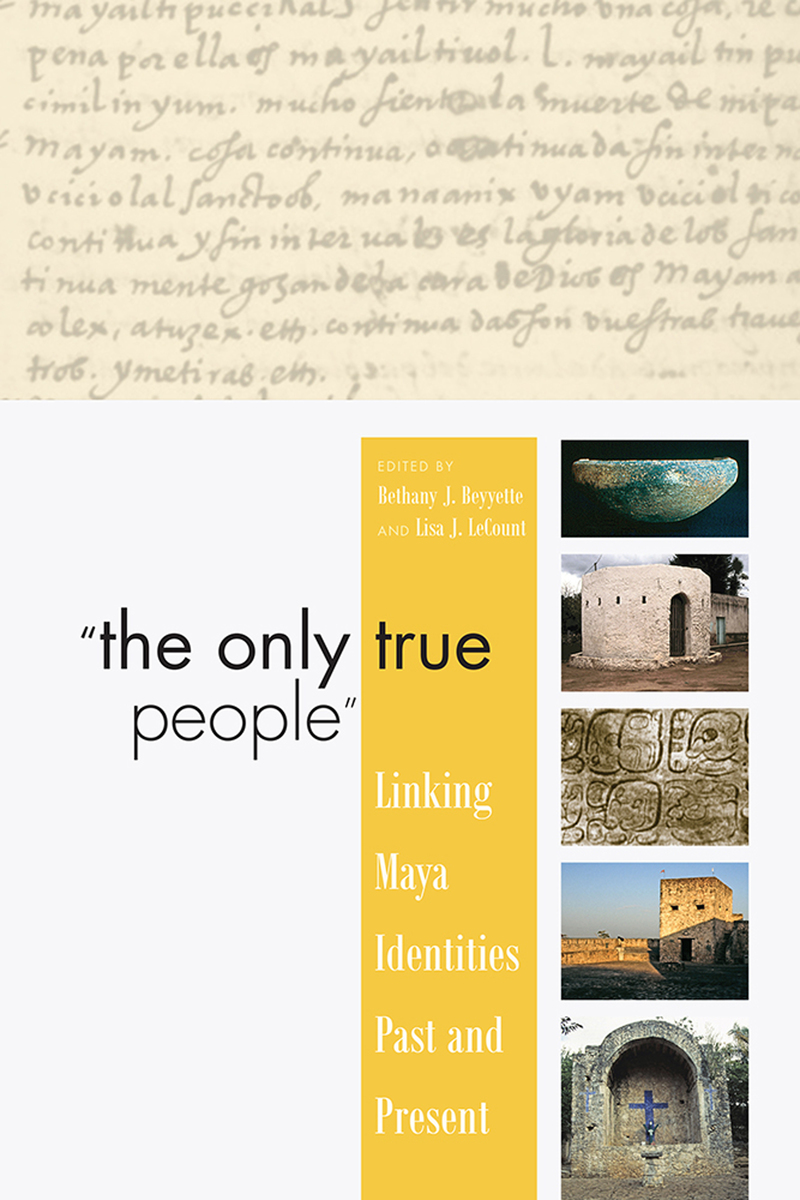
edited by Bethany J. Beyette and Lisa J. LeCount
University Press of Colorado, 2017
Cloth: 978-1-60732-566-6
Paper: 978-1-64642-044-5
eISBN: 978-1-60732-567-3 (all)
"The Only True People" is a timely and rigorous examination of ethnicity among the ancient and modern Maya, focusing on ethnogenesis and exploring the complexities of Maya identity—how it developed, where and when it emerged, and why it continues to change over time. In the volume, a multidisciplinary group of well-known scholars including archaeologists, linguists, ethnographers, ethnohistorians, and epigraphers investigate ethnicity and other forms of group identity at a number of Maya sites and places, from the northern reaches of the Yucatan to the Southern Periphery, and across different time periods, from the Classic period to the modern day.
Each contribution challenges the notion of ethnically homogenous "Maya peoples" for their region and chronology and explores how their work contributes to the definition of "ethnicity" for ancient Maya society. Contributors confront some of the most difficult theoretical debates concerning identity in the literature today: how different ethnic groups define themselves in relation to others; under what circumstances ethnicity is marked by overt expressions of group membership and when it is hidden from view; and the processes that transform ethnic identities and their expressions.
By addressing the social constructs and conditions behind Maya ethnicity, both past and present, "The Only True People" contributes to the understanding of ethnicity as a complex set of relationships among people who lived in real and imagined communities, as well as among people separated by social boundaries. The volume will be a key resource for Mayanists and will be of interest to students and scholars of ethnography, anthropology, and cultural studies as well.
Contributors: McCale Ashenbrener, Ellen E. Bell, Marcello A. Canuto, Juan Castillo Cocom, David A. Freidel, Wolfgang Gabbert, Stanley P. Guente, Jonathan Hill, Charles Andrew Hofling, Martha J. Macri, Damien B. Marken, Matthew Restall, Timoteo Rodriguez, Mathew C. Samson, Edward Schortman, Rebecca Storey
Bethany J. Beyyette is assistant professor of anthropology and sociology at University of Maryland University College, Europe Division. Her research is strongly interdisciplinary and focuses on ethnic identities and racial formation in postcolonial contexts.
Lisa J. LeCount is professor of anthropology at The University of Alabama, Tuscaloosa, and director of the Actuncan Archaeological Project in Belize. She is an anthropological archaeologist who has published on provincial politics, feasting, kitchens, markets, and pre-Columbian pottery as markers of time and identity.
—Bodil Liljefors Persson, Malmö University
"This edited volume of 11 essays is one of the first to explore the issue of Maya identity in the most comprehensive terms from the point of view of Maya archaeology and epigraphy, linguistics, history, and ethnography. . . . The essays trace avenues for future research and showcase research techniques and data sources that can clarify the complicated, changing nature of Indigenous identities. Highly recommended."
—CHOICE
"The diversity of critical perspectives on identity and ethnicity creates a mass of scholarship that. . . . should be read by all students of Maya archaeology, of ethnicity, and of postcolonial radicalization."
—Latin American Antiquity
“This volume will be useful to scholars from a wide variety of disciplines and. . . . for undergraduates in the college classroom. . . . This work points to important methodological approaches and convincingly argues that reconsideration of an ethnic category taken at face value is long overdue. It should not be the last word on the matter but instead ought to point scholars in new directions as they call into question Maya ethnicity as a static, permanent condition in other contexts.”
—Hispanic American Historical Review
—Journal of Anthropological Research
—Journal of the Royal Anthropological Institute
Label: Knowledge Unlatched
License: CC-BY-NC-ND 4.0

 Loading...