
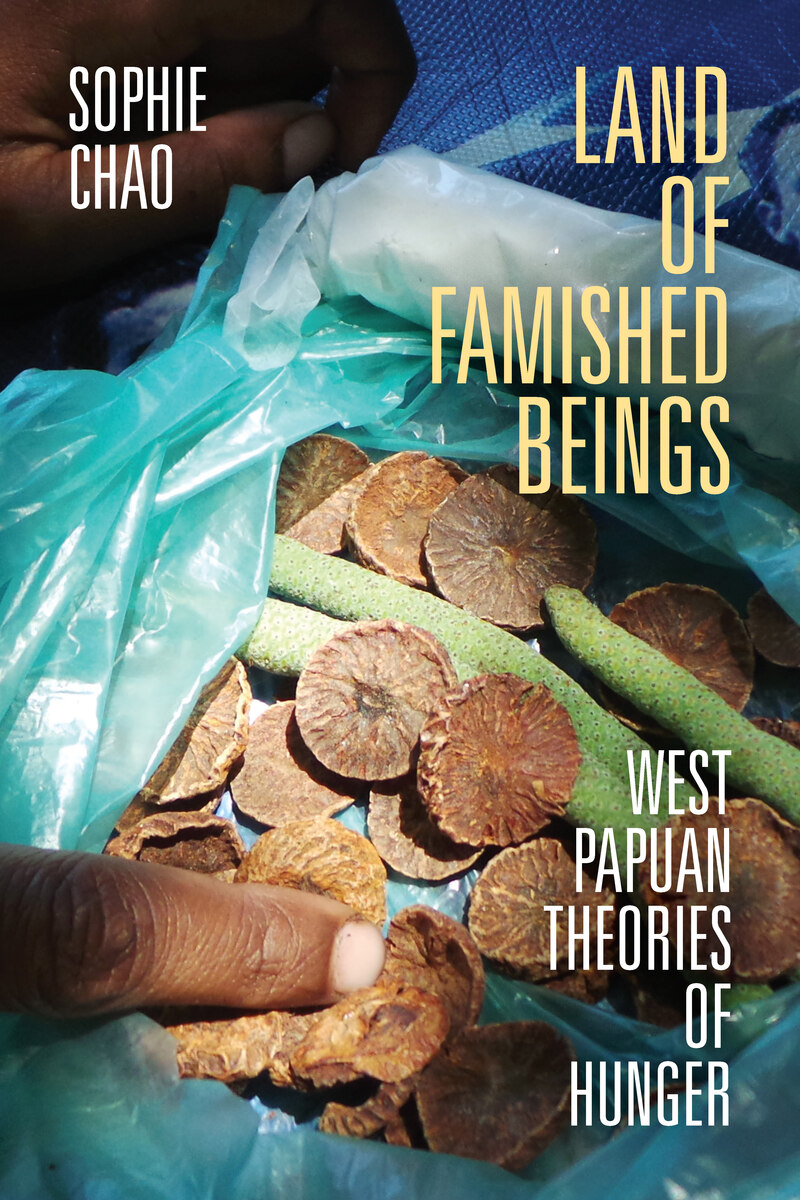
Land of Famished Beings: West Papuan Theories of Hunger
Land of Famished Beings: West Papuan Theories of Hunger
by Sophie Chao
Duke University Press, 2025
ISBNs
Cloth: 978-1-4780-2876-5
Paper: 978-1-4780-3203-8
eISBN: 978-1-4780-9456-2 (OA)
eISBN: 978-1-4780-6095-6 (standard)
About the Book
In Land of Famished Beings, Sophie Chao examines how Indigenous Marind communities understand and theorize hunger in lowland West Papua, a place where industrial plantation expansion and settler-colonial violence are radically reconfiguring ecologies, socialities, and identities. Instead of seeing hunger as an individual, biophysical state defined purely in nutritional, quantitative, or human terms, Chao investigates how hunger traverses variably situated humans, animals, plants, institutions, infrastructures, spirits, and sorcerers. When approached through the lens of Indigenous Marind philosophies, practices, and protocols, hunger reveals itself to be a multiple, more-than-human, and morally imbued modality of being—one whose effects are no less culturally crafted or contested than food and eating. In centering Indigenous feminist theories of hunger, Chao offers new ways of thinking about the relationship between the environment, food, and nourishment in an age of self-consuming capitalist growth. She also considers how Indigenous theories invite anthropologists to reimagine the ethics and politics of ethnographic writing and the responsibilities, hesitations, and compromises that shape anthropological commitments in and beyond the field.
About the Author
Sophie Chao is Senior Lecturer in Anthropology at the University of Sydney, author of In the Shadow of the Palms: More-Than-Human Becomings in West Papua, and coeditor of The Promise of Multispecies Justice, both also published by Duke University Press.
Reviews
“In this book, Sophie Chao brilliantly metabolizes the entanglements of hunger, health, colonialism, and capitalism in West Papua. Land of Famished Beings is a must-read for students and scholars of environmental anthropology and multispecies ethnography. Moreover, it is essential reading for anyone passionate about justice in the Pacific, a region hungry for justice.”
-- Craig Santos Perez, author of Navigating CHamoru Poetry: Indigeneity, Aesthetics, and Decolonization
-- Craig Santos Perez, author of Navigating CHamoru Poetry: Indigeneity, Aesthetics, and Decolonization
"Sophie Chao gained insight into Marind people's conceptualizations of hunger by living and working with them and by including them as cothinkers and cotheorists. Contending that hunger cannot be understood outside of rapacious capitalism, Chao shows how hungry people themselves make this argument, how they debate it, and how they work to counteract hunger. Evocatively written and expertly reasoned, Land of Famished Beings, exemplifies how to carry out and write about anthropological fieldwork in the twenty-first century."
-- Emily Yates-Doerr, author of Mal-Nutrition: Maternal Health Science and the Reproduction of Harm
-- Emily Yates-Doerr, author of Mal-Nutrition: Maternal Health Science and the Reproduction of Harm
"In poignant and poetic prose, Chao explores the transformation of nourishing, sentient forests into impoverished, extractive zones. . . . Poignant and disturbing, this book also explores the ethics and politics of contemporary ethnographic writing. Recommended. General readers through faculty; professionals."
-- Choice
-- Choice
"Land of Famished Beings would be a meaningful addition to courses on medical, food, and environmental anthropology as well as those on global political economy. . . .This book will hold special relevance for anyone working collaboratively with colonized and occupied communities and with those living under conditions of food apartheid."
-- Terese V. Gagnon Food Anthropology
-- Terese V. Gagnon Food Anthropology
“This is a visceral, gut-wrenching ethnography and exemplary anthropology at its reflexive best.”
-- Margaret Jolly The Australian Journal of Anthropology
-- Margaret Jolly The Australian Journal of Anthropology
Tags
Food supply, Nutrition, Food security, Hunger, Farm produce, Papua Barat, Asian Studies, Agriculture, Indigenous Studies, Cultural & Social, Anthropology, Cultural & Ethnic Studies, Social Science
Open Access Information
License: CC BY-NC-ND 4.0

 Loading...