
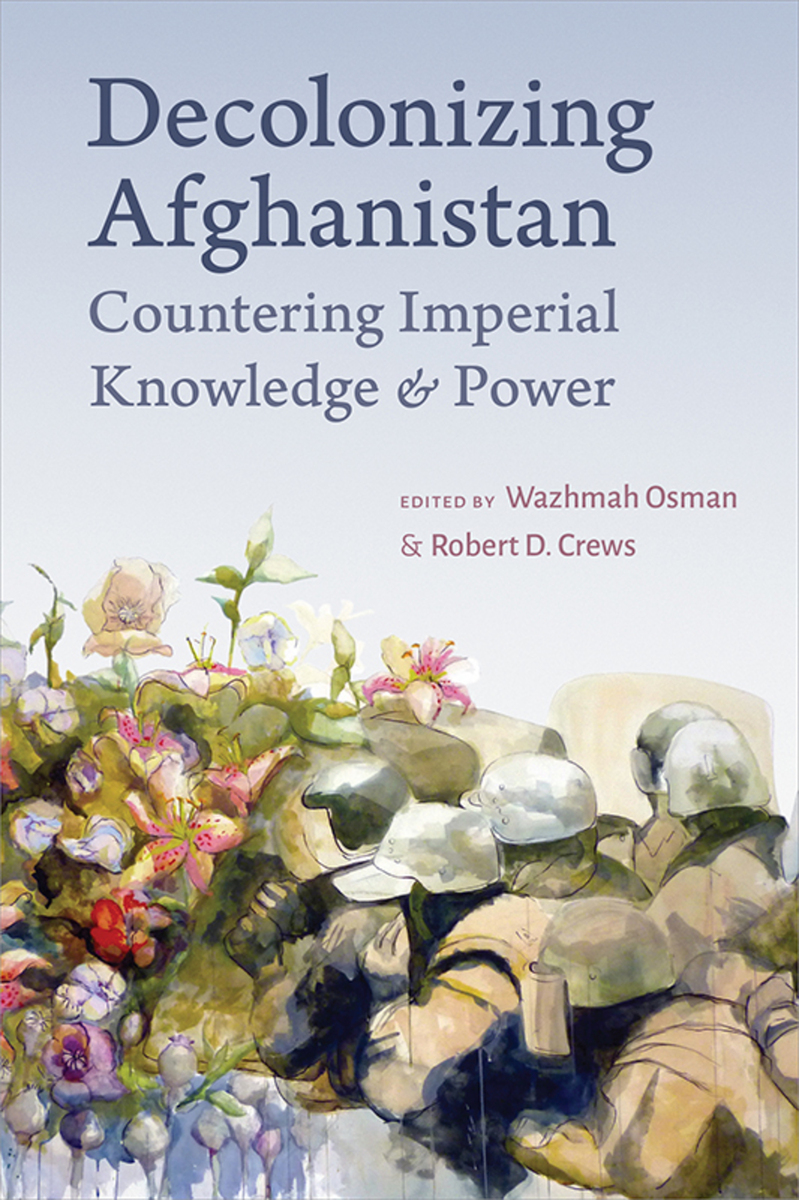
Decolonizing Afghanistan: Countering Imperial Knowledge and Power
Decolonizing Afghanistan: Countering Imperial Knowledge and Power
edited by Wazhmah Osman and Robert D. Crews
Duke University Press, 2025
ISBNs
Cloth: 978-1-4780-2922-9
Paper: 978-1-4780-3260-1
eISBN: 978-1-4780-9443-2 (OA)
eISBN: 978-1-4780-6142-7 (standard)
About the Book
As the first comprehensive volume to explore the impact of empire on Afghanistan’s past and present, Decolonizing Afghanistan marks a decolonial turn in Afghanistan and American studies. Featuring new and often sidelined ground-up perspectives, this collection examines how Afghan communities have subverted, resisted, and participated in colonial projects from the early twentieth century to the present, with a particular focus on the US intervention that began in 2001. Contributors interrogate the relationship between knowledge and power to analyze how narratives about Afghanistan have framed and legitimated imperial governance. Topics span the contradictions and consequences of the US “Forever” War, the rise of private security contracting, the deployment of biometric and surveillance technologies, the politics of US and Taliban countermedia operations, the evolution of gender discourses, and the mobilization of Afghan Americans and “Afghan culture,” among others. Throughout, contributors draw important connections and insights to ongoing global anticolonial struggles and offer paths to decolonial futures.
Contributors. Matthieu Aikins, Dawood Azami, Purnima Bose, Paula Chakravartty, Robert D. Crews, Marya Hannun, Ali Karimi, Nivi Manchanda, Sabauon Nasseri, Tausif Noor, Wazhmah Osman, Hosai Qasmi, Zohra Saed, Gazelle Samizay, Morwari Zafar, Helena Zeweri
Contributors. Matthieu Aikins, Dawood Azami, Purnima Bose, Paula Chakravartty, Robert D. Crews, Marya Hannun, Ali Karimi, Nivi Manchanda, Sabauon Nasseri, Tausif Noor, Wazhmah Osman, Hosai Qasmi, Zohra Saed, Gazelle Samizay, Morwari Zafar, Helena Zeweri
About the Author
Wazhmah Osman is Associate Professor of Media and Communication at Temple University.
Robert D. Crews is Professor of History at Stanford University.
Robert D. Crews is Professor of History at Stanford University.
Reviews
“Groundbreaking, refreshing, eloquent, and powerful, Decolonizing Afghanistan makes a crucial intervention into the knowledge produced on Afghanistan in the United States and more broadly. It provides nuance, depth, and original perspectives in its analysis of Afghanistan’s social, political, economic, and intellectual histories, and in its unique approach of decoloniality. Thanks to its wide scope and analytical richness, it represents a turning point in the dominant understanding of Afghanistan.”
-- Zahra Ali, author of Women and Gender in Iraq: Between Nation-Building and Fragmentation
-- Zahra Ali, author of Women and Gender in Iraq: Between Nation-Building and Fragmentation
“Employing dynamic decolonial approaches, this pathbreaking multidisciplinary volume does the crucial work of putting Afghanistan in the context of colonialism studies. Richly textured and brimming with historical context, it is the volume we need to teach about overlapping colonial formations, how diasporic and local political contestations can occur in tandem, and the vitality of Afghan cultural production. Including Afghanistan in colonialism studies, as this book implores us to do, is a must for our time.”
-- Amahl Bishara, author of Crossing a Line: Laws, Violence, and Roadblocks to Palestinian Political Expression
-- Amahl Bishara, author of Crossing a Line: Laws, Violence, and Roadblocks to Palestinian Political Expression
"... Decolonizing Afghanistan makes a valuable contribution by re-centering Afghanistan within broader debates on empire, knowledge and power. It challenges scholars of Asian studies, international relations and development to interrogate the epistemological assumptions underpinning their work. The volume will be of particular interest to researchers and graduate students engaged in decolonial approaches, critical security studies and the politics of intervention, and it represents an important step toward rethinking Afghanistan beyond imperial epistemic frames."
-- Zulfia Abawe International Quarterly of Asian Studies
-- Zulfia Abawe International Quarterly of Asian Studies
Tags
Political stability, 2021-, Violence, Globalization, Power, Emigration and immigration, 21st century, World, Social conditions, Politics and government, Cultural & Ethnic Studies, Political Science, Social Science, History
Open Access Information
Label: Stanford University
License: CC BY-NC-ND 4.0

 Loading...