
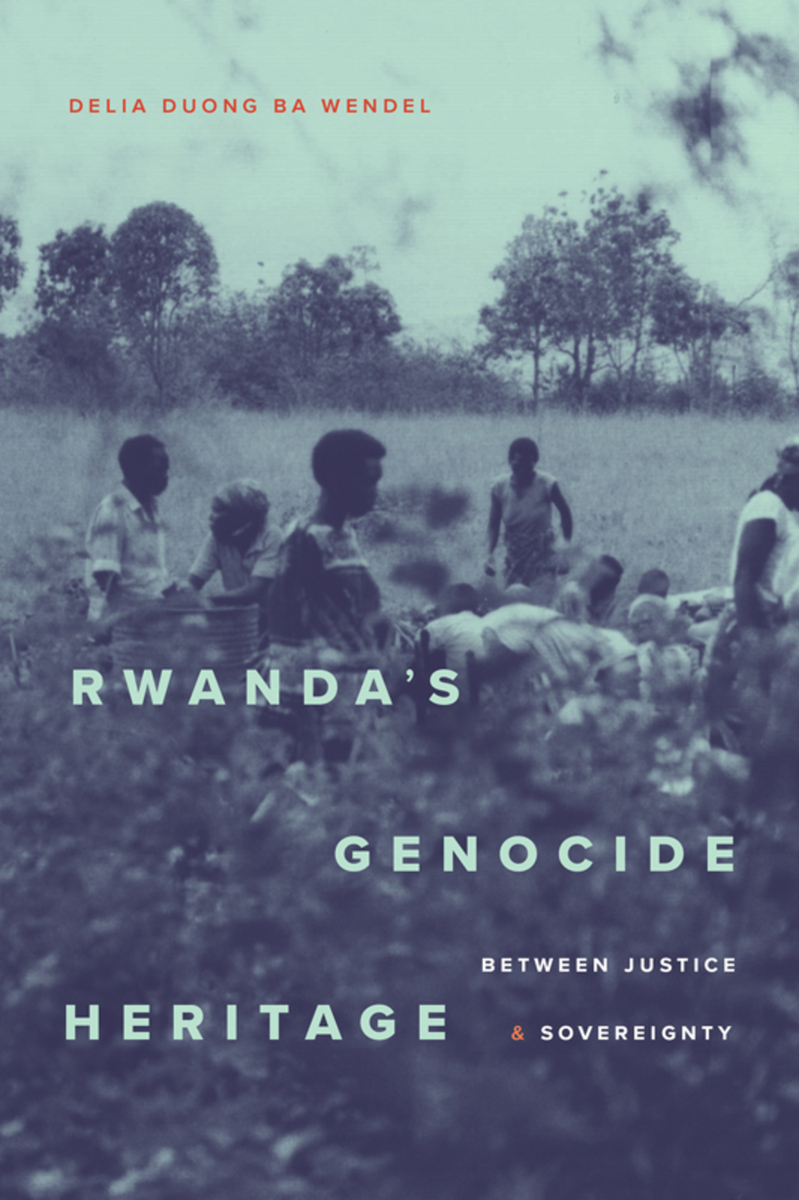
Rwanda's Genocide Heritage: Between Justice and Sovereignty
Rwanda's Genocide Heritage: Between Justice and Sovereignty
by Delia Duong Ba Wendel
Duke University Press, 2025
ISBNs
Cloth: 978-1-4780-2910-6
Paper: 978-1-4780-3247-2
eISBN: 978-1-4780-9441-8 (OA)
eISBN: 978-1-4780-6131-1 (standard)
About the Book
In Rwanda’s Genocide Heritage, Delia Duong Ba Wendel contends with the forms of justice and sovereignty enacted through sites of violent memory. Drawing from oral histories and a visual archive of memory work after the 1994 genocide in Rwanda, she explores the human rights and government priorities that preserved killing sites and victims’ remains for public display. Rwanda’s genocide memorials exemplify a global phenomenon that Wendel terms trauma heritage, wherein hidden or unrecognized violence is spatialized—made visible in public space—to demand justice and recognition. She argues that trauma heritage innovates on the form histories take by “writing” them into landscapes, constituting a reparative historiography from the Global South. Among those sites, Rwanda’s genocide heritage comprises exceptionally visceral sites of truth-telling that highlight the politics of a past made present. Wendel demonstrates that such sites of memory require reckoning with the ethical and political dilemmas that arise from viewing violence as forms of repair and control.
About the Author
Delia Duong Ba Wendel is Associate Professor of Urban Studies and International Development at Massachusetts Institute of Technology and coeditor of Spatializing Politics: Essays on Power and Place.
Reviews
“This is a work of rare ethnographic honesty, in which Delia Wendel examines how the material traces of the brutal ethnocide in Rwanda in the early 1990’s are turned into trauma heritage. It confronts the intimate pain involved in conserving and curating the bodily remains of victims, and richly theorizes the tormenting project of memory justice.”
-- Arjun Appadurai, author of Fear of Small Numbers
-- Arjun Appadurai, author of Fear of Small Numbers
“Wendel lays bare the ultimate paradox of how the very act of preserving genocide heritage both restores dignity and creates a dehumanising aesthetic of trauma. The extraordinary narratives of the “memory makers”—who with their hands, in acts of care and defiance, not only preserve the remains but also reclaim the victims’ humanity. Writing with exquisite detail, Wendel shows how their labor becomes a defiant insistence on visibility that transforms the act of cleaning into a form of truth-telling, making injustice materially and spatially undeniable.”
-- Pumla Gobodo-Madikizela, Professor and Research Chair, Stellenbosch University
-- Pumla Gobodo-Madikizela, Professor and Research Chair, Stellenbosch University
"Wendel’s volume is a compelling, original, and engaged contribution to scholarship on African and Global South politics, sociology, memory, urbanisation, and genocide studies, as well as for all those interested in understanding long-term mechanisms of reconstruction of collective identities in societies broken by mass violence episodes. By spatializing intimacy and positioning readers as secondary witnesses, Wendel honours the moral duty of documenting violence while illuminating the nuances and paradoxes between justice and sovereignty, empowerment and exclusion, objectification and education, which are present in today’s Rwanda."
-- Beatrice Morani International Spectator
-- Beatrice Morani International Spectator
Tags
Sovereignty, Genocide & War Crimes, War and society, 1994-, Rwanda, Transitional justice, Rwandan Genocide Rwanda 1994, Political aspects, Art, Politics and government, Social aspects, Cultural & Ethnic Studies, Political Science, Social Science
Open Access Information
Label: MIT
License: CC BY-NC-ND 4.0

 Loading...