
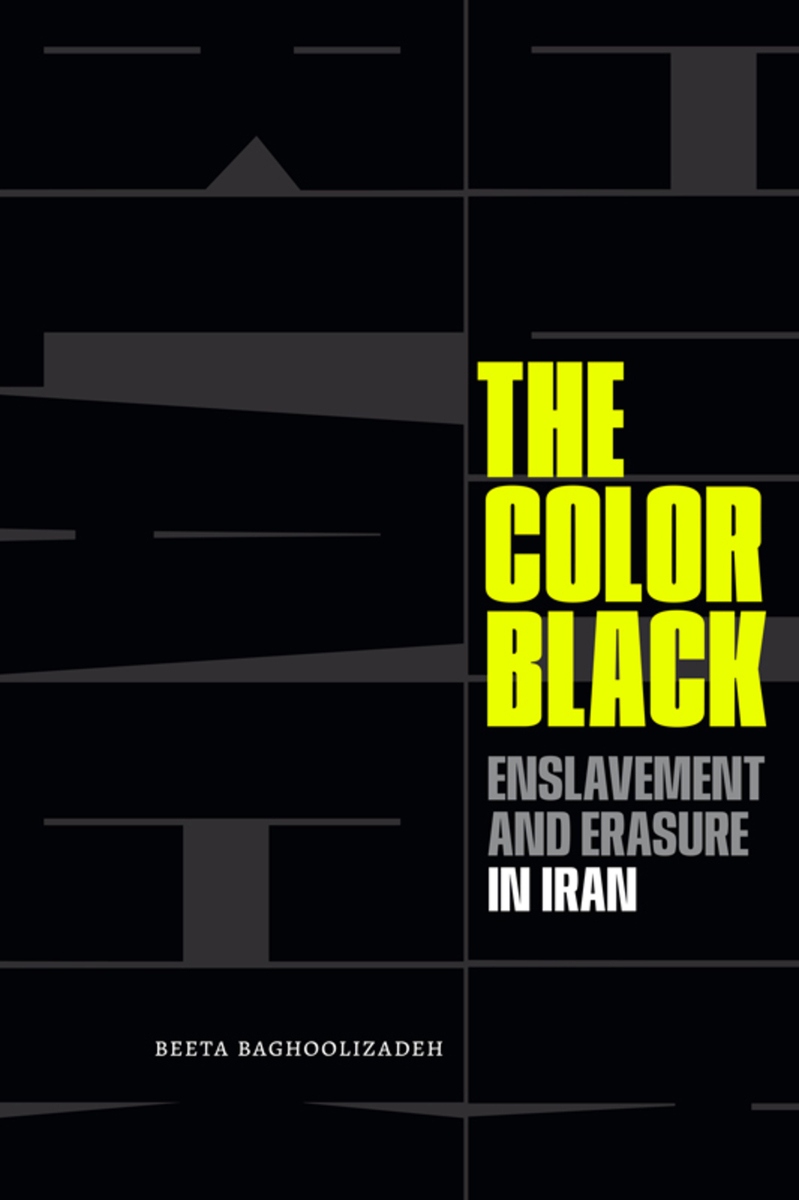
The Color Black: Enslavement and Erasure in Iran
The Color Black: Enslavement and Erasure in Iran
by Beeta Baghoolizadeh
Duke University Press, 2024
ISBNs
Cloth: 978-1-4780-2601-3
Paper: 978-1-4780-3024-9
eISBN: 978-1-4780-9412-8 (OA)
eISBN: 978-1-4780-5925-7 (standard)
About the Book
In The Color Black, Beeta Baghoolizadeh traces the twin processes of enslavement and erasure of Black people in Iran during the nineteenth and twentieth centuries. She illustrates how geopolitical changes and technological advancements in the nineteenth century made enslaved East Africans uniquely visible in their servitude in wealthy and elite Iranian households. During this time, Blackness, Africanness, and enslavement became intertwined—and interchangeable—in Iranian imaginations. After the end of slavery in 1929, the implementation of abolition involved an active process of erasure on a national scale, such that a collective amnesia regarding slavery and racism persists today. The erasure of enslavement resulted in the erasure of Black Iranians as well. Baghoolizadeh draws on photographs, architecture, theater, circus acts, newspapers, films, and more to document how the politics of visibility framed discussions around enslavement and abolition during the nineteenth and twentieth centuries. In this way, Baghoolizadeh makes visible the people and histories that were erased from Iran and its diaspora.
About the Author
Beeta Baghoolizadeh is an Associate Research Scholar at Columbia University’s Middle East Institute.
Reviews
-- Sarah M. A.. Gualtieri, author of Arab Routes: Pathways to Syrian California
-- Neda Maghbouleh, author of The Limits of Whiteness: Iranian Americans and the Everyday Politics of Race
-- Hooshyar Afsar Peyk
“In this pathbreaking study, Beeta Baghoolizadeh weaves together a social history of slavery in Iran; a feminist analysis of modern Iranian households and their racial underpinnings; a gendered reading of state policy on emancipation; and an intervention into the study of slavery and its afterlives. The Color Black is a tour de force of research and a beautiful and brilliant contribution to multiple fields.”
-- Sarah M. A.. Gualtieri, author of Arab Routes: Pathways to Syrian California
“Decentering the dominant lenses in Iranian studies, Beeta Baghoolizadeh advances a new understanding of Iran by showing how its modern construction of history was built upon the erasure of Black Iranians. Rigorously argued, ethically principled, and elegantly written, The Color Black is poised to be one of the most provocative and important new books in Iranian studies and Middle East studies.”
-- Neda Maghbouleh, author of The Limits of Whiteness: Iranian Americans and the Everyday Politics of Race
"A serious, well-researched academic work on a topic that has not been directly addressed in our community worldwide. . . . Through her work, Baghoolizadeh shines a powerful light on an unjustly erased part of Iranian history."
-- Hooshyar Afsar Peyk
"Beeta Baghoolizadeh has done an excellent job with her book The Color Black. Her research is very meticulous, yet not conveyed in an overwhelming way loaded with information. . . . The Color Black deserves attention for being a pioneering work on this subject which opens the way for future research, debate, and scholarship."
-- Forough Jahanbakhsh Islamic Studies
-- Forough Jahanbakhsh Islamic Studies
"This well-organized book will lead its readers to reconsider the history, iconography, and historiography of enslavement in Iran. . . . This well-written, beautifully illustrated, and well-annotated book works well for those familiar with Iranian society and history. . . ."
-- George Michael La Rue Iranian Studies
-- George Michael La Rue Iranian Studies
"In directly confronting vocal opposition among many Iranians to studies about slavery in Iran, The Color Black opens our eyes to the historiographical and tangible stakes of critically examining cultural memories of enslavement in Iran."
-- Mari N. Crabtree American Historical Review
-- Mari N. Crabtree American Historical Review
Tags
Racism against Black people, Erasure, Black people, Slavery, Black Studies (Global), Middle East, 19th century, Social conditions, Cultural & Ethnic Studies, 20th century, Social Science, History
Open Access Information
Label: Princeton University
License: CC BY-NC-ND 4.0

 Loading...