
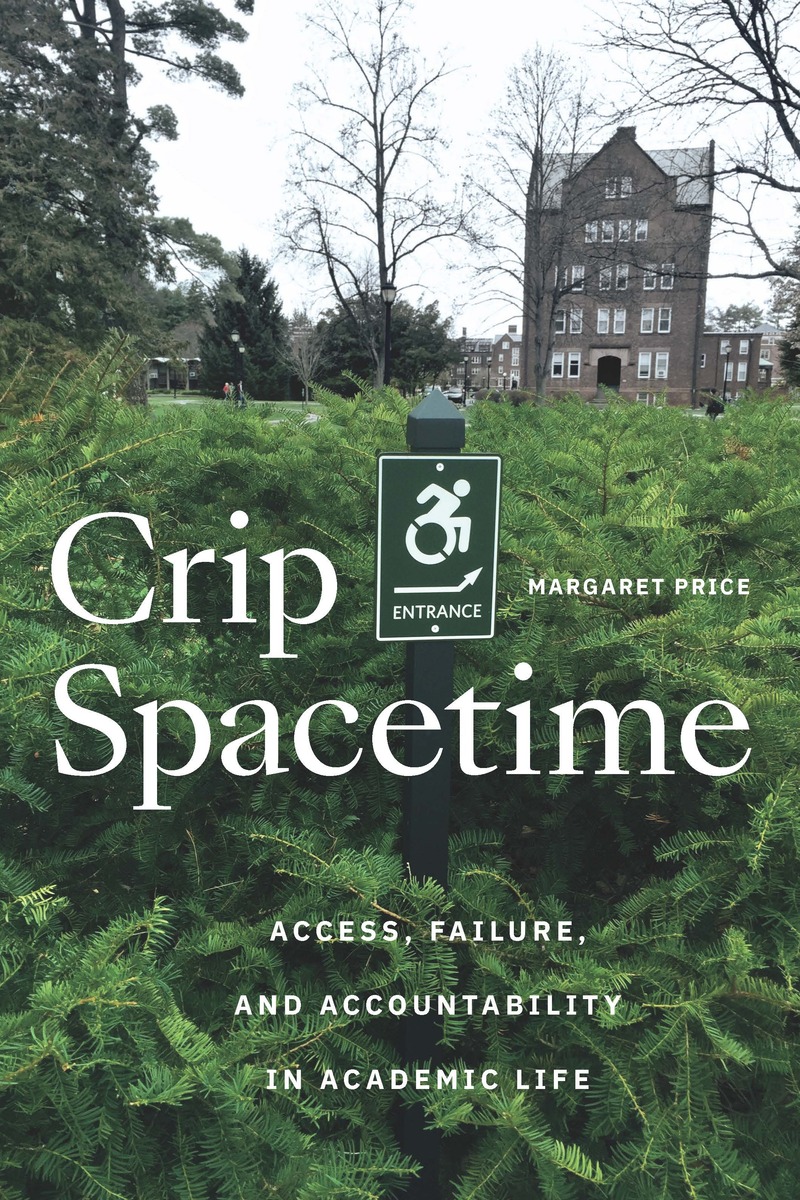
Crip Spacetime: Access, Failure, and Accountability in Academic Life
Crip Spacetime: Access, Failure, and Accountability in Academic Life
by Margaret Price
Duke University Press, 2024
ISBNs
Cloth: 978-1-4780-2613-6
Paper: 978-1-4780-3037-9
eISBN: 978-1-4780-9399-2 (OA)
eISBN: 978-1-4780-5937-0 (standard)
About the Book
In Crip Spacetime, Margaret Price intervenes in the competitive, productivity-focused realm of academia by sharing the everyday experiences of disabled academics. Drawing on more than three hundred interviews and survey responses, Price demonstrates that individual accommodations—the primary way universities address accessibility—actually impede access rather than enhance it. She argues that the pains and injustices encountered by academia’s disabled workers result in their living and working in realities different from nondisabled colleagues: a unique experience of space, time, and being that Price theorizes as “crip spacetime.” She explores how disability factors into the exclusionary practices found in universities, with multiply marginalized academics facing the greatest harms. Highlighting the knowledge that disabled academics already possess about how to achieve sustainable forms of access, Price boldly calls for the university to move away from individualized models of accommodation and toward a new system of collective accountability and care.
About the Author
Margaret Price is Associate Professor of English at the Ohio State University and author of Mad at School: Rhetorics of Mental Disability and Academic Life.
Reviews
-- Sara Ahmed, author of Complaint!
-- Aimi Hamraie, author of Building Access: Universal Design and the Politics of Disability
-- Karla J. Strand Ms.
“Crip Spacetime is a very important book not only for disability studies, gender studies, and race studies but also for anyone whose project is to think deeply about how the reproduction of institutions as being for some and not for others is a form of institutional violence. Margaret Price shows that we need collective accountability to do more than get more disabled people through the door, teaching us that if we listened to disabled academics, we would learn how to build better universities.”
-- Sara Ahmed, author of Complaint!
“In this highly anticipated analysis of disabled academics’ experiences, Margaret Price weaves critical disability theory with qualitative research to analyze the material and discursive textures of accessibility. This book will be essential reading for scholars, teachers, and students seeking to understand disabled lifeworlds in the modern university.”
-- Aimi Hamraie, author of Building Access: Universal Design and the Politics of Disability
"In this necessary volume, Margaret Price details the results of a study she conducted on the daily experiences of academics with disabilities. After collecting over 300 interviews and surveys, Price calls for universities to learn from disabled academics and adopt their models of collective accountability and care."
-- Karla J. Strand Ms.
"Price weaves deeply moving personal stories with questions about the very nature and purpose of higher education, revealing profound tensions between the modern university and the well-being of its workforce while maintaining the possibility of imagining academia otherwise."
-- Liz Bowen Public Books
-- Liz Bowen Public Books
"Price’s work in Crip Spacetime is crucial for changing not only the way academia understands the experience of disability and access, but also for recognizing that current systems of accommodation in academia are actually preventing access. . . . Her work has the potential to affect the way accommodations are framed and viewed in academic institutions and beyond, including in the realms of medicine and public policy."
-- Gabrielle Bunko Rhetoric Review
-- Gabrielle Bunko Rhetoric Review
"I found it liberating and profoundly satisfying to hear so many others’ stories collected and analyzed so compassionately."
-- Jonathan Sterne American Literary History
-- Jonathan Sterne American Literary History
"Crip Spacetime is worth reading because it shifts the burden of change from disabled individuals . . . to institutions themselves. . . . Most importantly, it advocates for collective accountability and systemic transformation rather than individual accommodations—a vision with implications far beyond academia."
-- Pallavi Sanil Contemporary Social Science
-- Pallavi Sanil Contemporary Social Science
“This book is a must-read for scholars, administrators, and practitioners who are serious about moving beyond the shallow rhetoric of inclusivity towards the realisation of substantive institutional justice. It not only diagnoses the problem but also proposes a possible way forward. … Ultimately, Crip Spacetime is not a call for reform but for a revolution in how we view access.”
-- Rahmat Siregar & Irwan Abdullah European Journal of Social Work
-- Rahmat Siregar & Irwan Abdullah European Journal of Social Work
Tags
Failure, Disability studies, Accountability, Access, Academic Life, Employment, Disability, Higher, Levels, Schools, Education, United States, Social Science
Open Access Information
Label: Ohio State University
License: CC BY-NC-ND 4.0

 Loading...