
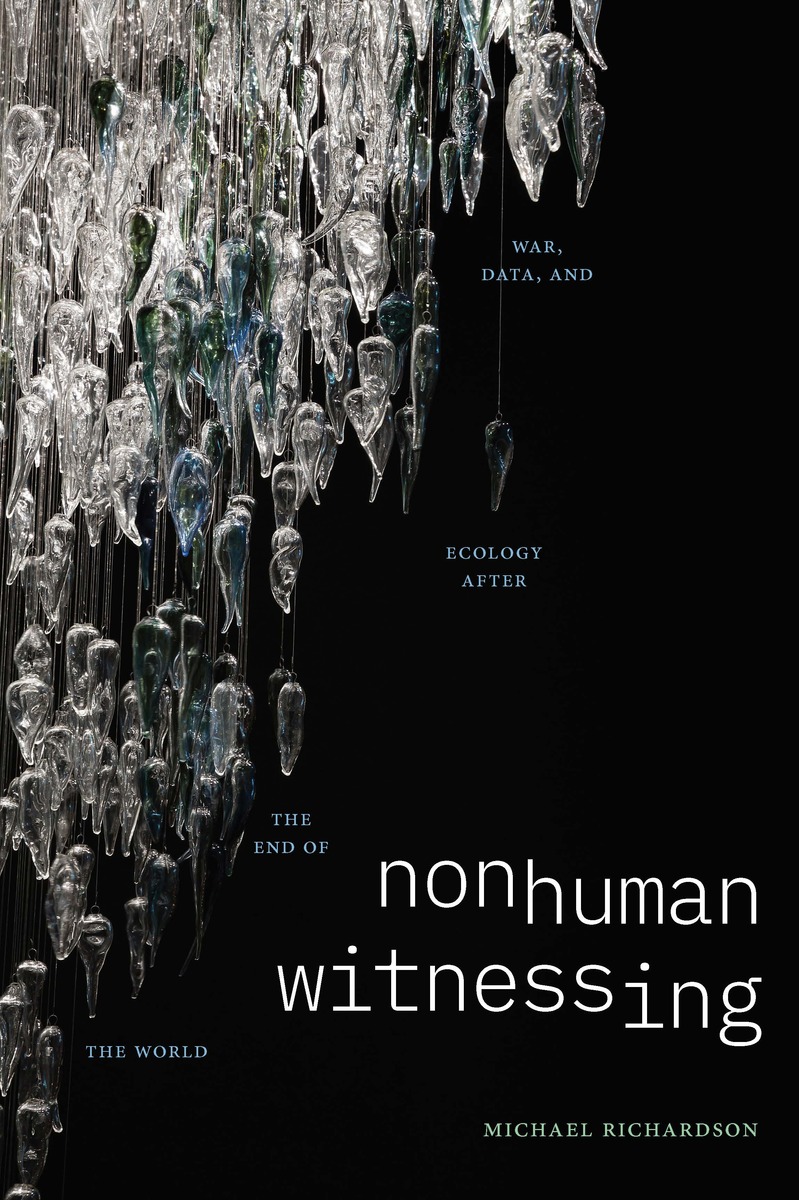
Nonhuman Witnessing: War, Data, and Ecology after the End of the World
Nonhuman Witnessing: War, Data, and Ecology after the End of the World
by Michael Richardson
Duke University Press, 2024
ISBNs
Cloth: 978-1-4780-2090-5
Paper: 978-1-4780-2564-1
eISBN: 978-1-4780-9393-0 (OA)
eISBN: 978-1-4780-2778-2 (standard)
About the Book
In Nonhuman Witnessing Michael Richardson argues that a radical rethinking of what counts as witnessing is central to building frameworks for justice in an era of endless war, ecological catastrophe, and technological capture. Dismantling the primacy and notion of traditional human-based forms of witnessing, Richardson shows how ecological, machinic, and algorithmic forms of witnessing can help us better understand contemporary crises. He examines the media-specificity of nonhuman witnessing across an array of sites, from nuclear testing on First Nations land and autonomous drone warfare to deepfakes, artificial intelligence, and algorithmic investigative tools. Throughout, he illuminates the ethical and political implications of witnessing in an age of profound instability. By challenging readers to rethink their understanding of witnessing, testimony, and trauma in the context of interconnected crises, Richardson reveals the complex entanglements between witnessing and violence and the human and the nonhuman.
About the Author
Michael Richardson is Associate Professor of Media and Culture at the University of New South Wales, Sydney, and author of Gestures of Testimony: Torture, Trauma, and Affect in Literature.
Reviews
-- Eyal Weizman, coauthor of Investigative Aesthetics: Conflicts and Commons in the Politics of Truth
-- Jairus Victor Grove, author of Savage Ecology: War and Geopolitics at the End of the World
“The work of Michael Richardson is like a four dimensional cartography to navigate the hyperaesthetics of our post-photographic present.”
-- Eyal Weizman, coauthor of Investigative Aesthetics: Conflicts and Commons in the Politics of Truth
“Foregrounding the ethical dimensions of the convergence between the fields of security and ecology, Michael Richardson explores whether witnessing is taking place beyond the boundaries of the human. By making a fantastic case for the reversal of the humanist concept of witnessing, Richardson impacts what kinds of research questions can be asked across the disciplines.”
-- Jairus Victor Grove, author of Savage Ecology: War and Geopolitics at the End of the World
"Richardson examines what it means to bear witness in the modern world. In an era of escalating geopolitical tensions and instability, impending climate disaster, and technological transformation with artificial intelligence, the book makes a case for expanding our conception of what forms witnessing can take."
-- University of New South Wales Sydney
-- University of New South Wales Sydney
"Nonhuman Witnessing is ingeniously structured and beautifully written, and for geographers concerned with questions of testimony and trauma it provides a provocative and original rendering of witnessing as a concept, while the array of examples and theoretical arguments speak directly to geographical work on violence, (non)relationality, the Anthropocene and more."
-- Richard Carter-White Social and Cultural Geography
-- Richard Carter-White Social and Cultural Geography
"Readers who are interested in the connections that span manifold challenges in the world today, across technology, the environment, and geopolitical aggression, will find much of value in Nonhuman Witnessing, which provides both a rich vocabulary for articulating their affects, and a wide selection of case studies that draw these together in provocative and insightful ways."
-- Richard A. Carter Continuum
-- Richard A. Carter Continuum
"Nonhuman Witnessing is theoretically adventurous, wandering in and out of cultural studies, media theory, visual arts, political ecology, and environmental humanities and grapples with questions that are – if not new – of accelerating importance in the context of digital globalisation and the climate crises."
-- Mark Filipowich Visual Studies
-- Mark Filipowich Visual Studies
Tags
Thought in the Act, Information society, Data, Communication and technology, Witnesses, Mass media and technology, Ecology after, Mass media, War, Influence, History & Theory, Media Studies, World, Political aspects, Social aspects, Political Science, Social Science
Open Access Information
License: CC BY-NC-ND 4.0

 Loading...