
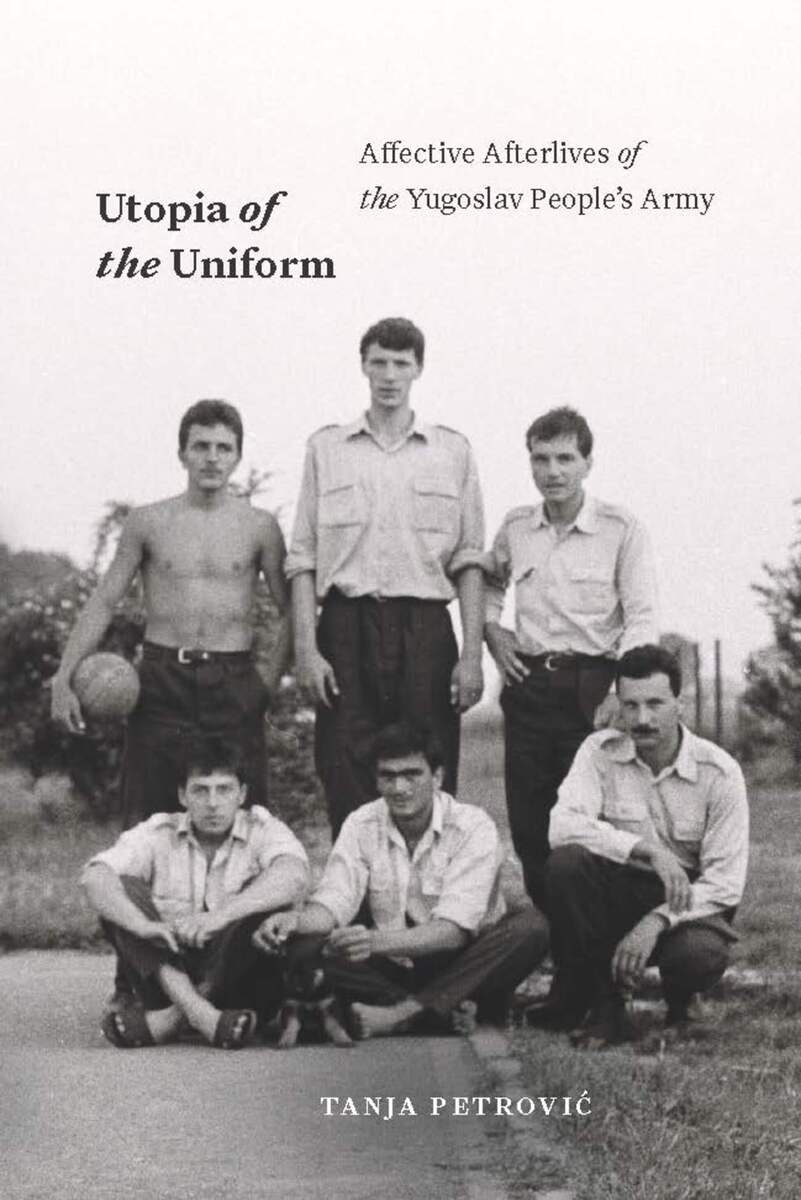
Utopia of the Uniform: Affective Afterlives of the Yugoslav People's Army
Utopia of the Uniform: Affective Afterlives of the Yugoslav People's Army
by Tanja Petrovic
Duke University Press, 2024
ISBNs
Cloth: 978-1-4780-2094-3
Paper: 978-1-4780-2568-9
eISBN: 978-1-4780-9378-7 (OA)
eISBN: 978-1-4780-2780-5 (standard)
About the Book
The compulsory service for young men in the Yugoslav People’s Army (JNA) created bonds across ethnic, religious, and social lines. These bonds persisted even after the horrific violence of the 1990s, in which many of these men found themselves on opposite sides of the front lines. In Utopia of the Uniform, Tanja Petrović draws on memories and material effects of dozens of JNA conscripts to show how their experience of military service points to futures, forms of collectivity, and relations between the state and the individual different from those that prevailed in the post-Yugoslav reality. Petrović argues that the power of repetitive, ritualized, and performative practices that constituted military service in the JNA provided a framework for drastically different men to live together and befriend each other. While Petrović and her interlocutors do not idealize the JNA, they acknowledge its capacity to create interpersonal relationships and affective bonds that brought the key political ideas of collectivity, solidarity, egalitarianism, education, and comradeship into being.
About the Author
Tanja Petrović is Head of the Institute of Culture and Memory Studies at the Research Center of the Slovenian Academy of Sciences and Arts. She is the author of numerous books, including A Long Way Home: Representations of the Western Balkans in Political and Media Discourses.
Reviews
-- Kristen R. Ghodsee, author of Everyday Utopia: What 2,000 Years of Wild Experiments Can Teach Us about the Good Life
-- Samuel Fury Childs Daly, author of A History of the Republic of Biafra: Law, Crime, and the Nigerian Civil War
-- Astrea Nikolovska Reviews in Anthropology
“In Utopia of the Uniform, Tanja Petrović offers a powerful and compelling narrative that provides a very much needed alternative reading of the end of socialist Yugoslavia. I particularly like the way the author mines the Yugoslav past for the possibilities of a utopian future. This book will shift the debate in a variety of fields.”
-- Kristen R. Ghodsee, author of Everyday Utopia: What 2,000 Years of Wild Experiments Can Teach Us about the Good Life
“Tanja Petrović’s Utopia of the Uniform is a tender, provocative account of how men lived, thought, and felt in the Yugoslav armed forces. It is also about what happened to their friendships and solidarities when their country came apart at the seams. Petrović writes about masculinity from a place outside it. In so doing, she captures something that those who live it can’t see.”
-- Samuel Fury Childs Daly, author of A History of the Republic of Biafra: Law, Crime, and the Nigerian Civil War
“Utopia of the Uniform stands out for its engaging language. The large number of first-hand testimonies and photographs transcend the hermeticism of academic literature, making it accessible to a wider readership interested in the former Yugoslavia.”
-- Astrea Nikolovska Reviews in Anthropology
"The work is ethnographically rich and theoretically complex, arguing strongly that Yugoslavia was held together by such “affective infrastructures,” which made Yugoslavs see themselves as members of a collectivity. This study is an important corrective to the literature focusing on the wars that ended Yugoslavia and to the anthropology of the state. Recommended. Advanced undergraduates through faculty."
-- R. M. Hayden Choice
-- R. M. Hayden Choice
"Based on years of research, Utopia of the Uniform is an intimate, tender and revealing study. ... The book will surely appeal not only to scholars of the former Yugoslavia, but those interested in militarization, masculinity and affective memory more broadly."
-- Nicholas Lackenby Slavonic and East European Review
-- Nicholas Lackenby Slavonic and East European Review
"Utopia of the Uniform offers a convincing and provocative account of how men’s friendships and feelings forged while serving in the military continue to live their afterlife more than 30 years after Yugoslavia’s demise."
-- Lieke Speerstra Comparative Southeast European Studies
-- Lieke Speerstra Comparative Southeast European Studies
"Petrović makes a compelling contribution to our understanding of Yugoslavia’s legacy, demonstrating how past utopian visions can still offer alternative futures in postsocialist spaces dominated by nationalist narratives."
-- Melissa Bokovoy American Historical Review
-- Melissa Bokovoy American Historical Review
Tags
Theory in Forms, Draft, Uniform, Gender Studies, Cultural & Social, Social aspects, Anthropology, Europe, Social Science, History
Open Access Information
Label: ZRC SAZU
License: CC BY-NC-ND 4.0

 Loading...