
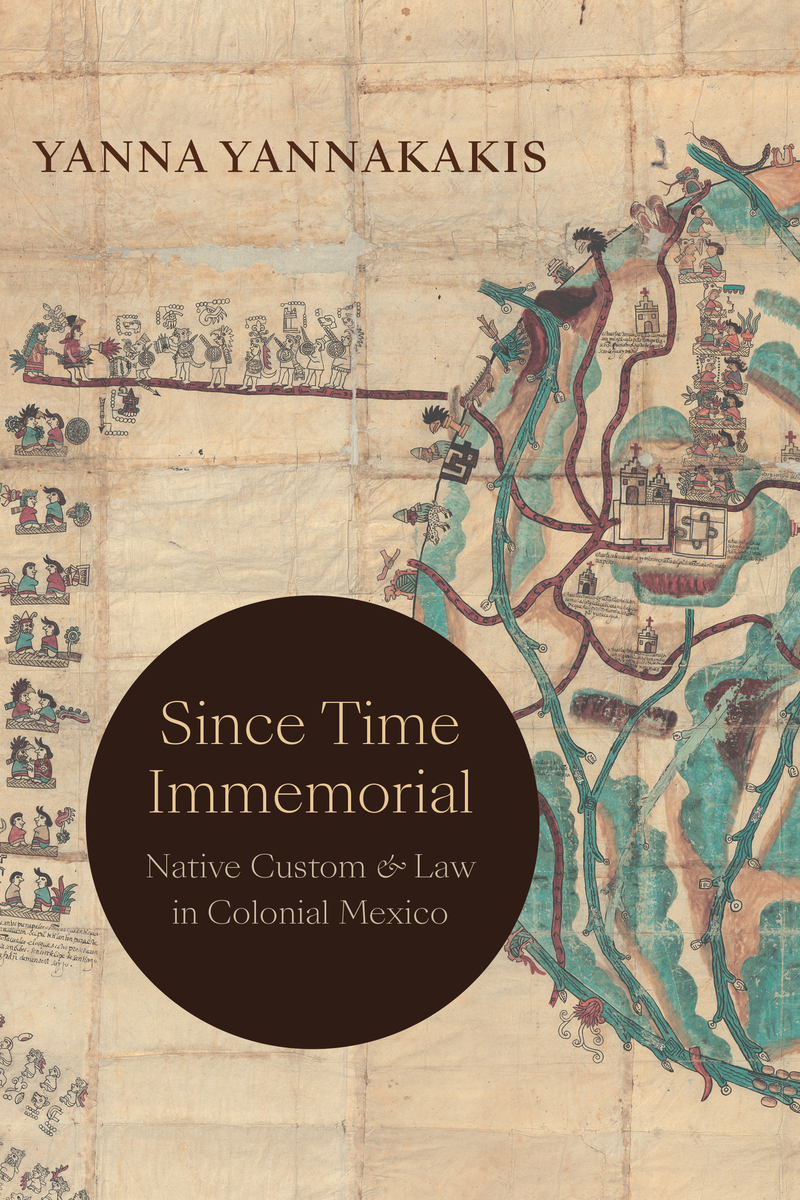
Since Time Immemorial: Native Custom and Law in Colonial Mexico
Since Time Immemorial: Native Custom and Law in Colonial Mexico
by Yanna Yannakakis
Duke University Press, 2023
ISBNs
Cloth: 978-1-4780-1698-4
Paper: 978-1-4780-1962-6
eISBN: 978-1-4780-9357-2 (OA)
eISBN: 978-1-4780-2425-5 (standard)
About the Book
In Since Time Immemorial Yanna Yannakakis traces the invention of Native custom, a legal category that Indigenous litigants used in disputes over marriage, self-governance, land, and labor in colonial Mexico. She outlines how, in the hands of Native litigants, the European category of custom—social practice that through time takes on the normative power of law—acquired local meaning and changed over time. Yannakakis analyzes sources ranging from missionary and Inquisition records to Native pictorial histories, royal surveys, and Spanish and Native-language court and notarial documents. By encompassing historical actors who have been traditionally marginalized from legal histories and highlighting spaces outside the courts like Native communities, parishes, and missionary schools, she shows how imperial legal orders were not just imposed from above but also built on the ground through translation and implementation of legal concepts and procedures. Yannakakis argues that, ultimately, Indigenous claims to custom, which on the surface aimed to conserve the past, provided a means to contend with historical change and produce new rights for the future.
About the Author
Yanna Yannakakis is Associate Professor of History at Emory University, author of The Art of Being In-Between: Native Intermediaries, Indian Identity, and Local Rule in Colonial Oaxaca, and coeditor of Indigenous Intellectuals: Knowledge, Power, and Colonial Culture in Mexico and the Andes, both also published by Duke University Press.
Reviews
-- Noah Zachary World History Encyclopedia
"Aimed at a scholarly audience, Yanna Yannakakis' Since Time Immemorial explores how Spanish authorities and indigenous elites navigated the ambiguous boundary between custom and law in16th-century Mexico. Deeply reasoned and argued, this book should be of interest to both history majors and experts interested in the legal framework of Spanish Mexico."
-- Noah Zachary World History Encyclopedia
"Yannakakis has written a sophisticated and eminently readable text that could serve as an introduction to legal historical methods as well as a longue-durée study of Mexican Native communities. It is an exemplary model for thinking about law from the bottom up without losing sight of imperial foundations or a historically romanticizing a Native past."
-- Karen B. Graubart Colonial Latin American Review
-- Karen B. Graubart Colonial Latin American Review
"Since Time Immemorial shows persuasively how preconquest custom shaped the laws governing the Indigenous world of postconquest Mexico. But it equally demonstrates the complex ways that traditional customs were manipulated to refect new realities as well as how new customs contributed to the evolution of legal practices in colonial society."
-- Jeremy Baskes Estudios Interdisciplinarios de America Latina y el Caribe
-- Jeremy Baskes Estudios Interdisciplinarios de America Latina y el Caribe
"Since Time Immemorial contributes to and expands the literature on the normative power of custom or tradition. . . . Since Time Immemorial is an expansive historical narrative. Its magnitude and scope demonstrate the breadth of Yannakakis’s expertise. . . ."
-- Luis Sierra Journal of Global South Studies
-- Luis Sierra Journal of Global South Studies
"A must-read for scholars of Mexican history, both those studying colonial times and others interested in the ongoing legal struggles of Indigenous communities in Mexico today. Since Time Immemorial is an appropriate text for graduate students and deserves a place in the bibliographies of all researchers interested in the globalization of legal history."
-- Jason Dyck Mexican Studies
-- Jason Dyck Mexican Studies
". . . There is much to commend Since Time Immemorial. Its nuanced history of custom in Mexico’s indigenous communities will be of interest to both ethnohistorians and legal historians, but it also offers much beyond this. It operates as a primer on a broad range of topics involving indigenous-Spanish relations in the colonial era. Students and instructors in large survey classes will find the text useful. . . ."
-- Nora E. Jaffary Journal of Social History
-- Nora E. Jaffary Journal of Social History
Tags
Indigenous Studies, Legal status laws etc, Mexico, Latin America, Law, Cultural & Social, Politics and government, Anthropology, Social Science, History
Open Access Information
Label: Emory University
License: CC BY-NC-ND 4.0

 Loading...