
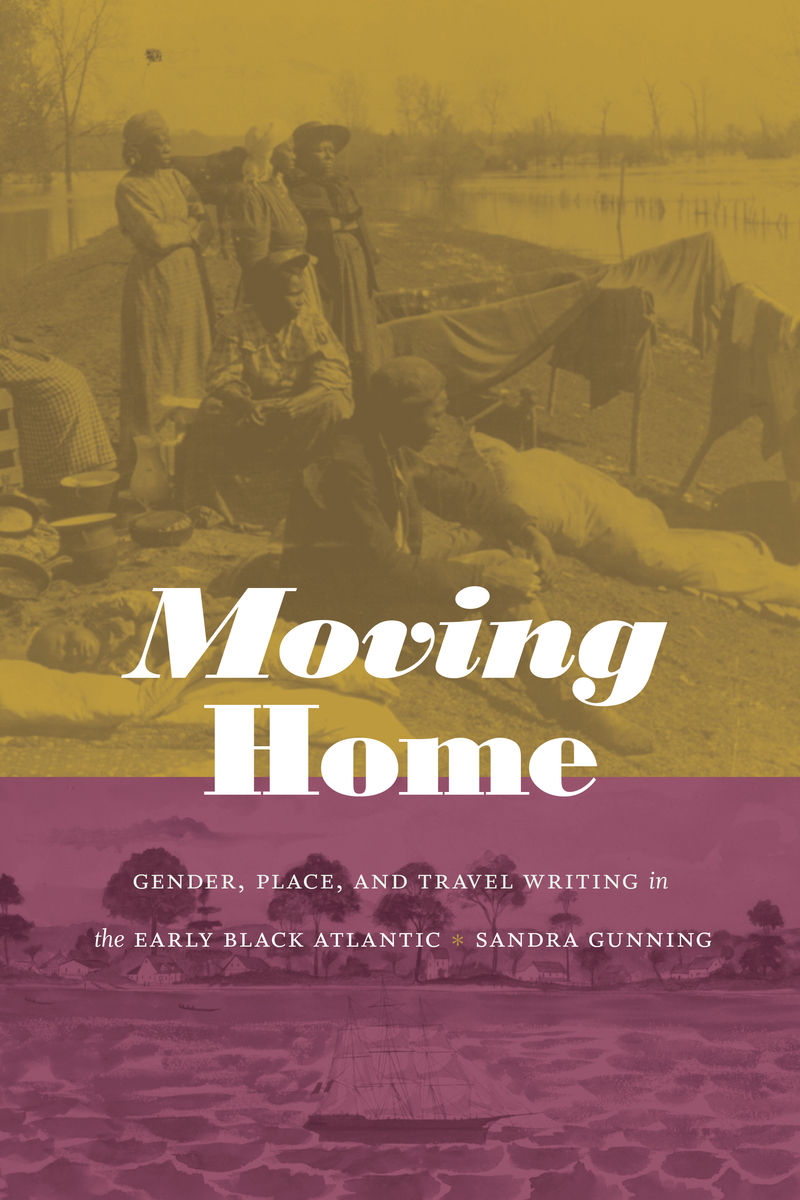
Moving Home: Gender, Place, and Travel Writing in the Early Black Atlantic
Moving Home: Gender, Place, and Travel Writing in the Early Black Atlantic
by Sandra Gunning
Duke University Press, 2021
ISBNs
Cloth: 978-1-4780-1362-4
Paper: 978-1-4780-1455-3
eISBN: 978-1-4780-9263-6 (OA)
eISBN: 978-1-4780-2185-8 (standard)
About the Book
In Moving Home, Sandra Gunning examines nineteenth-century African diasporic travel writing to expand and complicate understandings of the Black Atlantic. Gunning draws on the writing of missionaries, abolitionists, entrepreneurs, and explorers whose work challenges the assumptions that travel writing is primarily associated with leisure or scientific research. For instance, Yoruba ex-slave turned Anglican bishop Samuel Ajayi Crowther played a role in the Christianization of colonial Nigeria. Sarah Forbes Bonetta, a formerly enslaved girl "gifted" to Queen Victoria, traveled the African colonies as the wife of a prominent colonial figure and under the protection of her benefactress. Alongside Nancy Gardiner Prince, Martin R. Delany, Robert Campbell, and others, these writers used their mobility as African diasporic and colonial subjects to explore the Atlantic world and beyond while they negotiated the complex intersections between nation and empire. Rather than categorizing them as merely precursors of Pan-Africanist traditions, Gunning traces their successes and frustrations to capture a sense of the historical and geographical specificities that shaped their careers.
About the Author
Sandra Gunning is Professor of American Studies and Afroamerican and African Studies at the University of Michigan, Ann Arbor, author of Race, Rape, and Lynching: The Red Record of American Literature, 1890–1912, and coeditor of Dialogues of Dispersal: Gender, Sexuality, and African Diasporas.
Reviews
-- Priscilla Wald, author of Contagious: Cultures, Carriers, and the Outbreak Narrative
-- Elizabeth A. Bohls Review 19
-- D. E. Magill Choice
“Sandra Gunning’s clear-sighted treatment of the complex political and social worlds in which her subjects found themselves and the multiple strategies through which they negotiated those worlds offers an especially important corrective to universalizing, homogenizing tendencies in much contemporary diasporic scholarship. Gunning argues for a new look at diaspora, particularly as a lens into the process of cultural change. Moving Home offers, in other words, provides a broad theory of the relationship of literature and literary criticism to profound social transformation.”
-- Priscilla Wald, author of Contagious: Cultures, Carriers, and the Outbreak Narrative
“Moving Home takes a nuanced, intersectional approach to travel writers' construction of gendered identities. . . . Throughout her book, Gunning eschews generalization and accentuates instead the specific politics surrounding each text she discusses."
-- Elizabeth A. Bohls Review 19
"An important corrective to dominant views of 19th-century Black identities and writings, as well as of travel writing, Gunning’s book will interest all scholars of literature and Black studies. Highly recommended. Upper-division undergraduates through faculty."
-- D. E. Magill Choice
Tags
Next Wave: New Directions in Women's Studies, Atlantic Ocean Region, African diaspora in literature, Early Black Atlantic, Colonies, African American authors, Black Studies (Global), Gender, Description and travel, American literature, African American & Black, Gender Studies, Great Britain, 19th century, History and criticism, Literary Criticism, Social Science, History
Open Access Information
Label: University of Michigan
License: CC BY-NC-ND 4.0

 Loading...