
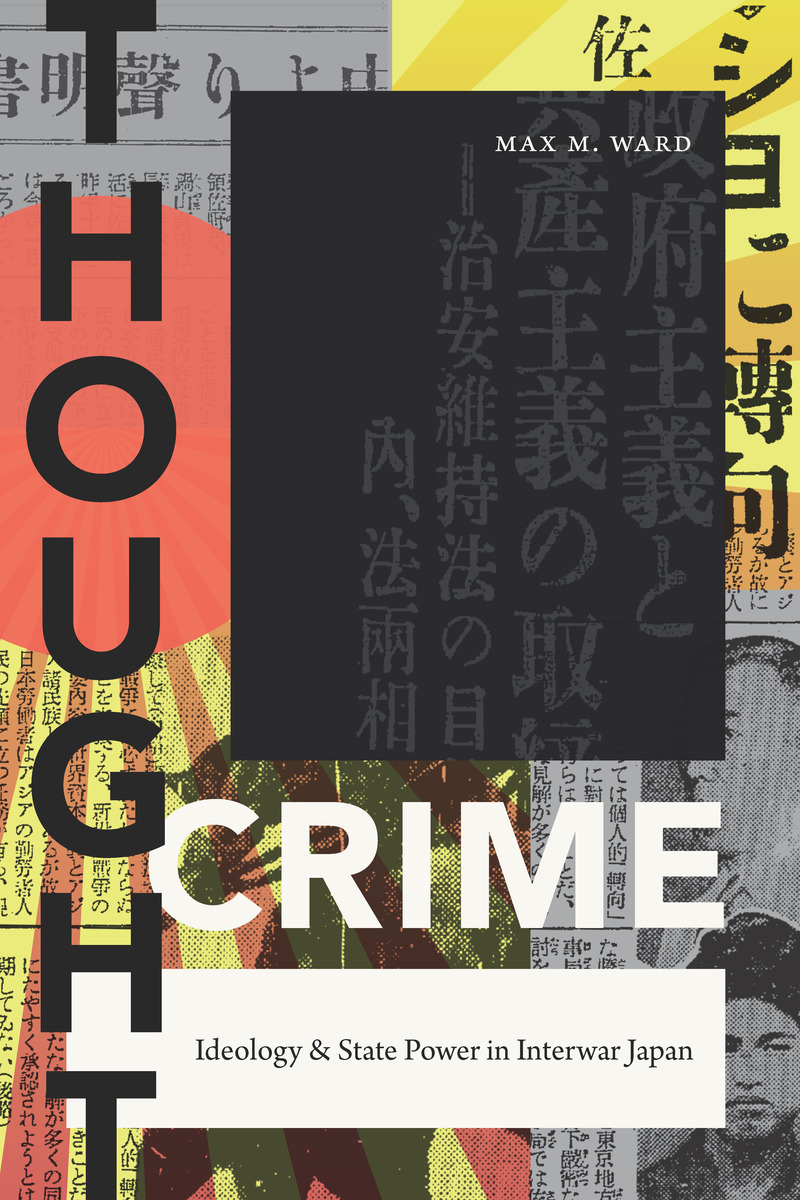
Thought Crime: Ideology and State Power in Interwar Japan
Thought Crime: Ideology and State Power in Interwar Japan
by Max M. Ward
Duke University Press, 2019
ISBNs
Cloth: 978-1-4780-0131-7
Paper: 978-1-4780-0165-2
eISBN: 978-1-4780-9229-2 (OA)
eISBN: 978-1-4780-0274-1 (standard)
About the Book
In Thought Crime Max M. Ward explores the Japanese state's efforts to suppress political radicalism in the 1920s and 1930s. Ward traces the evolution of an antiradical law called the Peace Preservation Law, from its initial application to suppress communism and anticolonial nationalism—what authorities deemed thought crime—to its expansion into an elaborate system to reform and ideologically convert thousands of thought criminals throughout the Japanese Empire. To enforce the law, the government enlisted a number of nonstate actors, who included monks, family members, and community leaders. Throughout, Ward illuminates the complex processes through which the law articulated imperial ideology and how this ideology was transformed and disseminated through the law's application over its twenty-year history. In so doing, he shows how the Peace Preservation Law provides a window into understanding how modern states develop ideological apparatuses to subject their respective populations.
About the Author
Max M. Ward is Associate Professor of History at Middlebury College and coeditor of Confronting Capital and Empire: Rethinking Kyoto School Philosophy.
Reviews
-- Augustine Adu Frimpong African and Asian Studies
-- David Ambaras Journal of Interdisciplinary History
-- John Person Journal of Asian Studies
-- Jeremy A. Yellen Journal of Japanese Studies
-- Tomoko Seto Monumenta Nipponica
-- Walter Skya History: Reviews of New Books
-- Q. E. Wang Choice
-- Jason Morgan Japan Review
"[Ward] has provided his readers with a well-written account of how between 1920 and the 1930s the Japanese nation endeavored to suppress political radicalism."
-- Augustine Adu Frimpong African and Asian Studies
"Thought Crime offers a lucid reflection on theories of power and the modern state while refusing to fetishize the particularities of the Japanese case."
-- David Ambaras Journal of Interdisciplinary History
"Thought Crime sets itself apart from past studies of the Peace Preservation Law by developing a theory of imperial ideology that focuses on its effects on those in proximity to it: bureaucrats, thought criminals, and those who were mobilized to rehabilitate them."
-- John Person Journal of Asian Studies
"Thought Crime is a thought-provoking, intelligent, and necessary book.… It is a must-read for serious students of modern Japanese political and intellectual history."
-- Jeremy A. Yellen Journal of Japanese Studies
"Rigorous and creative explorations of the multiple modalities of state power are much needed in the study of the cultural and social history of modern Japan, and in that respect Thought Crime makes an invaluable contribution to the field."
-- Tomoko Seto Monumenta Nipponica
"This book is nicely written and well-organized, and the author makes excellent use of Japanese-language primary sources. Overall, this is an outstanding piece of research. It makes a substantial contribution to existing works on this topic and is recommended for use in graduate seminars on modern Japanese history."
-- Walter Skya History: Reviews of New Books
"This analysis is a valuable service in increasing our knowledge of the rise of Japanese militarism and the coming of WWII in Asa.… Recommended. Graduate students through faculty."
-- Q. E. Wang Choice
"Thought Crime is a theoretically and archivally rich intervention into discourse surrounding tenkō and the kokutai. . . . Max Ward's incorporation of theory into the body of literature on thought crime in Japan yields an important rethinking of politics and ideology during this most fraught of historical periods."
-- Jason Morgan Japan Review
Tags
Asia-Pacific: Culture, Politics, and Society , Political crimes and offenses, 1926-1945, Interwar Japan, Law and legislation, Japan, Asia, Modern, Politics and government, 20th century, History
Open Access Information
License: CC BY-NC-ND 4.0

 Loading...