
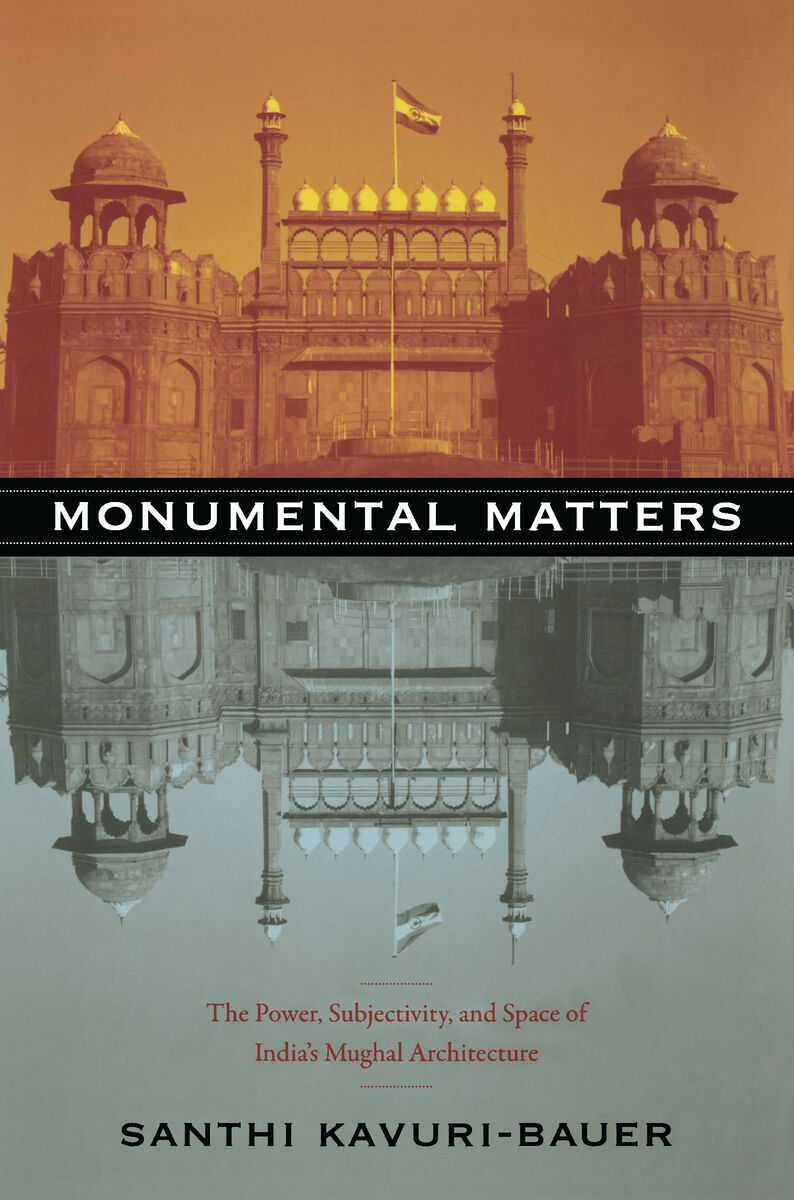
Monumental Matters: The Power, Subjectivity, and Space of India's Mughal Architecture
Monumental Matters: The Power, Subjectivity, and Space of India's Mughal Architecture
by Santhi Kavuri-Bauer
Duke University Press, 2011
ISBNs
Cloth: 978-0-8223-4899-3
Paper: 978-0-8223-4922-8
eISBN: 978-1-4780-9149-3 (OA)
eISBN: 978-0-8223-9376-4 (standard)
About the Book
Built in the sixteenth and seventeenth centuries, India’s Mughal monuments—including majestic forts, mosques, palaces, and tombs, such as the Taj Mahal—are world renowned for their grandeur and association with the Mughals, the powerful Islamic empire that once ruled most of the subcontinent. In Monumental Matters, Santhi Kavuri-Bauer focuses on the prominent role of Mughal architecture in the construction and contestation of the Indian national landscape.
She examines the representation and eventual preservation of the monuments, from their disrepair in the colonial past to their present status as protected heritage sites. Drawing on theories of power, subjectivity, and space, Kavuri-Bauer’s interdisciplinary analysis encompasses Urdu poetry, British landscape painting, imperial archaeological surveys, Indian Muslim identity, and British tourism, as well as postcolonial nation building, World Heritage designations, and conservation mandates. Since Independence, the state has attempted to construct a narrative of Mughal monuments as symbols of a unified, secular nation. Yet modern-day sectarian violence at these sites continues to suggest that India’s Mughal monuments remain the transformative spaces—of social ordering, identity formation, and national reinvention—that they have been for centuries.
She examines the representation and eventual preservation of the monuments, from their disrepair in the colonial past to their present status as protected heritage sites. Drawing on theories of power, subjectivity, and space, Kavuri-Bauer’s interdisciplinary analysis encompasses Urdu poetry, British landscape painting, imperial archaeological surveys, Indian Muslim identity, and British tourism, as well as postcolonial nation building, World Heritage designations, and conservation mandates. Since Independence, the state has attempted to construct a narrative of Mughal monuments as symbols of a unified, secular nation. Yet modern-day sectarian violence at these sites continues to suggest that India’s Mughal monuments remain the transformative spaces—of social ordering, identity formation, and national reinvention—that they have been for centuries.
About the Author
Santhi Kavuri-Bauer is Associate Professor of Art History at San Francisco State University.
Reviews
-- Jim Masselos American Historical Review
-- Fouzia Farooq Islamic Studies
-- Melia Belli CAA Reviews
-- Madhuri Desai Journal of Asian Studies
“Kavuri-Bauer’s study has implications for understanding public space and monuments generally—and the profound changes they may undergo. In this sense, her research has relevance beyond India. She raises broad interpretive issues, given an overall approach that implicitly queries notions of the invention of tradition through an analysis that privileges the accretion of change rather than any deliberate constructing of tradition.”
-- Jim Masselos American Historical Review
"[A] novel addition in Indian historical discourse due to its interdisciplinary approach and fresh perspective."
-- Fouzia Farooq Islamic Studies
"Monumental Matters successfully weaves diverse sources and personal voices into a rich study of the afterlives of India’s Mughal monuments. This important work illustrates why Mughal monuments matter... With its seamless incorporation of diverse methodologies and theories, this provocative, dense book will contribute to disciplines beyond art history, including history, urban planning, religious studies, anthropology, and more."
-- Melia Belli CAA Reviews
"Rich and insightful ... Monumental Matters is a welcome addition to the burgeoning literature on the 'afterlife' of objects and buildings and their entanglements with the discursive trajectories of nationalism and globalization."
-- Madhuri Desai Journal of Asian Studies
Tags
Islamic architecture, 1526-1765, India, Power, South, Architecture, Asia, History
Open Access Information
License: CC BY-NC-ND 4.0

 Loading...