
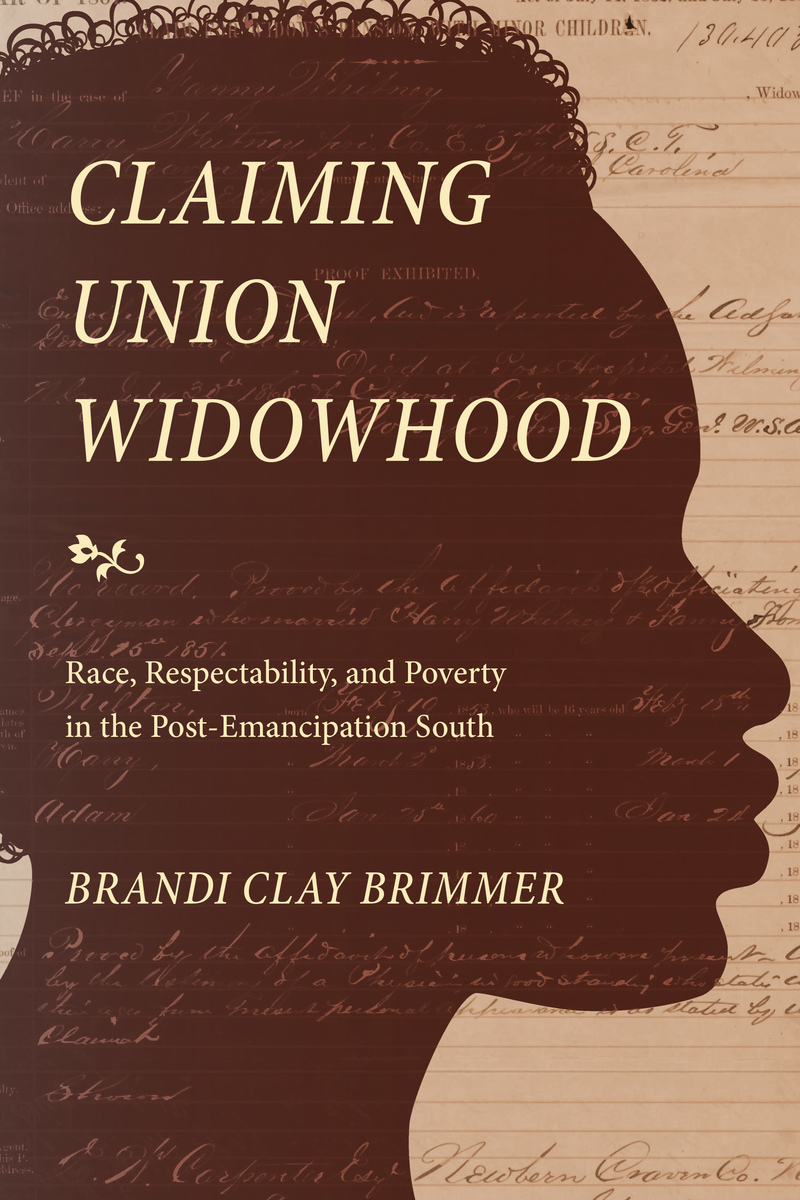
Claiming Union Widowhood: Race, Respectability, and Poverty in the Post-Emancipation South
Claiming Union Widowhood: Race, Respectability, and Poverty in the Post-Emancipation South
by Brandi Clay Brimmer
Duke University Press, 2020
ISBNs
Cloth: 978-1-4780-1025-8
Paper: 978-1-4780-1132-3
eISBN: 978-1-4780-9040-3 (OA)
eISBN: 978-1-4780-1283-2 (standard)
About the Book
In Claiming Union Widowhood, Brandi Clay Brimmer analyzes the US pension system from the perspective of poor black women during and after the Civil War. Reconstructing the grassroots pension network in New Bern, North Carolina, through a broad range of historical sources, she outlines how the mothers, wives, and widows of black Union soldiers struggled to claim pensions in the face of evidentiary obstacles and personal scrutiny. Brimmer exposes and examines the numerous attempts by the federal government to exclude black women from receiving the federal pensions that they had been promised. Her analyses illustrate the complexities of social policy and law administration and the interconnectedness of race, gender, and class formation. Expanding on previous analyses of pension records, Brimmer offers an interpretive framework of emancipation and the freedom narrative that places black women at the forefront of demands for black citizenship.
About the Author
Brandi Clay Brimmer is Associate Professor of History at Spelman College.
Reviews
-- Eileen Boris, author of Making the Woman Worker: Precarious Labor and the Fight for Global Standards, 1919–2019
-- Glenda Elizabeth Gilmore, Peter V. and C. Vann Woodward Professor Emerita, Yale University
-- Gretchen Long Journal of Southern History
-- David Silkenat Labor
-- Catherine A. Jones Journal of the Civil War Era
-- Melissa Milewski Journal of Social History
-- Carol Faulkner Journal of American History
“Brandi Clay Brimmer has written an amazing social history that transforms the study of poor black women’s quest for citizenship and recognition. Through finely grained research she revises our understanding of the racialized gendered state from the standpoint of poor women themselves. She advances how we think about the agency of newly emancipated women from after the Civil War into the late nineteenth century, in the process challenging existing interpretations about the origins of social assistance in the modern United States. This is historical research at its best.”
-- Eileen Boris, author of Making the Woman Worker: Precarious Labor and the Fight for Global Standards, 1919–2019
“This compelling study of eastern North Carolina black women’s claims for Union widows’ pensions marshals methodologically complex evidence to make striking arguments on questions of racialized motherhood, the origins of the welfare state, class formation, and Reconstruction’s failures. Brandi Clay Brimmer recaptures in rich detail the lives of heretofore unknown women who tried and often failed to secure their full Fourteenth Amendment rights. This book is a timely contribution to current debates on the nation’s history of racial injustice and a poignant saga of promises made and promises broken.”
-- Glenda Elizabeth Gilmore, Peter V. and C. Vann Woodward Professor Emerita, Yale University
“Claiming Union Widowhood is a valuable addition to African American and legal historiography. It would teach well in courses on women’s history, labor history classes, and any course concerning emancipation.”
-- Gretchen Long Journal of Southern History
“Claiming Union Widowhood is an important contribution that speaks to several significant historiographical conversations. Historians interested in the long history of emancipation, the African American family, the Black military experience, and Civil War veterans would benefit from reading this excellent study. It sheds new light on the relationship between race, gender, and poverty in Reconstruction and afterward that should inspire future research.”
-- David Silkenat Labor
“Historians interested in how to think more expansively about where political thought happens and who produces it will find much value in Claiming Union Widowhood. . . . Brimmer’s deeply researched book offers readers a rich portrait of Black Union widowhood that will spark new questions for the broad readership it is sure to find.”
-- Catherine A. Jones Journal of the Civil War Era
“Claiming Union Widowhood makes an important contribution to understanding how working-class African American women leveraged local networks and an understanding of institutional processes as they interacted with government institutions in the post-Civil War nation. It powerfully shows, too, the limitations that black women met as they worked within the pension system and were forced to justify their relationships using definitions that had little relevance to their lives.”
-- Melissa Milewski Journal of Social History
“Tracing Black women’s fight to prove their status and worthiness as war widows, Brimmer’s study demonstrates the racial origins of the welfare state in the nineteenth century. . . . Brimmer’s impressive research illuminates the extent and significance of the pension network to New Bern’s Black community.”
-- Carol Faulkner Journal of American History
Tags
Women's rights, United States. Army, North Carolina, Widows, Pensions, Respectability, Racism, Civil War 1861-1865, Civil War Period (1850-1877), Race, Gender Studies, African American & Black Studies, 19th century, Cultural & Ethnic Studies, United States, Social Science, History
Open Access Information
License: CC BY-NC-ND 4.0

 Loading...