
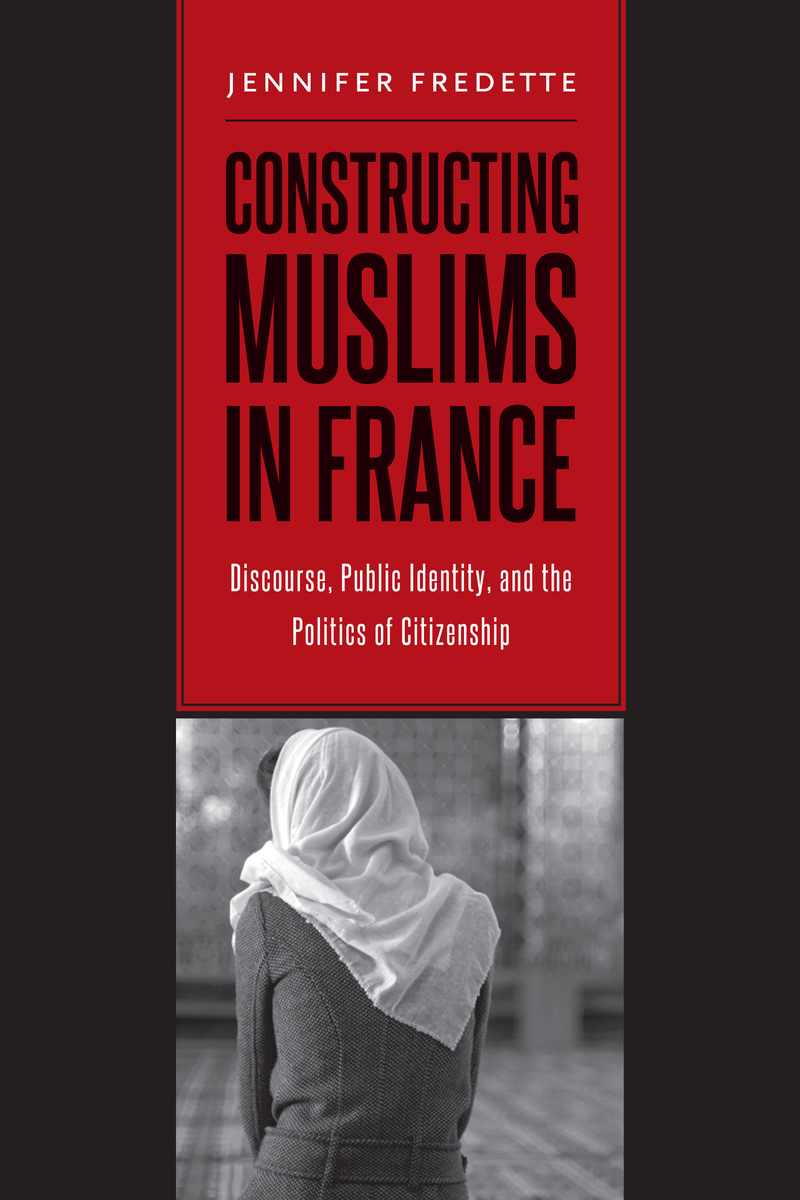
Constructing Muslims in France: Discourse, Public Identity, and the Politics of Citizenship
Constructing Muslims in France: Discourse, Public Identity, and the Politics of Citizenship
by Jennifer Fredette
Temple University Press, 2014
ISBNs
Cloth: 978-1-4399-1028-3
Paper: 978-1-4399-1029-0
eISBN: 978-1-4399-1030-6
About the Book
The standing of French Muslims is undercut by a predominant and persistent elite public discourse that frames Muslims as failed and incomplete French citizens. This situation fosters the very separations, exclusions, and hierarchies it claims to deplore as Muslims face discrimination in education, housing, and employment.
In Constructing Muslims in France, Jennifer Fredette provides a deft empirical analysis to show the political diversity and complicated identity politics of this relatively new population. She examines the public identity of French Muslims and evaluates images in popular media to show how stereotyped notions of racial and religious differences pervade French public discourse. While rights may be a sine qua non for fighting legal and political inequality, Fredette shows that additional tools such as media access are needed to combat social inequality, particularly when it comes in the form of unfavorable discursive frames and public disrespect.
Presenting the conflicting views of French national identity, Fredette shows how Muslims strive to gain recognition of their diverse views and backgrounds and find full equality as French citizens.
About the Author
Jennifer Fredette is Professor of Public Law at North Central College in Naperville, IL. She is the translator of Sylvain Brouard and Vincent Tiberj's As French As Everyone Else? A Survey of French Citizens of Maghrebin, African, and Turkish Origin (Temple).
Reviews
"With xenophobia and anti-immigrant narratives gaining currency is Europe and elsewhere, Fredette’s study is extremely pertinent in its unraveling of the bleak underbellies of republicanism, democracy and the modern nation state in itself. Rightly locating the anti-Muslim discourse as a narrative and affirmative ideology in France, what earmarks Fredette’s study is her intersectional positionality – addressing simultaneously race, gender and ethnic locations of immigrants. Breaking through the homogeneity of official claims on Muslim religiosity, Fredette has moved beyond – with the interviewees at times appropriating or even negating their hybrid identities."--Anthropology Book Forum
Tags
Discourse, Globalization, Ethnic identity, Ethnic relations, Immigration & Emigration, France, Politics, Social conditions, Political Science, Social Science
Open Access Information
License: CC BY-NC-ND

 Loading...