
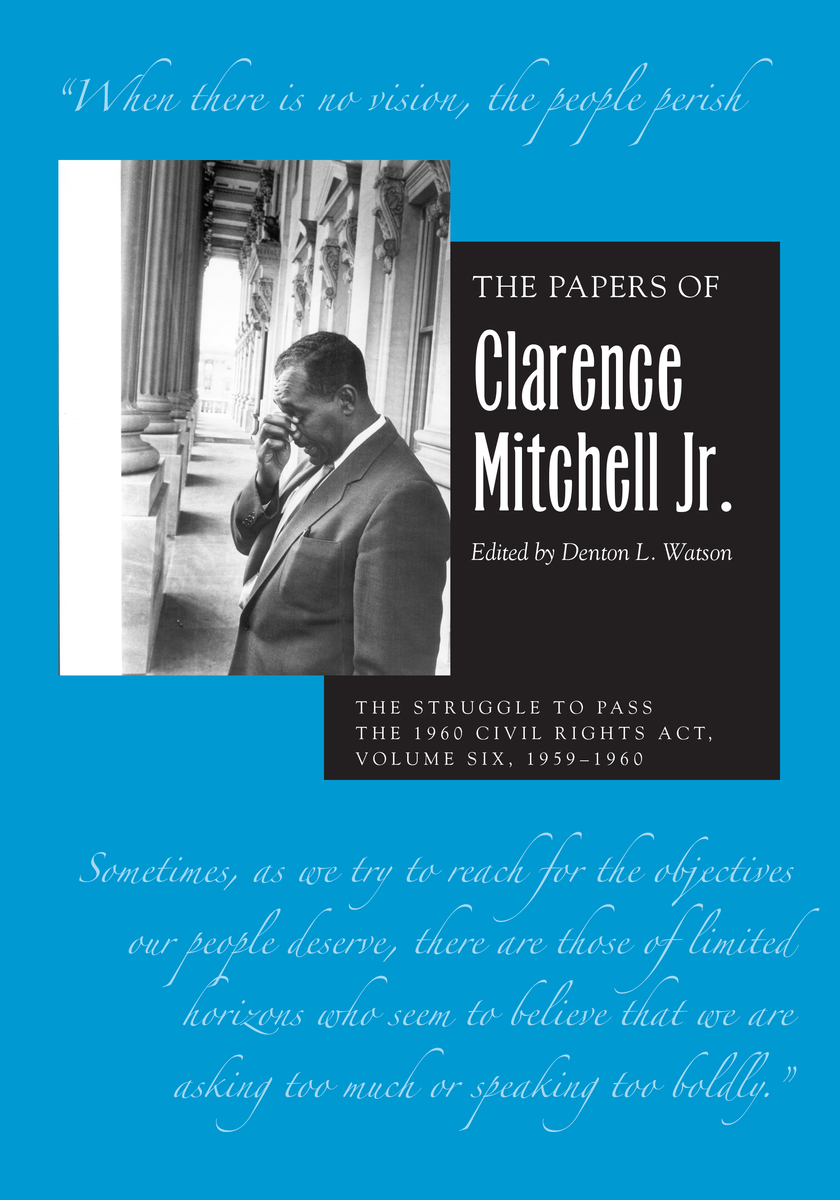
by Clarence Mitchell Jr.
edited by Denton L. Watson
Ohio University Press, 2021
Cloth: 978-0-8214-2460-5
eISBN: 978-0-8214-4746-8
The Civil Rights Act of 1960 aimed to close loopholes in its 1957 predecessor that had allowed continued voter disenfranchisement for African Americans and for Mexicans in Texas.
In early 1959, the newly seated Eighty-Sixth Congress had four major civil rights bills under consideration. Eventually consolidated into the 1960 Civil Rights Act, their purpose was to correct the weaknesses in the 1957 law. Mitchell’s papers from 1959 to 1960 show the extent to which congressional resistance to the passage of meaningful civil rights laws contributed to the lunch counter sit-ins in Greensboro, North Carolina, and to subsequent demonstrations. The papers reveal how the repercussions of these events affected the NAACP’s work in Washington and how, despite their dislike of demonstrations, NAACP officials used them to intensify the civil rights struggle.
Among the act’s seven titles were provisions authorizing federal inspection of local voter registration rolls and penalties for anyone attempting to interfere with voters on the basis of race or color. The law extended the powers of the US Commission on Civil Rights and broadened the legal definition of the verb to vote to encompass all elements of the process: registering, casting a ballot, and properly counting that ballot. Ultimately, Mitchell considered the 1960 act unsuccessful because Congress had failed to include key amendments that would have further strengthened the 1957 act. In the House, representatives used parliamentary tactics to stall employment protections, school desegregation, poll-tax elimination, and other meaningful civil rights reforms. The fight would continue.
The Papers of Clarence Mitchell Jr. series is a detailed record of the NAACP leader’s success in bringing the legislative branch together with the judicial and executive branches to provide civil rights protections during the twentieth century.
Clarence Mitchell Jr. (1911–84) was a civil rights activist and, for nearly thirty years, a chief lobbyist for the National Association for the Advancement of Colored People (NAACP). Nicknamed the “101st Senator,” he was instrumental to the successful passage of the most consequential US civil rights legislative acts of the 1950s and 1960s.
Denton L. Watson, formerly director of public relations for the National Association for the Advancement of Colored People, is an associate professor at SUNY College at Old Westbury. He is author of Lion in the Lobby: Clarence Mitchell, Jr.’s Struggle for the Passage of Civil Rights Laws and editor of The Papers of Clarence Mitchell Jr.
Label: Open access available
License: CC BY-NC-ND 4.0

 Loading...