
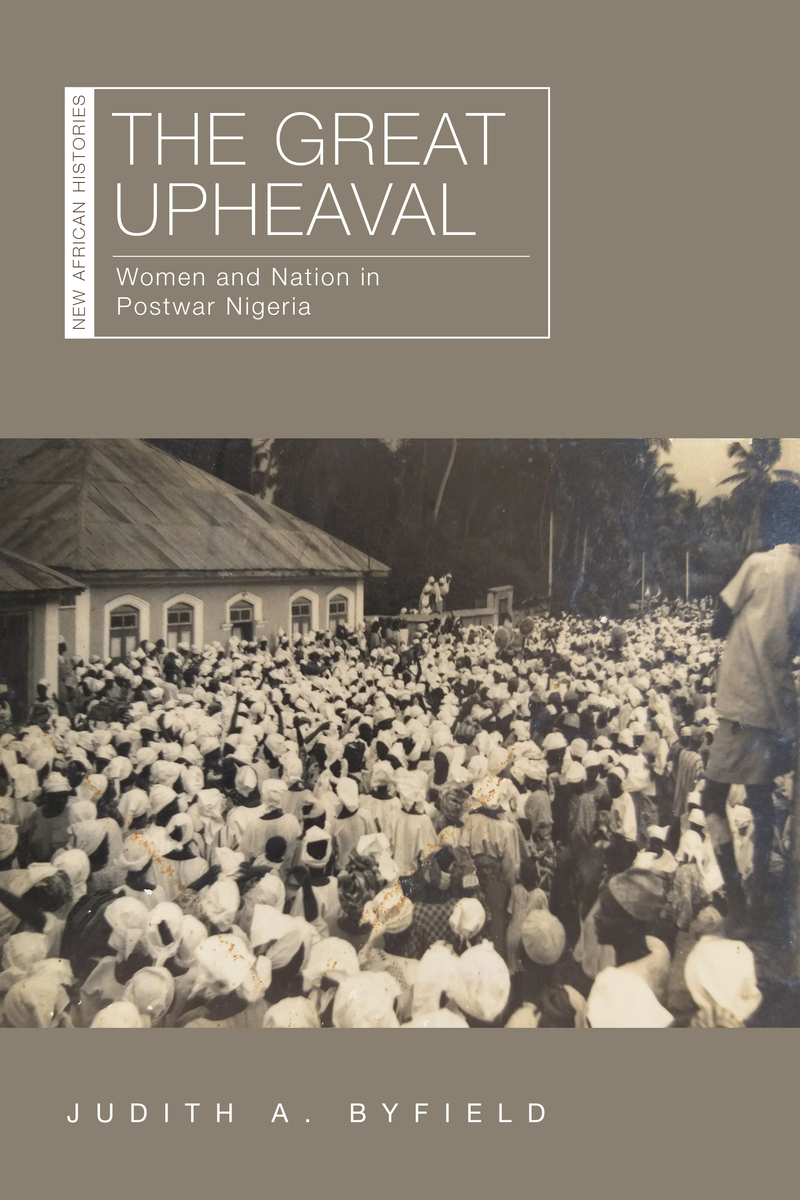
The Great Upheaval: Women and Nation in Postwar Nigeria
The Great Upheaval: Women and Nation in Postwar Nigeria
by Judith A. Byfield
Ohio University Press, 2021
ISBNs
Cloth: 978-0-8214-2397-4
Paper: 978-0-8214-2398-1
eISBN: 978-0-8214-4690-4
About the Book
This social and intellectual history of women’s political activism in postwar Nigeria reveals the importance of gender to the study of nationalism and poses new questions about Nigeria’s colonial past and independent future. In the years following World War II, the women of Abeokuta, Nigeria, staged a successful tax revolt that led to the formation first of the Abeokuta Women’s Union and then of Nigeria’s first national women’s organization, the Nigerian Women’s Union, in 1949. These organizations became central to a new political vision, a way for women across Nigeria to define their interests, desires, and needs while fulfilling the obligations and responsibilities of citizenship. In The Great Upheaval, Judith A. Byfield has crafted a finely textured social and intellectual history of gender and nation making that not only tells a story of women’s postwar activism but also grounds it in a nuanced account of the complex tax system that generated the “upheaval.” Byfield captures the dynamism of women’s political engagement in Nigeria’s postwar period and illuminates the centrality of gender to the study of nationalism. She thus offers new lines of inquiry into the late colonial era and its consequences for the future Nigerian state. Ultimately, she challenges readers to problematize the collapse of her female subjects' greatest aspiration, universal franchise, when the country achieved independence in 1960.
About the Author
Judith A. Byfield is a professor of history at Cornell University. She is the author of The Bluest Hands: A Social and Economic History of Women Dyers in Abeokuta (Nigeria), 1890–1940 and coeditor of Global Africa: Into the Twenty-First Century, Africa and World War II, and Gendering the African Diaspora: Women, Culture, and Historical Change in the Caribbean and Nigerian Hinterland.
Reviews
“Byfield has written a meticulously documented history of women’s political activities during the first half of the twentieth century. The women of Abeokuta played a leading part in the history of economic change, nationalism, and eventual independence in colonial Nigeria, and Byfield’s study is a welcome addition to scholarly analysis of political and economic transformation in Nigeria and Africa in general during this crucial period.”—Sara Berry, professor emerita of history, Johns Hopkins University
“The Great Upheaval is a brilliant historical sociology of the gendered struggle for ‘a new philosophy of life’ in a colonial context. Judith Byfield reminds us that the erasure of women and gender in nationalist histories of emancipation in Africa diminishes our understanding of the complexity of ‘nation-building,’ including the contradictions of gendered notions of agency and freedom. The author seamlessly interweaves gender and nation with colonial history and political economy in the analysis of how Abeokuta women expanded the vistas of human possibilities in early- to mid-20th century Nigeria.”—Wale Adebanwi, Presidential Penn Compact Professor of Africana Studies at the University of Pennsylvania
“Competent, coherent, and captivating, Judith Byfield combines the values of deep research with deep thinking to extend the frontiers of knowledge on gender politics in postwar Nigeria’s late colonial period. City, national, and global ideas converge in The Great Upheaval to locate Yoruba women in complex intersections of economy, politics, and race.”—Toyin Falola, Jacob and Frances Sanger Mossiker Chair in the Humanities, the University of Texas at Austin
Tags
New African Histories, Nation, West, Nationalism, Colonialism & Post-Colonialism, Political activity, Africa, Economic conditions, Women's Studies, Women, Social conditions, Politics and government, 20th century, Political Science, Social Science, History
Open Access Information
Label: Open Access edition funded by the National Endowment for the Humanities
License: CC BY 4.0

 Loading...