
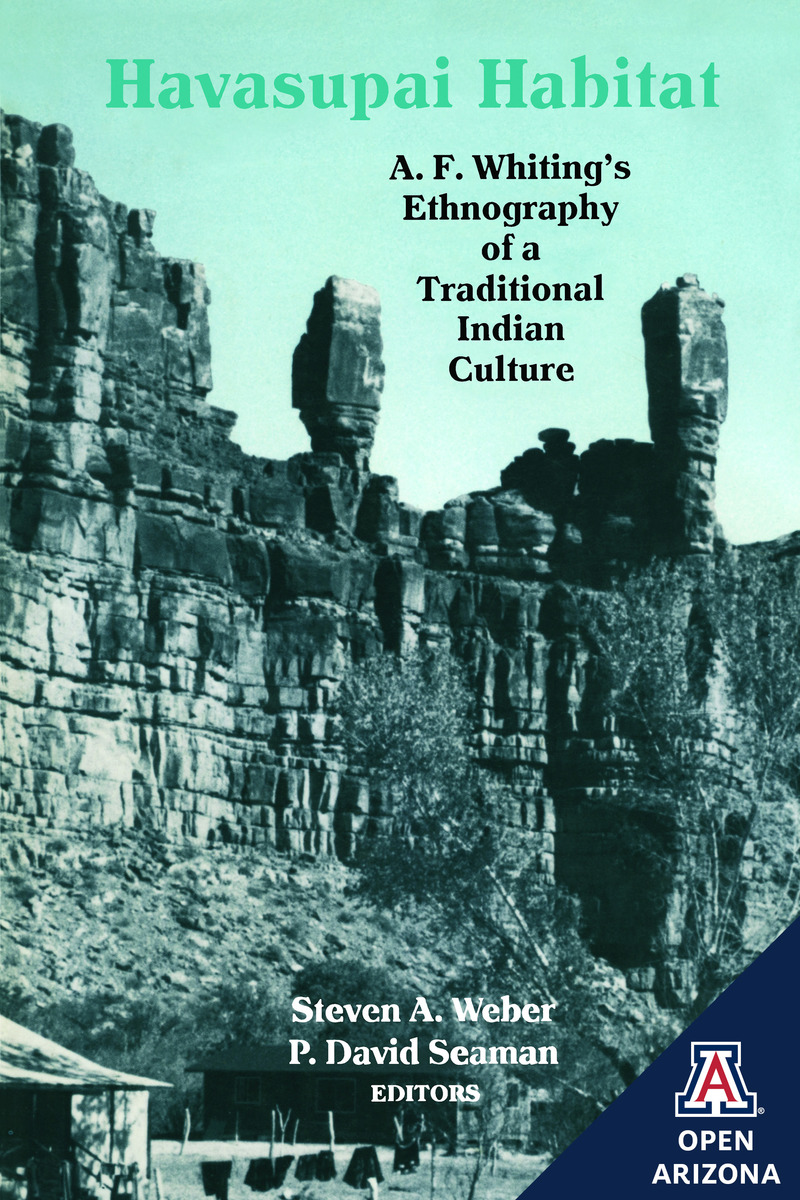
Havasupai Habitat: A. F. Whiting's Ethnography of a Traditional Indian Culture
Havasupai Habitat: A. F. Whiting's Ethnography of a Traditional Indian Culture
by A. F. Whiting
edited by Steven A. Weber and P. David Seaman
University of Arizona Press, 1985
ISBNs
Cloth: 978-0-8165-0866-2
eISBN: 978-0-8165-4119-5 (OA)
About the Book
The Havasupai Indians have lived for centuries in Cataract Canyon, and even came to be confined there by treaty. When anthopologist Alfred F. Whiting set out to study the Havasupai in the early 1940s, he found a culture that in many aspect remained unchanged. In Havasupai Habitat editors Weber and Seaman have distilled Whiting's ethnographic research. Part I comprises ten thematic chapters dealing with various aspects of culture, such as hunting and gathering, child care, housing, and religion. Part II offers a systematic presentation of Havasupai knowledge of weather and astronomy, minerals, animals, and plants; and for each item listed, Whiting has provided scientific and common English terminology, phonetic spelling, and a description of usage.
Published in 1985, Havasupai Habitat offers a rich ethnography on lifeways of the Havasupai people.
Published in 1985, Havasupai Habitat offers a rich ethnography on lifeways of the Havasupai people.
About the Author
Steven A. Weber became director of the Center for Western Studies in Flagstaff, Arizona, in 1980, and has been extensively involved in archaeological and ethnobotanical research with the Hopi and the Navajo, as well as with other cultures.
P. David Seaman was collaborating on the revision of A. F. Whiting's Ethnobotany of the Hopi at the time of Whiting's death in 1978 and has been a member of the Department of Anthopology at Northern Arizona University since 1967.
P. David Seaman was collaborating on the revision of A. F. Whiting's Ethnobotany of the Hopi at the time of Whiting's death in 1978 and has been a member of the Department of Anthopology at Northern Arizona University since 1967.
Reviews
"An important contribution to knowledge about the region and the ethnoscience of a people too long overlooked."—Masterkey
"A book of great value. The work reflects a moment frozen in cultural history, depicting these Native Americans as Whiting saw them."—Choice
"The Havasupai, an impoverished group of Native Americans confined until recently to a small but beautiful canyon trubutary to the Colorado River, were the subject of A.F Whiting's study in 1941. . . . This book is a welcome addition to Indian Ethnography."—Journal of the West
"The adolescent or adult interested in a lifestyle and culture now largely disappeared will find this enjoyable and informative reading."—School Science Mathematics
"A valuable contribution to the preservation of the diverse cultural traditions of the desert peoples of the Southwest."—New Mexico Historical Review
Tags
Anthropology, Social Science
Open Access Information
License: CC BY-NC-ND 4.0

 Loading...