
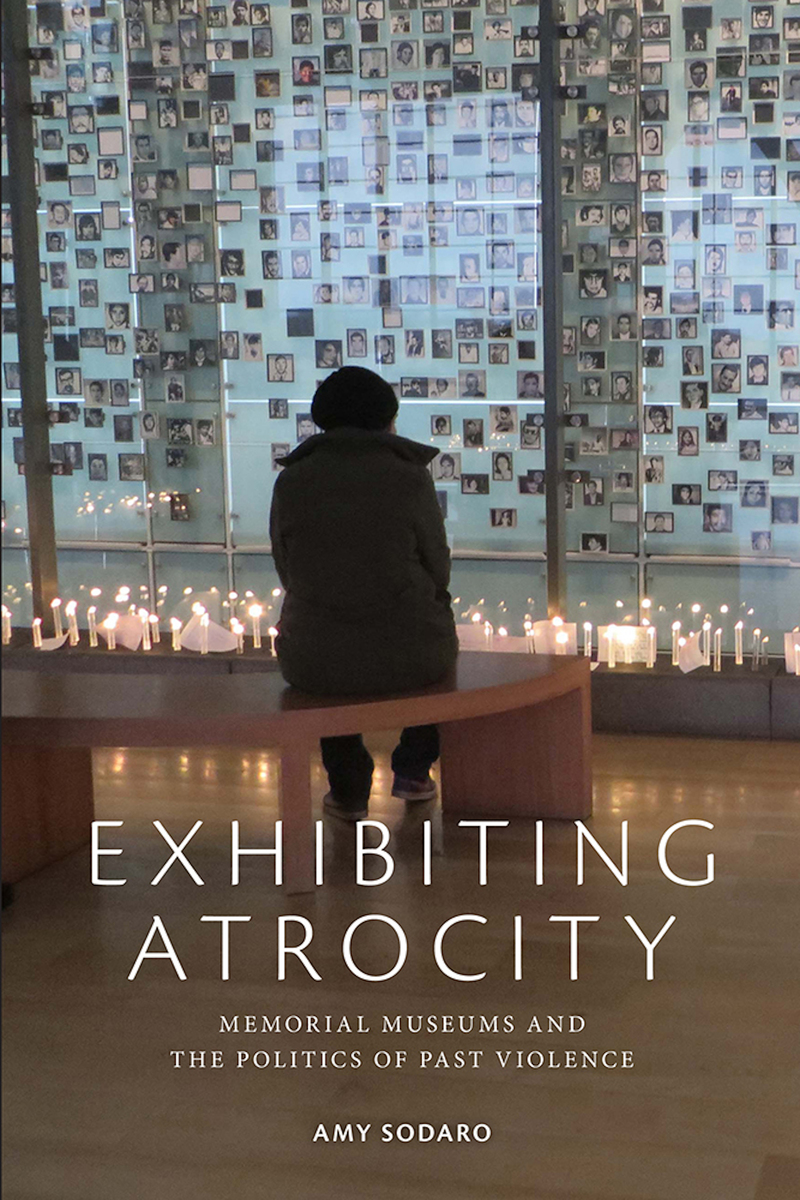
Exhibiting Atrocity: Memorial Museums and the Politics of Past Violence
Exhibiting Atrocity: Memorial Museums and the Politics of Past Violence
by Amy Sodaro
Rutgers University Press, 2018
ISBNs
Paper: 978-0-8135-9214-5
eISBN: 978-0-8135-9215-2 (ePub NK)
eISBN: 978-0-8135-9216-9 (Kindle)
eISBN: 978-0-8135-9217-6 (PDF)
About the Book
Honorable Mention, 2021 Outstanding First Book Award from the Memory Studies Association
Today, nearly any group or nation with violence in its past has constructed or is planning a memorial museum as a mechanism for confronting past trauma, often together with truth commissions, trials, and/or other symbolic or material reparations. Exhibiting Atrocity documents the emergence of the memorial museum as a new cultural form of commemoration, and analyzes its use in efforts to come to terms with past political violence and to promote democracy and human rights.
Through a global comparative approach, Amy Sodaro uses in-depth case studies of five exemplary memorial museums that commemorate a range of violent pasts and allow for a chronological and global examination of the trend: the U.S. Holocaust Memorial Museum in Washington, DC; the House of Terror in Budapest, Hungary; the Kigali Genocide Memorial Centre in Rwanda; the Museum of Memory and Human Rights in Santiago, Chile; and the National September 11 Memorial Museum in New York. Together, these case studies illustrate the historical emergence and global spread of the memorial museum and show how this new cultural form of commemoration is intended to be used in contemporary societies around the world.
Download open access ebook.
Today, nearly any group or nation with violence in its past has constructed or is planning a memorial museum as a mechanism for confronting past trauma, often together with truth commissions, trials, and/or other symbolic or material reparations. Exhibiting Atrocity documents the emergence of the memorial museum as a new cultural form of commemoration, and analyzes its use in efforts to come to terms with past political violence and to promote democracy and human rights.
Through a global comparative approach, Amy Sodaro uses in-depth case studies of five exemplary memorial museums that commemorate a range of violent pasts and allow for a chronological and global examination of the trend: the U.S. Holocaust Memorial Museum in Washington, DC; the House of Terror in Budapest, Hungary; the Kigali Genocide Memorial Centre in Rwanda; the Museum of Memory and Human Rights in Santiago, Chile; and the National September 11 Memorial Museum in New York. Together, these case studies illustrate the historical emergence and global spread of the memorial museum and show how this new cultural form of commemoration is intended to be used in contemporary societies around the world.
Download open access ebook.
About the Author
AMY SODARO is an associate professor of sociology at the Borough of Manhattan Community College, The City University of New York. She is coeditor of Memory and the Future: Transnational Politics, Ethics and Culture.
Reviews
"Exhibiting Atrocity is an ambitious, significant study providing in-depth case studies of three memorial museums and how they attempt to narrate 'difficult history' and navigate the politics of memory. Accessible and wide-ranging, this interdisciplinary volume is an important, timely resource for students as well as specialists."
— Joyce Apsel, author of Introducing Peace Museums"Sodaro examines how many communities, be they groups or countries, work through staggering events like 9/11 by building museums to parse through them."
— SUM"A welcome addition to a growing body of literature within memory studies that examines the global turn in using museums to commemorate past mass atrocities. This book demonstrates that there is much more research to be done and offers inquiring minds a useful starting point."
— Memory Studies
— New Books Network: New Books in Jewish Studies
"This intelligent and cogently-constructed narrative is a significant addition to the growing literature on public commemoration over the past fifty years."
— Jay Winter, coeditor of War and Remembrance in the Twentieth Century“An original and unique study…Exhibiting Atrocity: Memorial Museums and the Politics of Past Violence is an especially and unreservedly recommended addition to both community and academic library Human Rights and Cultural History collections [and] Museum Studies supplemental reading lists.”
— Midwest Book Review"Exhibiting Atrocity sets a precedent that will allow researchers and visitors to recognize these museums for the political projects that they really are – neither good nor bad but always potentially very dangerous. The greatest danger inherent in the ways in which memorial museums exhibit atrocity is that they routinely fail to expose the fragility, vulnerability and precariousness of political systems and norms. This leaves us vulnerable to manipulation, demagoguery, and the authoritarian personalities lying in wait."
— European Journal of Cultural and Political Socioloy
Tags
Genocide & War Crimes, Museums, Genocide, Memorialization, Historical museums, Crimes against humanity, Political atrocities, Violence in Society, Holocaust, Human Rights, Politics, 20th Century, Modern, Art, Political Science, Social Science, History
Open Access Information
Label: Funded by Knowledge Unlatched

 Loading...