
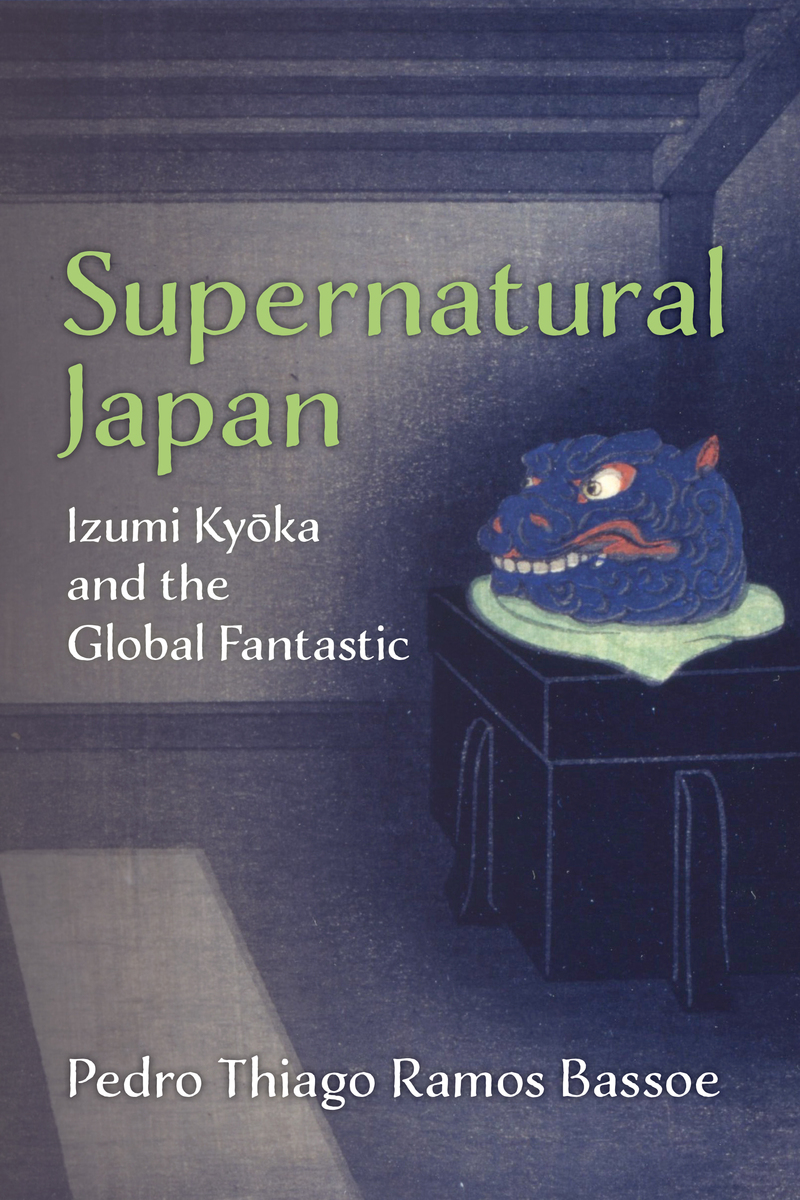
Supernatural Japan: Izumi Kyoka and the Global Fantastic
Supernatural Japan: Izumi Kyoka and the Global Fantastic
by Pedro Thiago Ramos Bassoe
University of Michigan Press, 2026
ISBNs
Cloth: 978-0-472-07799-1
Paper: 978-0-472-05799-3
eISBN: 978-0-472-90575-1 (OA)
About the Book
Supernatural Japan examines the role of Japanese writer Izumi Kyōka (1873–1939) in the formation of modern literature of the fantastic in Japan as a global literary genre. Kyōka wrote some of the most famous stories of ghosts, monsters, and the supernatural in modern Japanese literature, including The Holy Man of Mt. Kōya, The Grass Labyrinth, and The Castle Tower. Despite the clearly modernist elements and global influences of Kyōka’s fiction, his work has often been characterized as relying on traditional Japanese genres as inspiration for its themes and literary form.
Pedro Bassoe considers how Kyōka’s stories have been produced by a meeting of global influences—including Apuleius, The Arabian Nights, Hans Christian Andersen, the Brothers Grimm, Prosper Mérimée, Guy de Maupassant, Gerhart Hauptmann, and Jules Verne—combined with traditional Japanese genres. Bassoe develops the notion of “the scholarly fantastic” to describe how a set of realistic epistemologies reinforce the fantastic in Kyōka’s writings. Supernatural Japan offers an up-to-date introduction to Izumi Kyōka and his writing for students, scholars, or fans of Japanese fantasy literature and media.
Pedro Bassoe considers how Kyōka’s stories have been produced by a meeting of global influences—including Apuleius, The Arabian Nights, Hans Christian Andersen, the Brothers Grimm, Prosper Mérimée, Guy de Maupassant, Gerhart Hauptmann, and Jules Verne—combined with traditional Japanese genres. Bassoe develops the notion of “the scholarly fantastic” to describe how a set of realistic epistemologies reinforce the fantastic in Kyōka’s writings. Supernatural Japan offers an up-to-date introduction to Izumi Kyōka and his writing for students, scholars, or fans of Japanese fantasy literature and media.
About the Author
Pedro Thiago Ramos Bassoe is Assistant Professor of Japanese at Purdue University.
Reviews
“Supernatural Japan is an example of careful and thorough scholarship that adds an important wing to the edifice of modern Japanese literature. The door to that part of the house has always been there, but it took Pedro’s courage to actually find the key, open it, and walk in. Anyone doing an advanced degree in Japanese literature should read this book.”— Charles Shiro Inouye, Tufts University
“Supernatural Japan contributes substantially to the limited English-language studies of the impact of European and other non-Japanese influences on Kyōka’s writings, a writer who has perhaps erroneously been called a thoroughly ‘Japanese’ author. It makes a significant and important intervention in the secondary sources on Kyōka in English.”— Nina Cornyetz, New York University
“Pedro Thiago Ramos Bassoe’s Supernatural Japan repositions Izumi Kyōka as a key figure in global supernatural literature, linking him to Western authors like Hans Christian Andersen and Guy de Maupassant. By exploring Kyōka’s fusion of image and text, Bassoe reshapes our understanding of his literary innovations and their impact on transnational genres like horror and speculative fiction. A masterful, field-defining work.”— Rebecca Copeland, Washington University in St. Louis
Tags
Michigan Monograph Series in Japanese Studies, Supernatural in literature, 1873-1939, Japan, Asian, Criticism and interpretation, Asia, Modern, History and criticism, 20th century, Literary Criticism, History
Open Access Information
License: CC BY-NC

 Loading...