
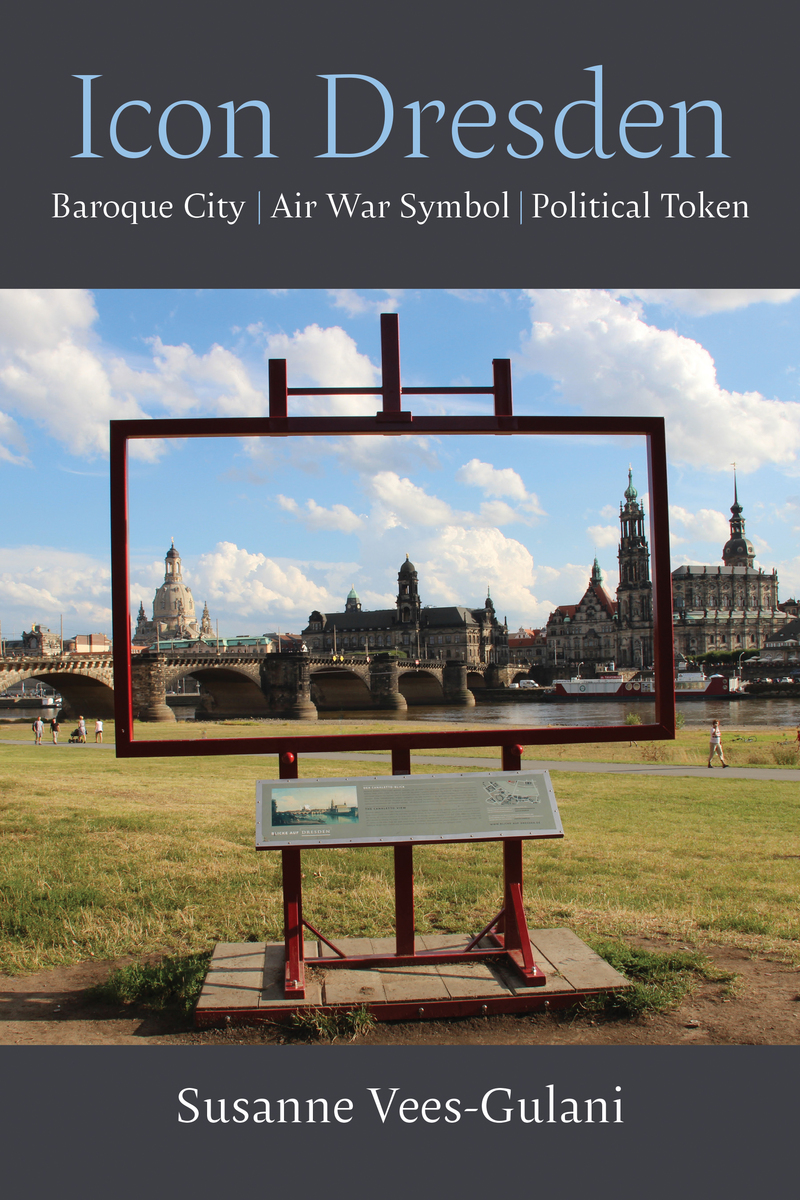
Icon Dresden: Baroque City, Air War Symbol, Political Token
Icon Dresden: Baroque City, Air War Symbol, Political Token
by Susanne Vees-Gulani
University of Michigan Press, 2026
ISBNs
Cloth: 978-0-472-07790-8
Paper: 978-0-472-05790-0
eISBN: 978-0-472-90566-9 (OA)
About the Book
Icon Dresden explores how memory and politics in Dresden after its 1945 bombing are deeply intertwined with the city’s urban history. It highlights the complex origins of Dresden’s reputation as an exclusively cultural center, focusing on urban planning, marketing, tourism, and the city’s visual archive since the 17th century. Based on this iconic status, a narrative of victimhood arose after its destruction that ignored responsibilities while highlighting the city’s innocence. Despite its origin in Nazi propaganda, this narrative influenced postwar political discourse in socialist and post-reunification Germany. Icon Dresden also provides insight into Dresden’s role under National Socialism and the GDR’s evasive response to this history. It reveals how the strong presence of far-right movements in the city today stems from multiple discourses formed over centuries and communicated from generation to generation.
Drawing on urban, heritage, and tourism studies, visual and memory studies, and environmental psychology, Icon Dresden examines Dresden’s history, identity, visual representations, and rebuilding decisions. It exposes the narratives that define its place in German and international memory and how, paradoxically, they support both Dresden’s current image as a symbol of peace and reconciliation and its backing of nativist and far-right movements.
Drawing on urban, heritage, and tourism studies, visual and memory studies, and environmental psychology, Icon Dresden examines Dresden’s history, identity, visual representations, and rebuilding decisions. It exposes the narratives that define its place in German and international memory and how, paradoxically, they support both Dresden’s current image as a symbol of peace and reconciliation and its backing of nativist and far-right movements.
About the Author
Susanne Vees-Gulani is Associate Professor of German and Comparative Literature at Case Western Reserve University.
Reviews
“In her painstakingly researched and compellingly argued study, Vees-Gulani interrogates narratives of the Allied firebombing of Dresden. Contextualizing this event within the city’s longer history, she carefully documents the ways in which memory of the destruction has functioned as a singular flashpoint for political and cultural debates about culpability, suffering, and German national identity.”— Erin McGlothlin, Washington University in St. Louis
“Icon Dresden provides a rich and detailed account of its subject. Vees-Gulani has a remarkable eye for finding new directions from which to approach the history of the city and its controversies.”— Brad Prager, University of Missouri
“Susanne Vees-Gulani offers a definitive and multifaceted analysis of politicized mythologies about Dresden: a firebombed city whose memorialization and reconstruction have spurred tropes of seemingly singular victimhood. Vees-Gulani’s evocative monograph articulates how and why Dresden obtained its imaginary potential as a criminally destroyed Baroque cultural masterpiece—a vision crafted by the Nazis, embraced during the GDR, and perpetuated by rightwing activists today. Not least given Dresden’s central place in German, European, and global debates about how authoritarian actors reshape history for extremist agendas, this is a most timely book.”— Andrew Demshuk, American University
“Vees-Gulani has achieved the rare feat of writing an interdisciplinary book at the pinnacle of cultural and memory studies today that impresses with historical details. Icon Dresden is original, well written, and clearly structured. It is a completely new reading of the symbolic power of the self-representation of Dresden.”— Stephan Jaeger, University of Manitoba
Tags
Social History, Popular Culture, And Politics In Germany, Bombardment 1945, Nationalism and collective memory, Collective memory and city planning, Dresden, Dresden (Germany), Jewish Studies, World War II, World War 1939-1945, Wars & Conflicts, Germany, Europe, Social Science, History
Open Access Information
License: CC BY-NC

 Loading...