
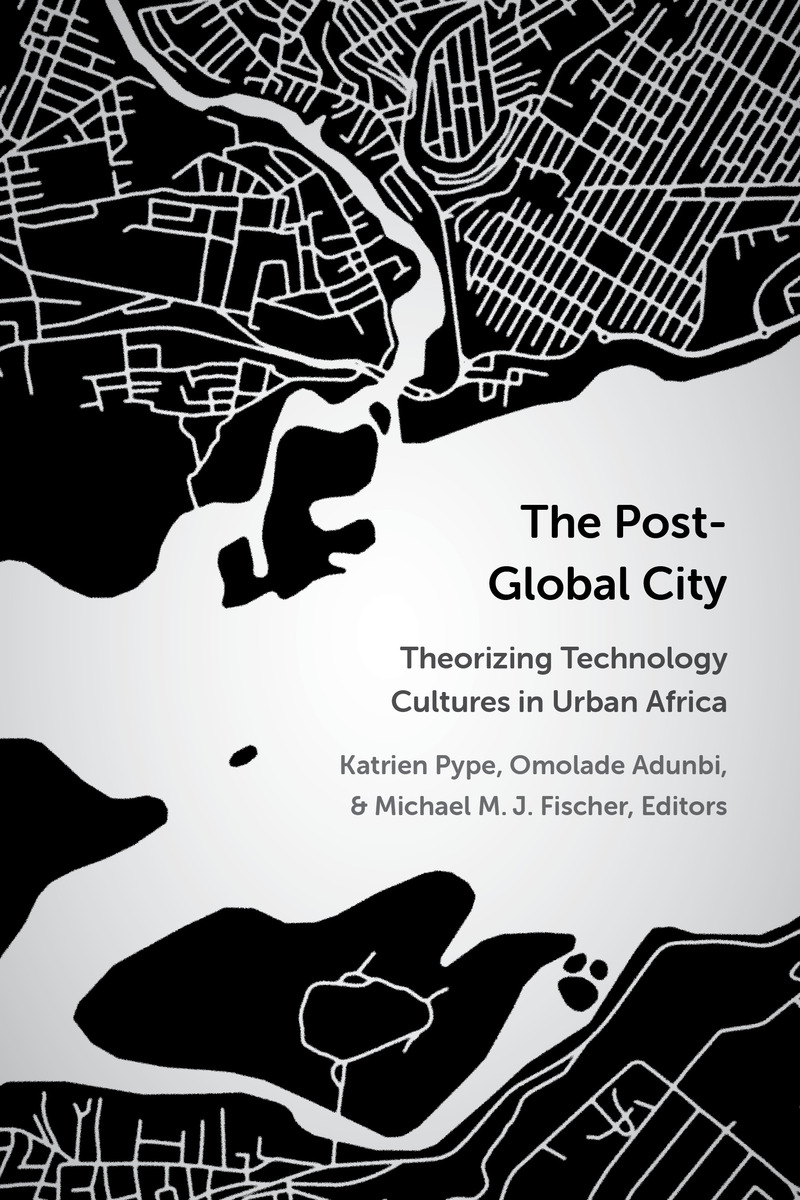
edited by Katrien Pype, Omolade Adunbi and Michael M.J. Fischer
University of Michigan Press, 2026
Cloth: 978-0-472-07782-3
Paper: 978-0-472-05782-5
eISBN: 978-0-472-90543-0 (OA)
The Post-Global City seeks to open a new field of analytical inquiry that examines knowledge production and technological developments in urban Africa rooted in local, historical realities, while also partaking in transnational, global processes. This work explores the ways in which urban residents have utilized technologies and networks to operate around, under, and beyond the state and the international “order,” and challenges the stereotypical images of Africa as a continent either devoid of technology or filled with either broken technologies or technologies from the Global North or Asia. This book focuses on accounts and critiques of new “Rising Africa” ideologies, examining megaprojects such as geothermal and hydroelectric plants with new networked startups that circumvent state and patriarchal hierarchies, women vendors selling online, youths designing and constructing oil refining technologies and tech startups working across diasporas.
Grounded in ethnographic fieldwork carried out in urban spaces in Nigeria, Kenya, the Democratic Republic of Congo, Sudan, Gabon, Cameroon, and Tanzania, The Post-Global City brings together voices from Africa, Europe, and the United States to inquire into the dialectics between technology and the urban on the African continent.
Omolade Adunbi is Professor of Anthropology and Afroamerican and African Studies and the Director of the African Studies Center at the University of Michigan.
Michael M. J. Fischer is Andrew W. Mellon Professor in the Humanities and Professor of Anthropology and Science and Technology Studies at the Massachusetts Institute of Technology.
“This path-breaking anthology offers original perspectives on contemporary Africa through a focus on technological creativity. Chapters explore the dynamism beneath urban assemblages that bring together forms of expertise from occult knowledge to engineering, and give rise to different moral orientations from upright professionals to hustlers. Theoretical concepts like ‘the post-global city’ point to new directions for scholarship beyond Africa.”
— Victoria Bernal, UC Irvine“The Post-Global City is a bold and imaginative book. It overturns the assumption that African urban modernity is derivative, showing instead how Africa’s cities are generative laboratories of the contemporary world, where technological innovation, moral aspiration, and new forms of social imagination are constantly being forged. By theorizing the post-global city, the editors and contributors move beyond the old vocabulary of ‘globalization’ to reveal how African actors create connections, design technologies, and build futures that matter far beyond the continent itself. ”
— Elísio Macamo, University of BaselLicense: CC BY-NC

 Loading...