
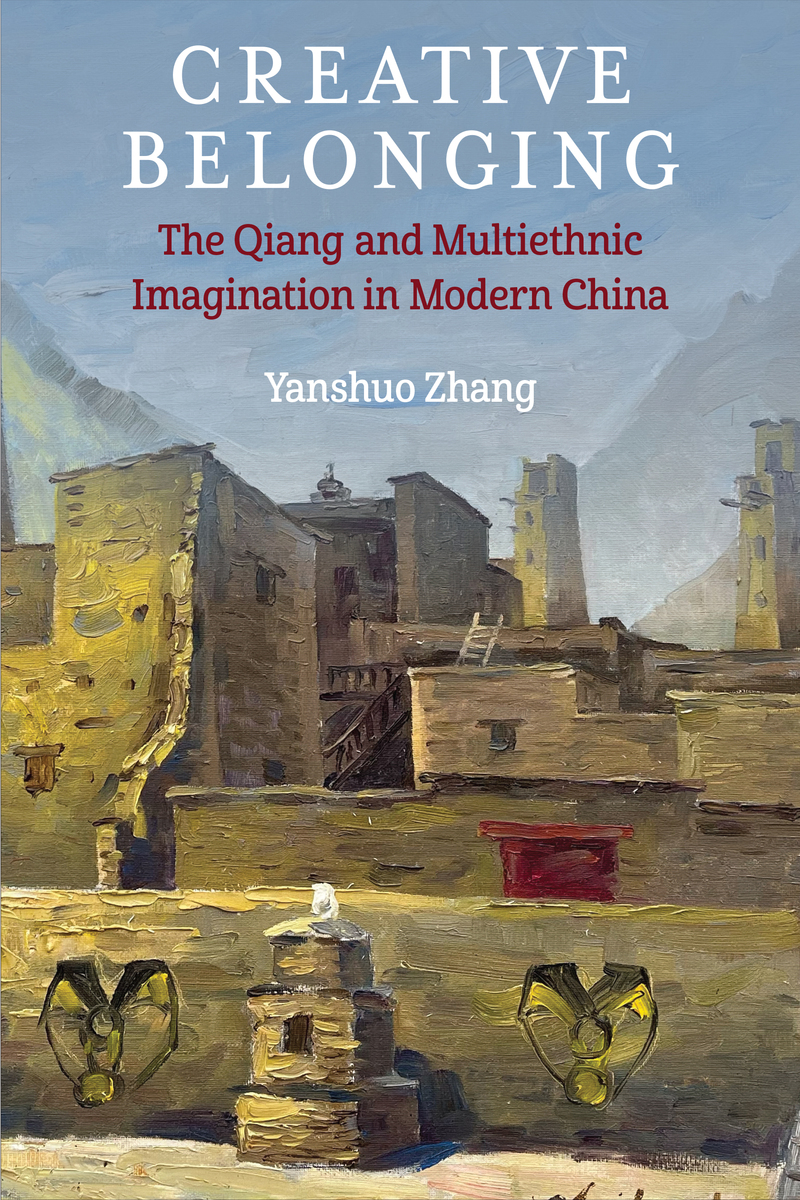
by Yanshuo Zhang
University of Michigan Press, 2026
Cloth: 978-0-472-07777-9
Paper: 978-0-472-05777-1
eISBN: 978-0-472-90536-2 (OA)
China is a multicultural country home to fifty-five ethnic minority groups, yet due to linguistic and cultural barriers many of these groups remain understudied or unknown in the West. The Qiang, one of modern China’s officially recognized ethnic minorities, is also China’s longest-standing ethnoracial identity marker that has existed since the earliest recorded history of China. Creative Belonging investigates the formation and evolution of the Qiang as a people, a concept, and a cultural history in China. It further examines how the contemporary Qiang ethnic group interacts strategically with mainstream Chinese society, challenging the historically entrenched hierarchies between the sociocultural “centers” of China and its ethnic “peripheries.”
This book is based on years of ethnographic and textual-archival research in the Himalayan regions of southwest China, where the contemporary Qiang group resides. Drawing on a diverse range of official and local political discourses and previously unstudied literary, historiographical, and cinematic works, Yanshuo Zhang illuminates how the Qiang have carved out spaces of “creative belonging” within the parameters of multiculturalism in contemporary China. Rooted in ethnographic and textual-archival research, the book presents original materials produced by Qiang indigenous writers, scholars, artists, grassroots village cultural activists, and entrepreneurs at both the local and the global levels. Creative Belonging invites readers to rethink ethnicity and national belonging in China by centering minority groups’ efforts to expand the meanings and implications of “Chinese culture.”
"I strongly recommend Professor Yanshuo Zhang’s latest scholarly work, Creative Belonging, an innovative and cross-disciplinary study of Qiang culture and China’s borderland regions. Richly illustrated and intellectually adventurous, this pioneering book is well worth the close attention of scholars and students alike."
— Jia-Yan Mi, The College of New Jersey“Yanshuo Zhang defies disciplinary boundaries to introduce a variegated array of Qiang cultural texts and practices, advancing the argument that the Qiang ethnic group has been constructed ambivalently as both constitutive of and other to Chineseness. Rolling out concepts such as ‘ethnographic poetics,’ ‘fluid indigeneity,’ and ‘discursive self-fashioning,’ this lushly illustrated study illuminates the complex processes and struggles that go into the creative imagining of a Chinese national identity that is decidedly multiethnic.”
— Louisa Schein, Rutgers UniversityLicense: CC BY-NC

 Loading...