
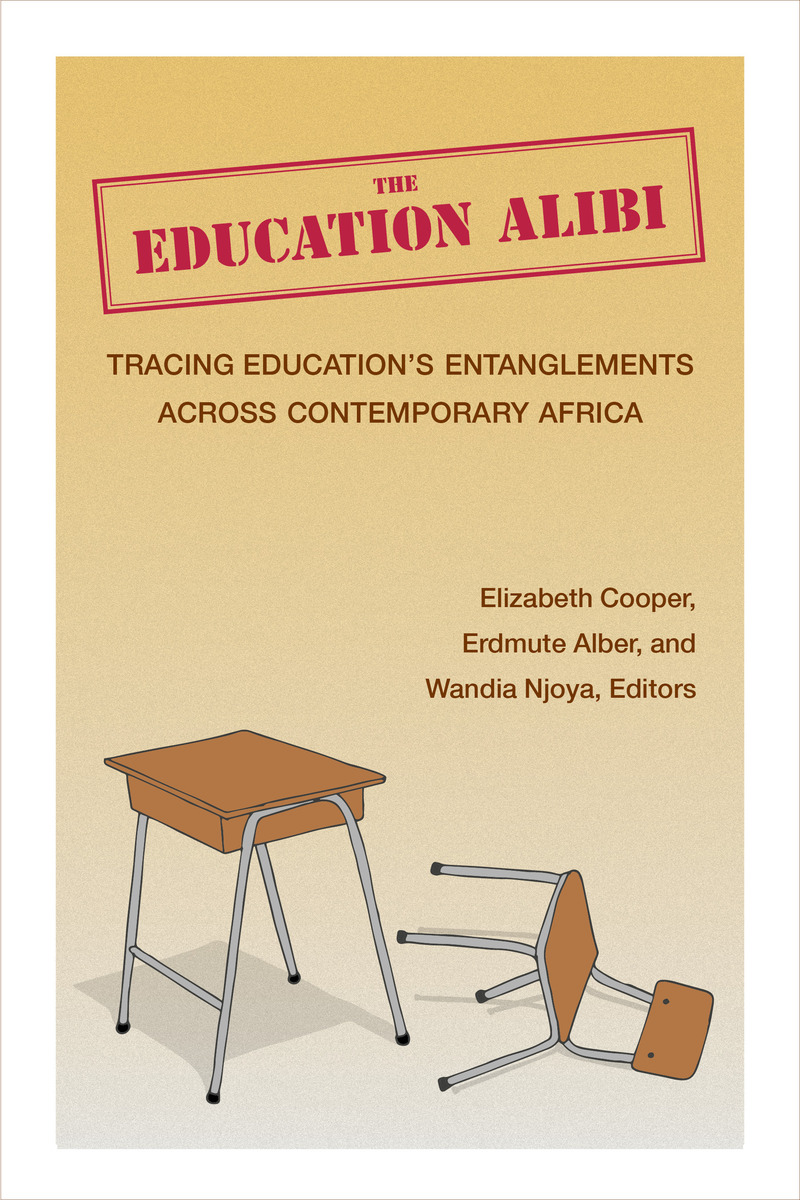
The Education Alibi: Tracing Education's Entanglements Across Contemporary Africa
The Education Alibi: Tracing Education's Entanglements Across Contemporary Africa
edited by Elizabeth Cooper, Erdmute Alber and Wandia Njoya
University of Michigan Press, 2025
ISBNs
Cloth: 978-0-472-07775-5
Paper: 978-0-472-05775-7
eISBN: 978-0-472-90534-8 (OA)
About the Book
Education is generally promoted as the key to the future of Africa in global development discourses about the continent. Education’s official story in Africa continues to be one of innocence and public good, yet, since colonial times, education has constituted an area of intense contestation. The Education Alibi asks if it is possible that while claiming to be doing one thing, education has also been doing another in African communities. The concept of the “alibi” shines an interrogative light on institutions’ and actors’ use of education to divert scrutiny from other effects. Through ethnographic research and critical analysis across the continent, this volume focuses on people’s lived experiences to demonstrate how contemporary education systems in fact deepen economic, racialized, gendered, urban-rural, linguistic, religious, and other intranational and international inequalities.
About the Author
Elizabeth Cooper is Associate Professor at the School for International Studies at Simon Fraser University.
Erdmute Alber is Professor and Chair of Social Anthropology at the University of Bayreuth.
Wandia Njoya is Associate Professor of Literature at Daystar University in Kenya.
Erdmute Alber is Professor and Chair of Social Anthropology at the University of Bayreuth.
Wandia Njoya is Associate Professor of Literature at Daystar University in Kenya.
Reviews
“This book is an excellent addition to the field of African studies as it provides insightful perspectives on the discourse around educational inequality by offering a theoretical framework for examining educational inequalities within the ‘Education for All’ campaign.”— Obed Mfum-Mensah, Messiah University
“The Education Alibi speaks to an issue that is known but not discussed in the field, specifically that the education in its present forms is not always a solution. It will be a useful book for educational policy scholars and graduate students to think differently and critically about what they are engaged in and how that will change outcomes for students."— Angi Stone-MacDonald, California State University, San Bernardino
"This timely book explores how education embeds moral frameworks that depoliticize poverty and responsibilize communities, while also being complicit in reproducing social inequalities. Drawing on rich ethnographic studies from diverse African contexts, it offers fresh and compelling insights into how global education agendas intersect with political-economic structures, unpacks the tensions between schooling and education, and invites us to rethink how young people experience and engage with both."— Tatek Abebe, Norwegian University of Science and Technology
“This provocative book challenges the idealized portrayal of education’s intricate role in African societies. It contends that education frequently acts as an ‘alibi,’ camouflaging underlying power dynamics and inequalities. Through compelling case studies, the book explores themes of responsibilization, depoliticization, and the perpetuation of inequality, ultimately urging a more nuanced comprehension of education’s true impact.”— Francis B. Nyamnjoh, University of Cape Town
Tags
African Perspectives, Educational anthropology, Effect of education on, Africa, Education, History
Open Access Information
License: CC BY-NC

 Loading...