
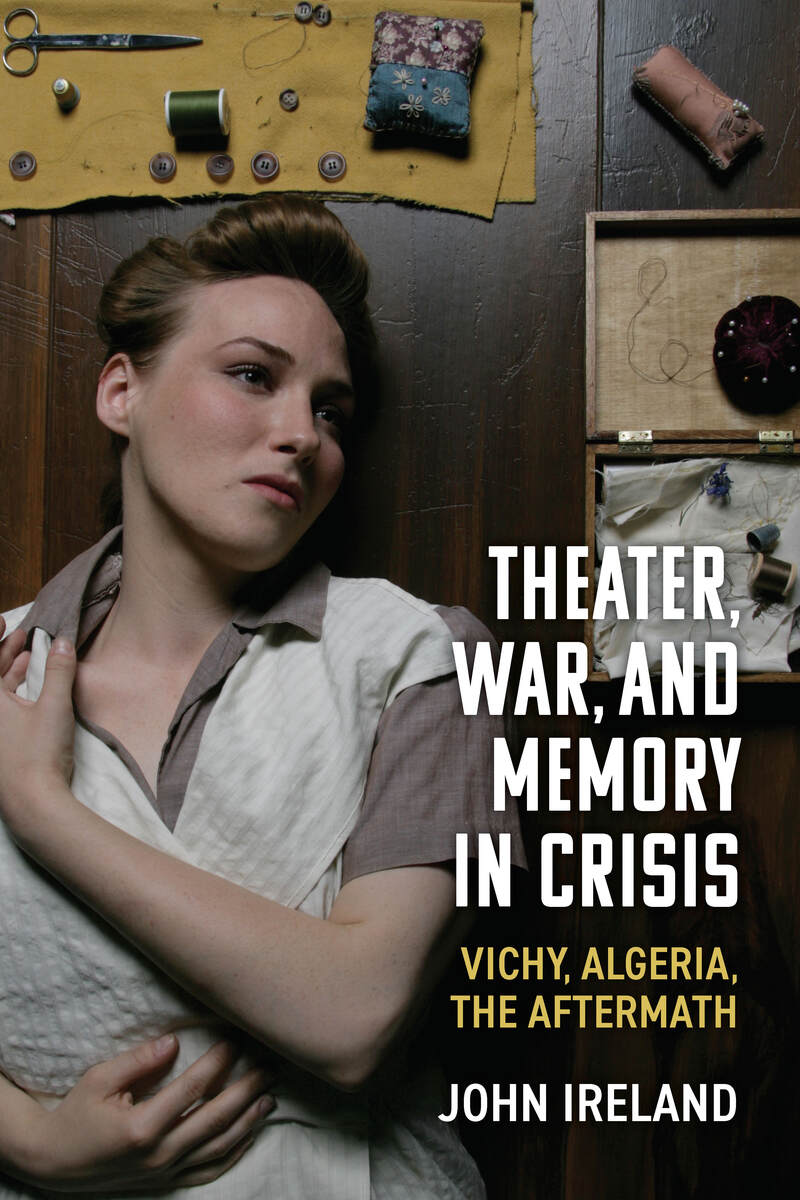
by John Ireland
University of Michigan Press, 2025
Cloth: 978-0-472-07728-1
Paper: 978-0-472-05728-3
eISBN: 978-0-472-90489-1 (OA)
Drawing upon the contributions of anthropology and sociology, Ireland addresses concepts such as memory, whereby people analyze experiences after the actual events, thereby producing more realistic evaluations with the benefit of hindsight.
— Frederick J. Augustyn Jr., Library Journal“In a complex and interesting book, John Ireland quite rightly points out the relative lack of academic works on French theatre dealing with the Holocaust and the Vichy years or the Algerian War of Independence . . . Ireland demonstrates that theatre may be uniquely situated to portray and heal war trauma.”
— Judith Samuel, French Studies"In this wide-ranging study, John Ireland assembles a series of thought-provoking and admirably informed essays that capture resoundingly the contributions and paradoxes of several quite disparate twentieth- and twenty-first-century French and Francophone playwrights. . . . Highly recommended for practitioners and students of political theatre."
— Judith G. Miller, Modern Drama“Ireland establishes a broad context for a long-overdue awareness of theater's potential in the process of healing. Ireland's detailed analyses of plays by Armand Gatti, Liliane Atlane, and Jean-Claude Grumberg examine strategies for acknowledging lingering wounds inflicted by the Vichy regime's anti-Semitic actions. Summing up: Recommended. Graduate students, faculty, and professionals.”
— F. H. Londre, Choice“…Ireland right guides the reader to an understanding that, especially as globalization and migration continue to change the gaps of mobility between the two countries, memory of French violence in Algeria and against Algerians is not something that can be thought of or understood in the absence of Algerian voices. As such this monograph makes a compelling reading choice for scholars not just of Algerian theater, but for those interested in the implications for oral and written languages on memory work.”
— Erin Twohig, H-France“In these cogent analyses, Ireland invites his readers to look at the theater that emerged in response to these conflicts in new ways, and this is certainly useful. What breaks new ground, though, is the way he situates these plays and his readings of them within a theoretical framework that invites readers to look beyond theatrical form towards what he sees as the theater's deeply rooted, universal cultural function.”
— Susan McCready, H-FranceLabel: The Herbert A. and Bessie W. Kenyon Dramatic Library
License: CC BY-NC

 Loading...