
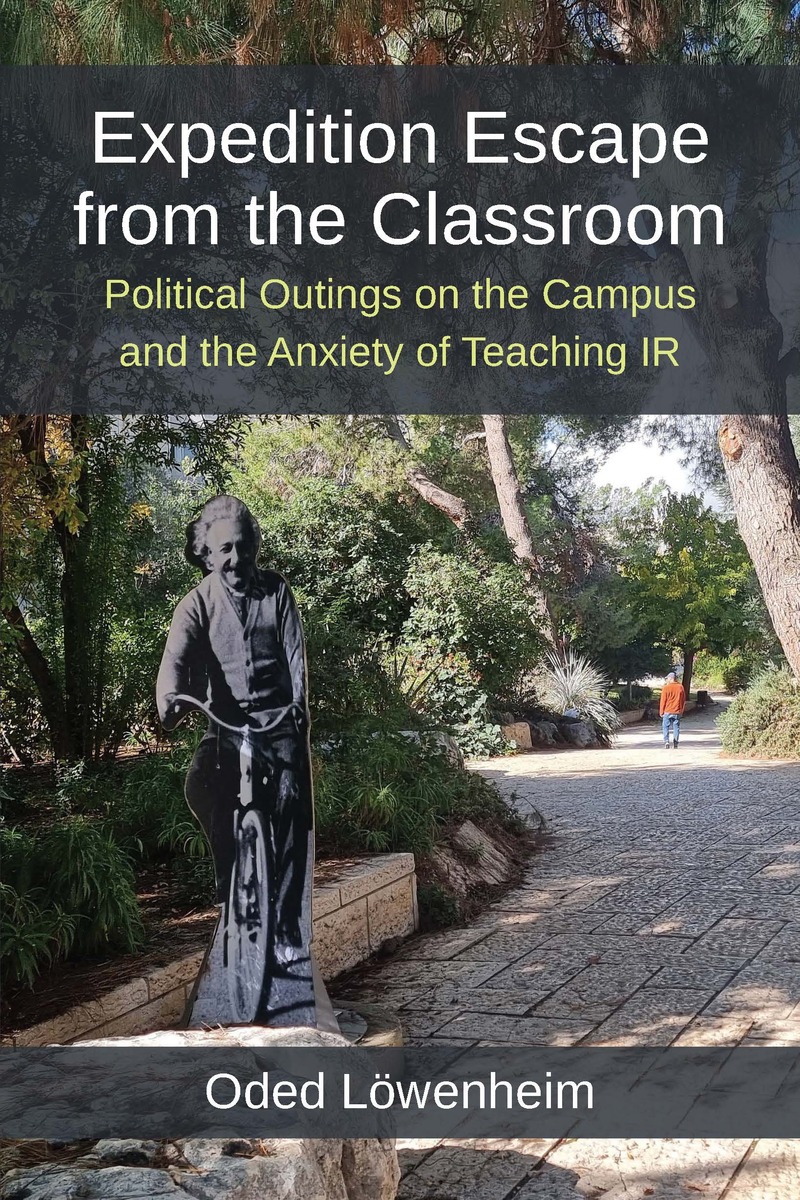
Expedition Escape from the Classroom: Political Outings on the Campus and the Anxiety of Teaching IR
Expedition Escape from the Classroom: Political Outings on the Campus and the Anxiety of Teaching IR
by Oded Löwenheim
University of Michigan Press, 2024
ISBNs
Cloth: 978-0-472-07711-3
Paper: 978-0-472-05711-5
eISBN: 978-0-472-90472-3 (OA)
About the Book
Despite facing profound teaching anxiety stemming from the politically intense surroundings in Israel and his own writer’s block, Oded Löwenheim crafted an innovative college course that breaks free from the traditional classroom setting to explore the depths of Jerusalem’s Mount Scopus campus. He takes his class—and by extension, the reader—to explore the political and historical imprints scattered throughout Mount Scopus, such as the Jerusalem British War Cemetery, the botanical garden of the campus, and the bomb shelter of the Harry S. Truman Research Institute. Drawing from a rich tapestry of disciplines that include political geography, botany, literature, history, and archaeology, this book invites readers to find the international in the everyday.
Expedition Escape from the Classroom offers a unique narrative where teaching and its inherent challenges intersect with the intricacies of global politics, history, and identity. While recounting his academic experiment, Löwenheim grapples with the changing landscape of academia in a neoliberal age, while illustrating how personal vulnerabilities can transform into powerful tools for growth, exploration, and enlightenment. Whether you’re an educator, student, or just a curious reader, Expedition Escape from the Classroom promises a journey of reflection, critical thinking, and profound revelations.
Expedition Escape from the Classroom offers a unique narrative where teaching and its inherent challenges intersect with the intricacies of global politics, history, and identity. While recounting his academic experiment, Löwenheim grapples with the changing landscape of academia in a neoliberal age, while illustrating how personal vulnerabilities can transform into powerful tools for growth, exploration, and enlightenment. Whether you’re an educator, student, or just a curious reader, Expedition Escape from the Classroom promises a journey of reflection, critical thinking, and profound revelations.
About the Author
Oded Löwenheim is Associate Professor in the Department of International Relations at The Hebrew University of Jerusalem.
Reviews
“Oded Löwenheim has written a bold, exceptionally honest book that should be read by everyone who has ever questioned—even a little bit—their own teaching. The innovative course he created to deal with his teaching anxiety is a model for professors as they consider their own role in the production and dissemination of IR knowledge.”— Brent E. Sasley, University of Texas at Arlington
"A beautifully written, searingly honest work of autoethnography, Expedition Escape from the Classroom rips back the curtain to reveal the ubiquitous wounds at the heart of IR scholarship and teaching. The author explores how these wounds, investigated through innovative pedagogical experiments, can lead to genuine learning and greater understanding of the violent forces which shape our world and our subjectivity. Innovative, analytical and richly detailed, it is a powerful work of critical IR that fully deserves a wide audience. I couldn’t stop reading it. Its emotional and intellectual resonances will stay with me for a long time."— Richard Jackson, The University of Otago, New Zealand
“Expedition Escape from the Classroom is a highly engaging, vulnerable, and personal book. A pioneer of autoethnography in IR, Löwenheim draws the reader into his journey outside the classroom, showing that IR is all around them, inspiring the reader to look inward and advance their own craft as scholar-teachers with thoughtfulness and care. This book expands his oeuvre into pedagogy, drawing back the curtain on the intellectual, political, and emotional work that goes into teaching. This is a very important and valuable move for the field.”— Mira Sucharov, Carleton University
“Lowenheim’s original course, ‘The Mount Scopus Enclave: Hebrew University’s Campus as a Political-Security-Academic Space,’ creatively disrupts the traditional teaching and learning experience as he takes his students on ‘adventures’ to different sites around campus. This book is an autoethnographic account of his experience teaching this course, engaging with questions around the purpose and conduct of teaching, and how faculty must navigate the various pressures of academic life. It also provokes us all to reconsider the boundaries of classroom spaces and the politics of the everyday in campus life.”— Andrea Paras, University of Guelph
Tags
Configurations: Critical Studies Of World Politics, Campus, Political and social views, Higher, Levels, Study and teaching, Schools, International Relations, Memoirs, Education, Biography & Autobiography, Philosophy, Political Science
Open Access Information
License: CC BY-NC

 Loading...