
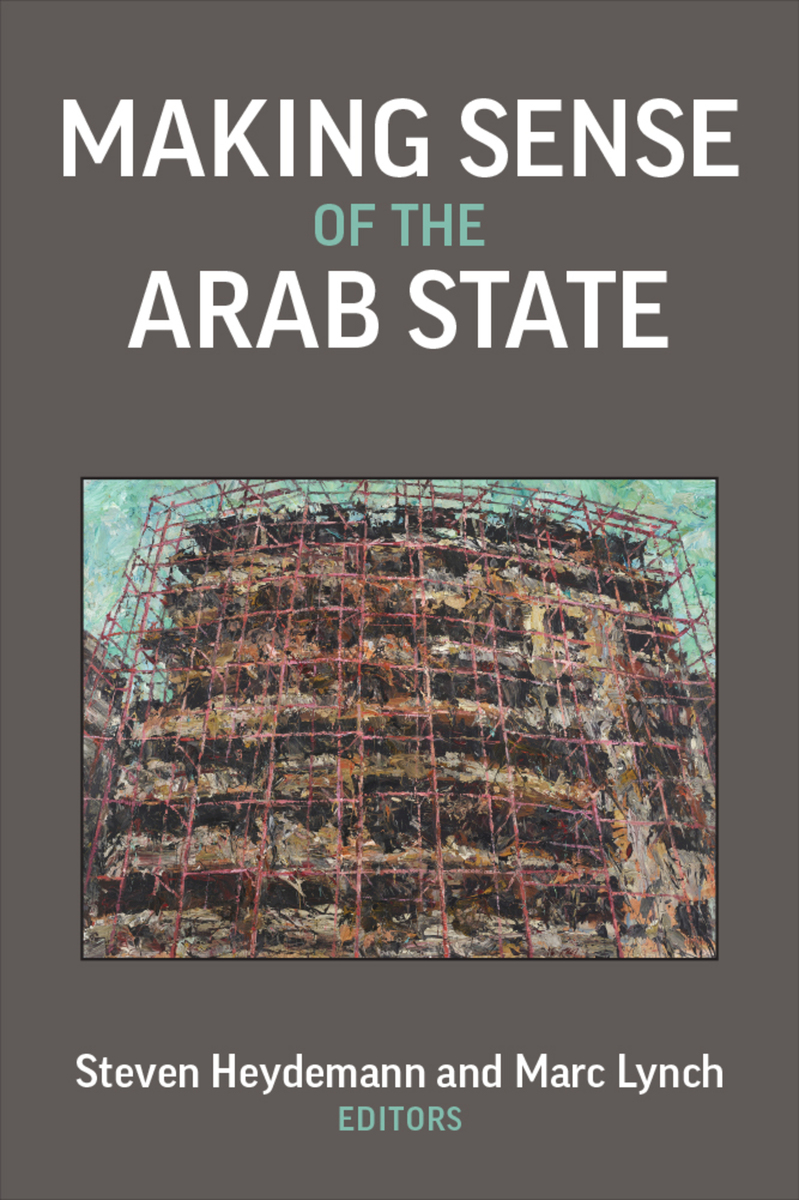
Making Sense of the Arab State
Making Sense of the Arab State
edited by Steven Heydemann and Marc Lynch
University of Michigan Press, 2024
ISBNs
Cloth: 978-0-472-07698-7
Paper: 978-0-472-05698-9
eISBN: 978-0-472-90461-7 (OA)
About the Book
No region in the world has been more hostile to democracy, more dominated by military and security institutions, or weaker on economic development and inclusive governance than the Middle East. Why have Arab states been so oppressively strong in some areas but so devastatingly weak in others? How do those patterns affect politics, economics, and society across the region? The state stands at the center of the analysis of politics in the Middle East, but has rarely been the primary focus of systematic theoretical analysis.
Making Sense of the Arab State brings together top scholars from diverse theoretical orientations to address some of the most critically important questions facing the region today. The authors grapple with enduring questions such as the uneven development of state capacity, the failures of developmentalism and governance, the centrality of regime security and survival concerns, the excesses of surveillance and control, and the increasing personalization of power. Making Sense of the Arab State will be a must-read for scholars of the Middle East and of comparative politics more broadly.
Making Sense of the Arab State brings together top scholars from diverse theoretical orientations to address some of the most critically important questions facing the region today. The authors grapple with enduring questions such as the uneven development of state capacity, the failures of developmentalism and governance, the centrality of regime security and survival concerns, the excesses of surveillance and control, and the increasing personalization of power. Making Sense of the Arab State will be a must-read for scholars of the Middle East and of comparative politics more broadly.
About the Author
Steven Heydemann is Ketcham Chair in Middle East Studies and Professor of Government at Smith College and a Nonresident Senior Fellow in the Center for Middle East Policy at the Brookings Institution.
Marc Lynch is Professor of Political Science at The George Washington University.
Marc Lynch is Professor of Political Science at The George Washington University.
Reviews
"The volume provides new perspectives on the interaction of states, regimes, and societies in the post-Arab Spring era and reframes scholarly understanding of Middle Eastern States and more broadly, non-Western states. As such, the volume is strongly recommended for students of the modern Middle East and anyone interested in the role of the state in the Global South. Summing up: Highly recommended. Advanced undergraduates through faculty."— Choice Connect
"This edited volume takes an expansive view of the state, accounting not only for the importance of regimes and institutions, but also for the role of those who oppose the regimes and institutions of Arab states. It is an accessible and important account of Middle Eastern political science, contentious politics and international relations."— International Affairs
“This book brings together a group of top scholars to generate fresh perspectives on Arab states that move beyond approaches emphasizing the deficiencies of stateness in the region. Collectively, the contributors delve deeply into how Arab regimes, states, and societies operate in practice, situating them in comparative perspective to reveal their commonalities and differences as they have evolved over time. This volume is a must-read for scholars and students of the Middle East.”— Melani Cammett, Harvard University
“Making Sense of the Arab State offers a sophisticated account of the state in the Arab world. It examines the diversity of state qualities in the Arab world and offers new conceptual outlooks on dichotomies of state absence vs presence and state vs society. This is a novel approach and shifts scholarship on studies of the state and politics in the Arab world onto a new level.”
— Shahram Akbarzadeh, Deakin University"Making Sense of the Arab State offers rich details, illuminating case studies, and important analytical insights into authoritarian and Middle East politics, particularly when it comes to the critical question of how leaders maintain their grip on power"— Galen Jackson, H-Diplo
“The value of the volume lies principally in the diversity of the approaches it contains--perhaps slightly underplayed in the editor's introduction--which conveys the vibrancy of this field of study."
— Glen Rangwala, Middle East Journal"How can Arab states be understood beyond the widely accepted 'failed state' paradigm? Many analyses portray Arab states as weak, fragmented or dysfunctional. However, this anthology demonstrates that these perceived weaknesses are frequently strategic and historically rooted elements of state order, forming part of the regimes' deliberately controlled mechanisms. According to our reviewer, this book is aimed primarily at readers with prior knowledge of political theory and the history of the MENA region."— Sascha Ruppert-Karakas, Portal für Politikwissenschaft
“Making Sense of the Arab State is an exemplary volume that offers readers the conceptual tools for understanding recent trends in state development in the Arab world. This is a highly original contribution that should be widely read.”
— Lisa Blaydes, Stanford University“Making Sense of the Arab State provides a refreshing contribution to both the study of the
state and the Middle East. The theoretically nuanced, empirically rich chapters examine the
region’s states as they are, rather than bemoaning what they are not. In doing so, they teach us much state capacity and transformation in the region and beyond.”
— Ellen Lust, University of Gothenburg
state and the Middle East. The theoretically nuanced, empirically rich chapters examine the
region’s states as they are, rather than bemoaning what they are not. In doing so, they teach us much state capacity and transformation in the region and beyond.”
— Ellen Lust, University of Gothenburg
"With its nuanced insights and in-depth treatment, this book constitutes an essential resource for researchers, policymakers, and anyone seeking to understand the dynamics of the region's political landscape." [translated from Arabic]— Ahmed Bilal Al-Qatti, al-Salon
Tags
Emerging Democracies, Making Sense, 1945-, Foreign relations, World, Politics and government, Political Science, History
Open Access Information
License: CC BY-NC

 Loading...