
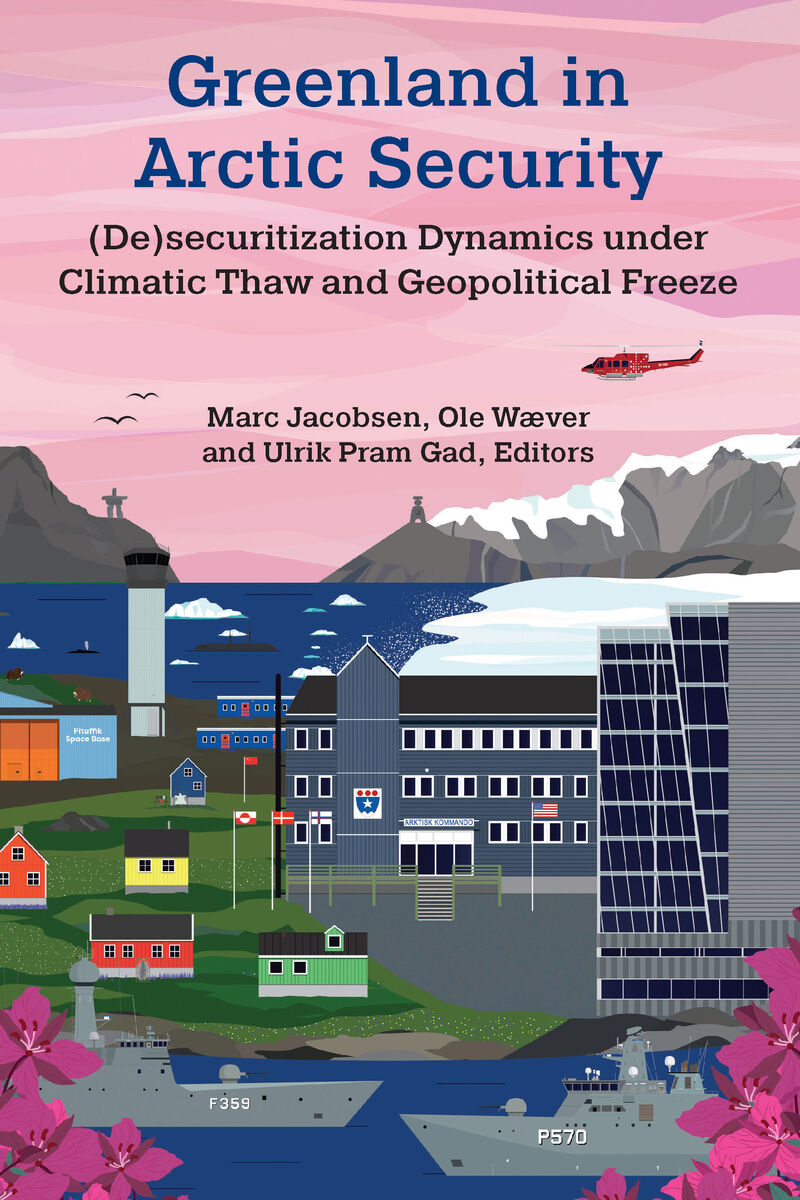
Greenland in Arctic Security: (De)securitization Dynamics under Climatic Thaw and Geopolitical Freeze
Greenland in Arctic Security: (De)securitization Dynamics under Climatic Thaw and Geopolitical Freeze
edited by Marc Jacobsen, Ulrik Pram Gad and Ole Wæver
University of Michigan Press, 2024
ISBNs
Cloth: 978-0-472-07670-3
Paper: 978-0-472-05670-5
eISBN: 978-0-472-90439-6 (OA)
About the Book
Greenland has increasingly captivated imaginations around the globe. Yet, while it is central to the Arctic region, its role has been poorly understood. Greenland in Arctic Security delivers a comprehensive overview of how security dynamics unfold in and in relation to Greenland. Each individual chapter analyzes specific discourses and dynamics pertaining to hard or soft security questions. These span from great power interests in geostrategic infrastructure to domestic debates centered on promoting and protecting Greenland identity when engaging with the outside world. In addition, the book offers perspectives on other security questions that have been catalyzed by the effects of climate change.
By combining these different analyses, Greenland in Arctic Security provides new, theoretically informed discussions on how security politics can manifest across different scales and territorial borders. At times, these politics can have consequences beyond their original intent. With Greenland geopolitics and securitization theory of current interest to political and academic debates, this book offers timely insights for readers.
By combining these different analyses, Greenland in Arctic Security provides new, theoretically informed discussions on how security politics can manifest across different scales and territorial borders. At times, these politics can have consequences beyond their original intent. With Greenland geopolitics and securitization theory of current interest to political and academic debates, this book offers timely insights for readers.
About the Author
Marc Jacobsen is Assistant Professor at the Royal Danish Defence College.
Ole Wæver is Professor of International Relations at the University of Copenhagen, founder of the Centre for Advanced Security Theory, and Director of the Centre for Resolution of International Conflicts.
Ulrik Pram Gad is a Senior Researcher at the Danish Institute for International Studies (DIIS).
Ole Wæver is Professor of International Relations at the University of Copenhagen, founder of the Centre for Advanced Security Theory, and Director of the Centre for Resolution of International Conflicts.
Ulrik Pram Gad is a Senior Researcher at the Danish Institute for International Studies (DIIS).
Reviews
"The book is the first coherent and methodologically well-founded attempt to establish a nuanced security structure for a territory that has so far been able to avoid the traditional categories within the study of international politics."— Altinget
“The study of international relations has not come to terms with the scope and significance of climate change for the international system. This book represents a significant and serious effort to address this fundamental failing of the discipline. Marshaled together by the incomparable intellectual leadership of Jacobsen, Wæver, and Gad, the authors tackle the complexity of a rapidly changing political and geophysical world through the context of Greenland. The empirical and theoretical riches here, particularly the deployment of securitization theory, far transcend the focus on Greenland. As the discipline slowly comes around to addressing the social, political, and physical ramifications of climate change, this volume sets the standard.”— Jarrod Hayes, University of Massachusetts Lowell
"The editors offer highly interesting specifications of theories concerning securitization and desecuritization and also engage in debate about regional security complexes. For a part of the globe that in fact comprises of several sub-regions (security sub-complexes, if you will), offering a more nuanced view of Arctic security and analysis levels represents a significant advancement in Arctic international relations studies." — Journal of Peace Research
"This excellent book makes an important contribution to the literature on climate change, using Greenland as a case study. Rated: highly recommended."— Choice
“Greenland in Arctic Security makes a substantial empirical contribution to Arctic regional studies as an up-to-date and theoretically nuanced account of Greenland’s security politics. The focus on Greenland as a polity results in an important effort in IR theorizing to move beyond the prevalent European and North American cases upon which many IR concepts are built. This volume will be of interest to scholars and students of politics and security in the Arctic and beyond.”— Elana Wilson Rowe, Norwegian Institute of International Affairs
"This is an excellent edited volume, displaying how securitization theory can be utilized in a broad range of empirical analyses. It demonstrates the enduring salience of the Copenhagen School, and it also advances securitization theory with a discussion on regions and security in the last chapter."— International Affairs
Tags
Arctic regions, Self-determination National, Greenland, Security (National & International), Regional Studies, Foreign relations, International Relations, Political Science, Social Science
Open Access Information
License: CC BY-NC

 Loading...