
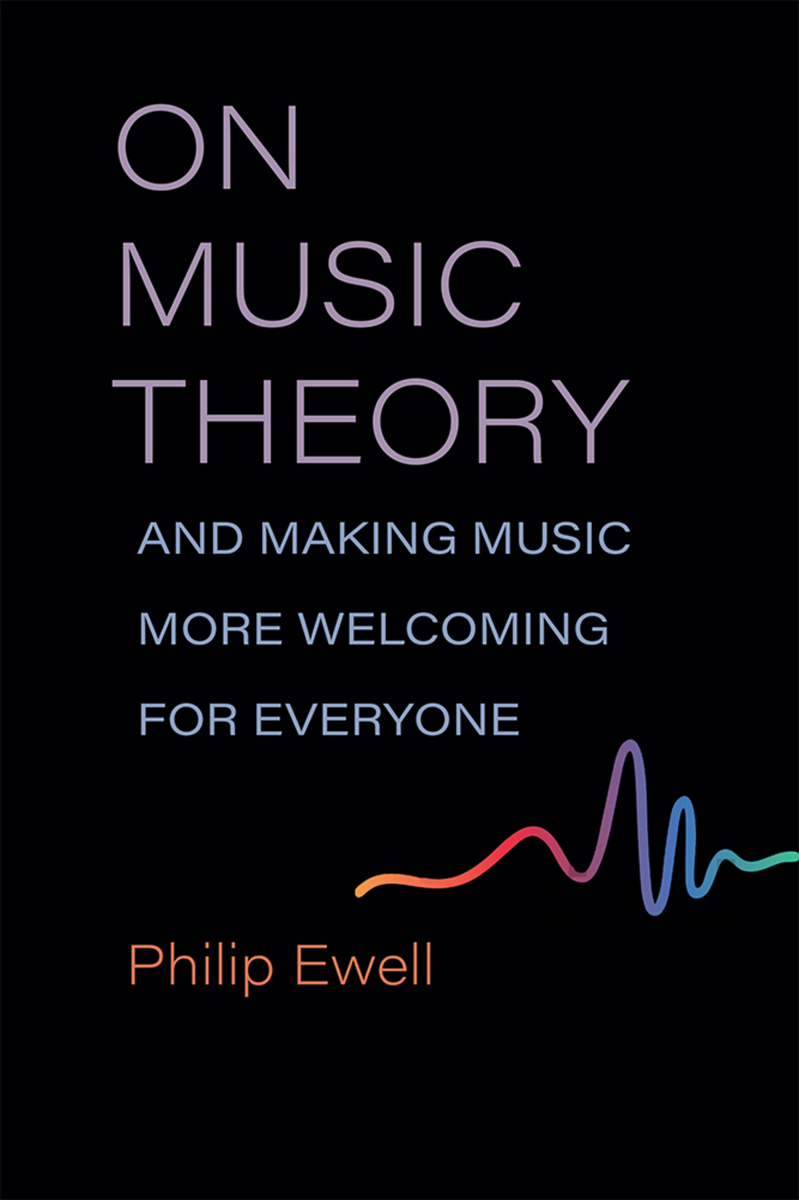
by Philip Ewell
University of Michigan Press, 2023
Cloth: 978-0-472-07502-7
Paper: 978-0-472-05502-9
eISBN: 978-0-472-90400-6 (OA)
eISBN: 978-0-472-12943-0 (standard)
Winner of the 2024 Association of American Publishers PROSE Award for Music and Performing Arts
Since its inception in the mid-twentieth century, American music theory has been framed and taught almost exclusively by white men. As a result, whiteness and maleness are woven into the fabric of the field, and BIPOC music theorists face enormous hurdles due to their racial identities. In On Music Theory, Philip Ewell brings together autobiography, music theory and history, and theory and history of race in the United States to offer a black perspective on the state of music theory and to confront the field’s white supremacist roots. Over the course of the book, Ewell undertakes a textbook analysis to unpack the mythologies of whiteness and western-ness with respect to music theory, and gives, for the first time, his perspective on the controversy surrounding the publication of volume 12 of the Journal of Schenkerian Studies. He speaks directly about the antiblackness of music theory and the antisemitism of classical music writ large and concludes by offering suggestions about how we move forward. Taking an explicitly antiracist approach to music theory, with this book Ewell begins to create a space in which those who have been marginalized in music theory can thrive.
2024 PROSE Award for Music and Performing Arts Winner
— Association of American Publishers“It should be required reading for all who teach music theory and for all who aspire to work toward racial justice in the academy. Ewell's book is a gift and an invitation. We must not squander either.”
— Anders Tobiason, Notes: the Quarterly Journal of the Music Library Association“On Music Theory is a unique book for a unique time, filled with critical materials and action items that justify its position as a central text in music theory's antiracist turn. . . . We hope that On Music Theory can begin a new era of disciplinary change based in collective action, respectful disagreement, and methodological diversity.”
— Music Theory Online: A Journal of the Society for Music Theory“On Music Theory leaves no doubt about the discipline’s deeply ingrained antiblackness. In doing so, Ewell successfully demonstrates that the problems facing music theory are systemic and not simply the fault of a few bad actors. The book provides a framework and vocabulary that will enable future scholars to identify and challenge racism in the field and demonstrates a new approach to music theory that draws on interdisciplinary scholarship about race.”
— Loren Kajikawa, George Washington University, Author of Sounding Race in Rap Songs“In conclusion, On Music Theory is as much a sincere testimony as it is an informed and documented scientific manual of anti-racism applied to the field of musicology and music theory.” [translated from French]
— Jérémy Michot, Revue de musicologie“It is an essential component of a longer anti-racism reading list for anyone engaging in academic music disciplines today.”
— CAML Review“Phil Ewell kicked the hornet’s nest in 2019 in a conference paper on the white racial frame of standard music theory. He was not the first to question tonality’s hierarchical principles whereby the dissonant other must be subsumed or eliminated for the sake of harmony: Schoenberg, George Russell, Christopher Small, and feminist theorists have raised similar critiques. But three years of panels, denunciations, and lawsuits have not settled the controversy over Ewell’s presumed transgression. In On Music Theory, he mounts a detailed defense of his arguments, as well as an account of the repercussions that followed in the wake of his talk. A crucial book for those involved in the ongoing debates over covert biases in academic disciplines.”
— Susan McClary, Case Western Reserve University, Author of The Passions of Peter Sellars: Staging the Music"Ewell deserves profound acknowledgment for doing the grueling work of unraveling a particularly insidious, intractable, and deeply embedded mode of racialized, gendered, and institutionalized hegemony. One can only imagine the experiences that inspired him to write this book, but like the artists mentioned above, he has transmuted those experiences, and by extension those of many others, into a powerful disciplinary critique that is likely to stand as a watershed moment in the evolution of Western music theory."
— Journal of the American Musicological SocietyLicense: CC BY-NC-ND

 Loading...