
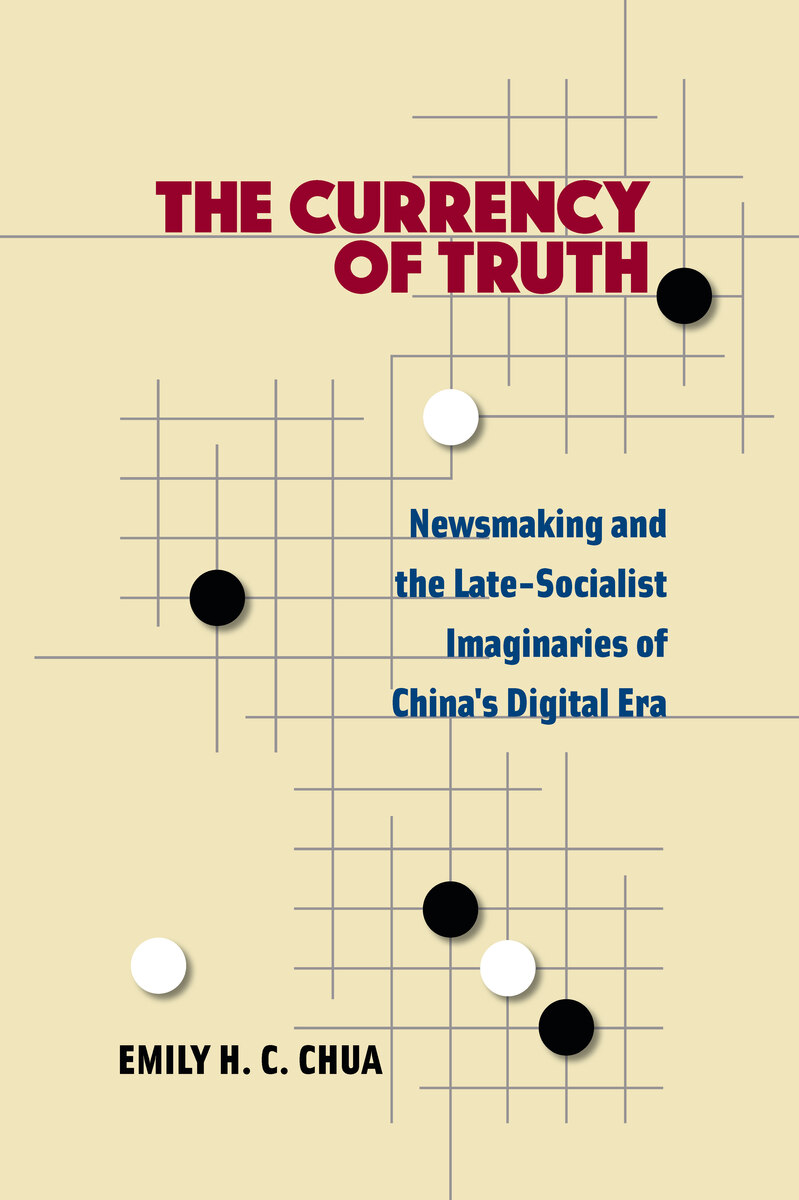
The Currency of Truth: Newsmaking and the Late-Socialist Imaginaries of China's Digital Era
The Currency of Truth: Newsmaking and the Late-Socialist Imaginaries of China's Digital Era
by Emily H. C. Chua
University of Michigan Press, 2023
ISBNs
Cloth: 978-0-472-07595-9
Paper: 978-0-472-05595-1
eISBN: 978-0-472-90327-6 (OA)
About the Book
China’s news sector is a place where newsmakers, advertising executives, company bosses, and Party officials engage one another in contingent and evolving arrangements that run from cooperation and collaboration to manipulation and betrayal. Drawing on long-term ethnographic fieldwork with journalists, editors, and executives at a newspaper in Guangzhou, The Currency of Truth brings its readers into the lives of the people who write, publish, and profit from news in this milieu. The book shows that far from working as mere cogs in a Party propaganda machine, these individuals are immersed in fluidly shifting networks of formal and informal relationships, which they carefully navigate to pursue diverse goals.
In The Currency of Truth, Emily H. C. Chua argues that news in China works less as a medium of mass communication than as a kind of currency as industry players make and use news articles to create agreements, build connections, and protect and advance their positions against one another. Looking at the ethical and professional principles that well-intentioned and civically minded journalists strive to uphold, and the challenges and doubts that they grapple with in the process, Chua brings her findings into conversation around “post-truth” news and the “crisis” of professional journalism in the West. The book encourages readers to rethink contemporary news, arguing that rather than setting out from the assumption that news works either to inform or deceive its publics, we should explore the “post-public” social and political imaginaries emerging among today’s newsmakers and remaking the terms of their practice.
In The Currency of Truth, Emily H. C. Chua argues that news in China works less as a medium of mass communication than as a kind of currency as industry players make and use news articles to create agreements, build connections, and protect and advance their positions against one another. Looking at the ethical and professional principles that well-intentioned and civically minded journalists strive to uphold, and the challenges and doubts that they grapple with in the process, Chua brings her findings into conversation around “post-truth” news and the “crisis” of professional journalism in the West. The book encourages readers to rethink contemporary news, arguing that rather than setting out from the assumption that news works either to inform or deceive its publics, we should explore the “post-public” social and political imaginaries emerging among today’s newsmakers and remaking the terms of their practice.
About the Author
Emily H. C. Chua is Assistant Professor in the Department of Sociology and Anthropology at the National University of Singapore.
Reviews
— John Osburg, University of Rochester
“The Currency of Truth is a highly readable, compelling, and insightful study of newsmaking in contemporary China. In addition to offering original arguments about the dynamics of the Chinese media, this book is simply one of the best workplace ethnographies I’ve ever read.”
"The book has four significant contributions to the journalism literature. First, it offers insights into the Chinese media system, which is understudied. Second, it explores an exciting conceptualization of the news as a currency. Third, it joins other scholars (Almiron, 2010; Anderson, 2013; Boyer, 2013; Henry, 2007; Carlson, 2017) in exploring the transformation of newsmaking influenced by technological advancement and expanding it to China. Fourth, the book offers an interesting insight into what the institution of news can be in a post-socialist society."
— Journalism, Mushfique Wadud
— Journalism, Mushfique Wadud
"Emily H. C. Chua’s The Currency of Truth stands out to me with its intricate portrayal of the everyday life within a Chinese newsroom. The book delves deeply into the complex identities of Chinese journalists who strive to unearth newsworthy stories and maintain journalistic integrity, all while navigating the treacherous waters of political and commercial pressures that threaten their survival."— Pacific Affairs, Luwei Rose Luqiu
"The Currency of Truth is a significant contribution to the study of news media in the digital age. The theoretical framework of news as currency advances the field of Chinese media politics beyond the censorship and propaganda paradigm, as it incorporates the multifaceted political, economic, and cultural forces where media outlets operate. The theoretical sophistication and empirical richness make it a recommended book to scholars of media studies, China studies, and many other related fields."— Journal of Asian Studies, Dan Chen
"The arguments Chua developed through the concepts of publicness, an ethic of efficacy, news as currency, and journalists' jianghu imaginary are convincing, and the vivid depictions of journalistic practice are fascinating to read. I consider The Currency of Truth a must-read for anyone interested in Chinese media and journalism."— Studies on Asia, Sally Xiaojin Chen
“The Currency of Truth provides a fascinating account of how news and publics are co-produced. Engagingly written and thoughtfully theorized, it will become a valuable read for scholars, practitioners, and policy makers alike.”
— Pablo J. Boczkowski, Northwestern University"The Currency of Truth is a significant contribution to the study of Chinese media. By shifting the analytical focus from macro-level structures to the micro-politics of news production and the lived experiences of journalists, Chua provides a nuanced and underexplored perspective on the complexities of journalistic practice in contemporary China." — Convergence, Kecheng Fang
"Emily H. C. Chua's book provides a rare ethnographic insight into the work of Chinese journalists at a Beijing and Guangzhou-based weekly newspaper. . . All in all, although focused on China, the book's ethnographic insights and theoretical framing of news as currency would be of interest to researchers from around the world."— European Journal of Communication
"Chua details the complexities and contradictions of China’s news sector and makes a convincing argument that news in contemporary China is “a medium of texts that work less as means of mass communication than like a kind of currency,” used by news professionals, company bosses, and government officials seeking personal, professional, political, and financial gains. Rated Recommended."— CHOICE Connect, Y. Liao
"Chua not only makes efforts to reveal the unique and intricate relationships within Chinese journalism but has also demonstrated the effectiveness of using the concept of currency to understand the actual role of news texts in journalistic relations."— Asian Journal of Social Science, Angze Li and Haiyan Wang
"The Currency of Truth is easily one of my favourite books and I cannot recommend it enough. Scholars and students in a wide array of disciplines such as anthropology, political science, commutations and sociology will benefit from it tremendously. Policymakers or members of the general public who are interested in media politics in China and beyond will find it educational, inspiring and highly accessible. The book even has an open access version. So go and get it!"— The China Quarterly
"Chua's original and nuanced argument constitutes a valuable and reasoned perspective, increasingly rare in contemporary China studies. Her argument, highlighting the currency-like value of news as a form of exchange within local, fragmented and relational contexts, is not only original and well-constructed but can also be extended beyond the news and media industry to other facets of contemporary Chinese society." — Europe-Asia Studies, Giulia D'Aquila
Tags
China Understandings Today, Truth, Press and politics, Mass media policy, Government and the press, Currency, Chinese newspapers, Mass media, Journalism, Asian, China, 21st century, World, Political aspects, Sociology, Cultural & Social, Cultural & Ethnic Studies, Anthropology, Political Science, Social Science, History
Open Access Information
Label: The Lieberthal-Rogel Center for Chinese Studies (LRCCS)
License: CC BY-NC-ND

 Loading...