
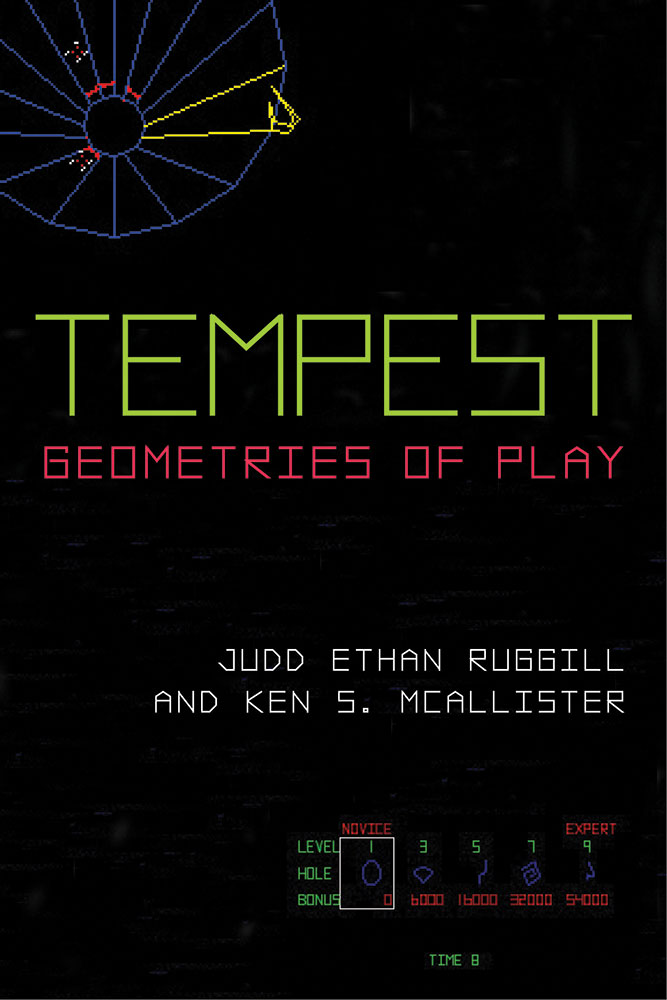
Tempest: Geometries of Play
Tempest: Geometries of Play
by Judd Ethan Ruggill and Ken S. McAllister
University of Michigan Press, 2015
ISBNs
Cloth: 978-0-472-07269-9
Paper: 978-0-472-05269-1
eISBN: 978-0-472-90010-7 (OA)
eISBN: 978-0-472-12114-4 (standard)
About the Book
Atari’s 1981 arcade hit Tempest was a “tube shooter” built around glowing, vector-based geometric shapes. Among its many important contributions to both game and cultural history, Tempest was one of the first commercial titles to allow players to choose the game’s initial play difficulty (a system Atari dubbed “SkillStep”), a feature that has since became standard for games of all types. Tempest was also one of the most aesthetically impactful games of the twentieth century, lending its crisp, vector aesthetic to many subsequent movies, television shows, and video games. In this book, Ruggill and McAllister enumerate and analyze Tempest’s landmark qualities, exploring the game’s aesthetics, development context, and connections to and impact on video game history and culture. By describing the game in technical, historical, and ludic detail, they unpack the game’s latent and manifest audio-visual iconography and the ideological meanings this iconography evokes.
About the Author
Judd Ethan Ruggill is Associate Professor of Communication at Arizona State University and co-directs the Learning Games Initiative with Ken McAllister.
Ken S. McAllister is Professor of English and Associate Dean of Innovation and Research at the University of Arizona.
Tags
Landmark Video Games, Video & Animation, Tempest, Design, Computers, Social aspects, United States, History
Open Access Information
License: CC BY-NC-ND

 Loading...