
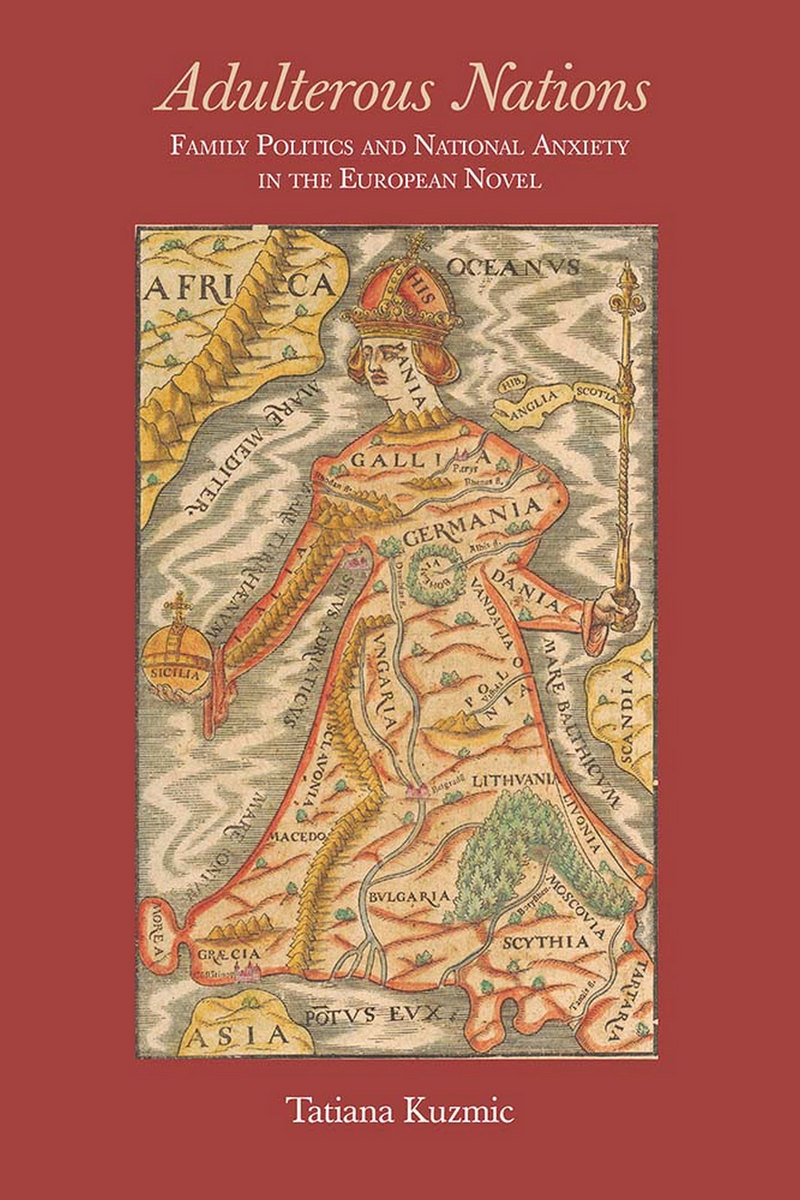
by Tatiana Kuzmic
Northwestern University Press, 2016
Cloth: 978-0-8101-3398-3
Paper: 978-0-8101-3397-6
eISBN: 978-0-8101-3399-0
In Adulterous Nations, Tatiana Kuzmic enlarges our perspective on the nineteenth-century novel of adultery, showing how it often served as a metaphor for relationships between the imperialistic and the colonized. In the context of the long-standing practice of gendering nations as female, the novels under discussion here—George Eliot’s Middlemarch, Theodor Fontane’s Effi Briest, and Leo Tolstoy’s Anna Karenina, along with August Šenoa’s The Goldsmith’s Gold and Henryk Sienkiewicz’s Quo Vadis—can be understood as depicting international crises on the scale of the nuclear family. In each example, an outsider figure is responsible for the disruption experienced by the family. Kuzmic deftly argues that the hopes, anxieties, and interests of European nations during this period can be discerned in the destabilizing force of adultery. Reading the work of Šenoa and Sienkiewicz, from Croatia and Poland, respectively, Kuzmic illuminates the relationship between the literature of dominant nations and that of the semicolonized territories that posed a threat to them. Ultimately, Kuzmic’s study enhances our understanding of not only these five novels but nineteenth-century European literature more generally.
"This stimulating cross-cultural study of how narratives of marital discord converge with issues of nation and empire in European "realism" between 1870 and 1900 straddles a divide in literary studies... The author is to be praised for bringing works from the so-called "minor" literatures of Croatia and Poland into a complex, historically meaningful relationship with Fontane’s, and especially Eliot’s and Tolstoy’s well-known novels." —Russian Review
"Adulterous Nations brings together two “hot” topics in literary criticism—sex and geopolitics—and argues for their interconnectedness in the nineteenth-century novel. Drawing on Kuzmic’s enviable linguistic capabilities and a wealth of historical research, the book explores this theme in five novels: three novels of empire (English, German, and Russian) and two from stateless “colonized” nations (Poland and Croatia). Although the stated topic is adultery, ultimately the book engages more profoundly with questions of belonging and outsiderhood and the complex, shifting perception of Slavic nations by their neighbors throughout the second half of the nineteenth century. The book is at its best in its detailed historical research and intriguing insights into the way geopolitics infuses the amorous themes. It is a model of historically grounded comparative study: it traces a theme across multiple national traditions, making a place for often overlooked minorities and reinstating them in the broader European tradition." —Comparative Literature

 Loading...